THE PASSENGER
(DIE PASSAGIERIN)
THE PASSENGER, an opera (1967–1968) in two acts by MIECZYSŁAW WEINBERG. Libretto by Alexander Medvedev and Yury Lukin, based on a novel by Zofia Posmysz. World premiere at the Bregenz Festival on July 21, 2010.
The opera tells the story of the unexpected encounter between Lisa, a former concentration camp guard who is traveling to Brazil by cruise ship with her husband, a diplomat, and Martha, a former Auschwitz prisoner.
The production of this opera, directed by Tobias Kratzer, premiered in March 2024 at the Bavarian State Opera in Munich. First performance at Dutch National Opera on April 7, 2026.
Music Mieczysław Weinberg Libretto Alexander W. Medvedev and Yury Lukin Musical direction Adam Hickox Direction Tobias Kratzer Nederlands Philharmonisch Orchestra The National Opera Chorus
Lisa Jenny Carlstedt Alte Lisa Sibylle Maria Dordel Walter Nikolai Schukoff Marta Sylvia D’Eramo Tadeusz Gyula Orendt Krystina Madison Horman Vlasta Iida Antola Hannah Eva Kroon Bronka 1 Margarita Nekrasova Bronka 2 Yvonne Kok Yvette Daria Brusova SS’er #1 Joe Chalmers SS’er #2 Mann Jasurbek Khaydarov SS’er #3 Lucas van Lierop Älterer Passagier Nanco de Vries Oberaufseherin / Kapo Sophie Wendt Steward Lukhanyo Bele Solo violinist Niek Baar
Music: 5 *
Direction 4,5 *
The Passenger
If you’ve been paying attention, you know that every opera has a timeless, burning relevance and evokes a startling sense of timeliness. Nudge nudge wink wink! Butterfly isn’t about a Green Beret trying to win over a Japanese sweetheart, but about the position of women—and in that sense, “it remains relevant to this day”. And, of course, about colonialism and slavery. Bohème is not a romantic-realistic, nonsensical tale, but a sharp social and existential indictment. “Poverty is not a prop!” Climate change, digital surveillance, geopolitics — all trivial compared to a dramatic deathbed in three acts. Let’s above all keep pretending that every costume drama is a mirror of our times. For who can do without the urgent social insights of a jealous 16th-century Duke (“I have not had a sexual relationship with that woman, Lady Gilda”)?
In short, all operas have relevance today. And they are shocking. And disorienting. Thus, Castellucci’s Giovanni, Warlikowski’s Macbeth, Kosky’s Meistersinger, and Kratzer’s Tannhäuser come into view. It is primarily the Dutch National Opera, the Department of Diversity and Inclusion (“Gott! welch Dunkel hier”), that insists that everything that sings, walks, drums, and composes is RELEVANT.
Disbelief
But what on earth is going on?! Now, for once, there is an opera that is contemporary and relevant, and yet there is little to no reference to current events in the Dutch National Opera texts. Why on earth is that?
Mieczysław Weinberg’s opera Die Passagierin is about the Holocaust, and one would at least expect the words “still urgent and confrontational” in the Dutch National Opera program notes. I haven’t seen those words or perhaps I missed them. The rambling texts by the narrow-minded thinkers at Dutch National Opera are nothing more than inflated “Things to restore the ego,” to quote Hemingway; they are unreadable and stand in flagrant contradiction to —or perhaps, in fact, in accordance with— Wittgenstein’s “What can be said at all can be said clearly.” There is a certain Ms. Roling at Dutch National Opera, who let slip Hannah Arendt’s brilliant cliché: “The Passenger confronts us with the banality of evil.” The banality of evil! Absolutely! And “Everything happens for a reason,” “Time heals all wounds,” and “Just follow your heart.”
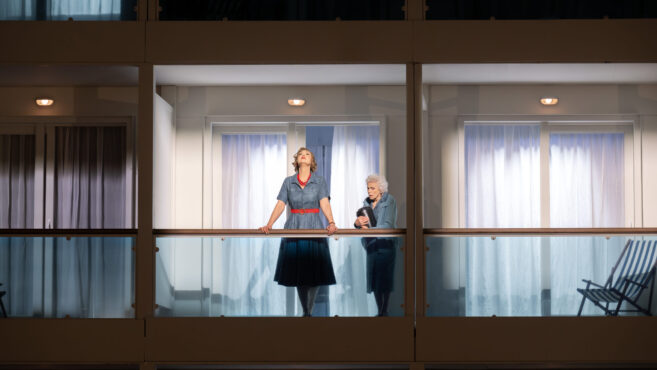
Okay, the Dutch National Opera (DNO) dutifully states, “In this production, a third temporal layer is added: the present day.” Of course, it should have said, “This production takes a strong stand against growing anti-Semitism and against rabid hatred of Israel.”
Especially in Amsterdam, which is becoming increasingly anti-Semitic, Die Passagierin could make a strong statement, were it not for the fact that DNO has entrenched itself in the same building as the left-wing Amsterdam City Council and its vassals, the City Council: insidious cross-pollination is obvious. Taking a firm stand against the pro-Hamas scum? That’s out of the question for now. If we want to get political, we’ll turn to Brecht and Weill — nice and safe. But we don’t want to turn groups against each other; we’re here for ALL the people of Amsterdam, as long as you don’t wear a kippah. We must… ENGAGE IN DIALOGUE WITH ONE ANOTHER! Bullshit.
Anyway, opera it is. For a long time, it was believed that the music of Die Passagierin composer Mieczysław Weinberg stood in the shadow of his friend Dmitri Shostakovich’s compositions, but Weinberg developed a style of his own. In Weinberg’s work, we hear influences from Romanticism, Jewish folk music, and more modern “Soviet music.” At times it sounds melodious, but just as easily, harsh dissonances fly around your ears. Weinberg uses angular rhythms that evoke unease and tension. His oeuvre is now regarded as one of the most significant rediscoveries of 20th-century classical music.
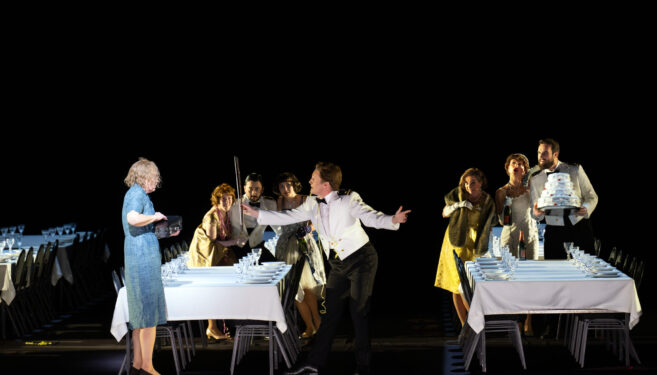
Die Passagierin (1968; based on the book by Auschwitz survivor Zofia Posmysz) is Weinberg’s best-known (aria-poor) work, based on an Auschwitz experience. The opera is set on a cruise ship, where two former “inhabitants” of the Auschwitz concentration camp meet. One is Lisa, who worked as a guard in the camp and is now traveling to Brazil with her husband, a diplomat. The other is Marta, a Polish Jewish woman, who was imprisoned in Auschwitz when Lisa was a guard there; Marta’s fiancé, Tadeusz, is with her. The opera explores the emotions of the main characters on the ship in the present and, in flashbacks, in the concentration camp.
In 1968, the specter of the Nazis —racism, anti-Semitism, torture, and genocidal violence— plagues the cruise ship. Just as they still do in 2026, though not limited to a ship: Jewish residents of Amsterdam, especially those recognizable by wearing a kippah, for example, are confronted with curses or offensive remarks on the street; Jews are spat upon and physically intimidated in the capital. Among certain groups of immigrants from the Middle East and North Africa, anti-Semitic views seem (to put it mildly) to be more prevalent, which doesn’t help either. And, more broadly, we also have politically accepted anti-Semitism, as propagated by Dutch Member of Parliament Kati Piri.
Kratzer
Kratzer’s staging is adequate, though he actually refers to Auschwitz or the war only obliquely or implicitly. In that regard, we preferred the direction by Bernd Reiner Krieger (Theater Lübeck 2025): a more direct visual connection between image and content, less intellectualism.
Not that Kratzer doesn’t serve up a few “gems” of scenes. Like the two SS men having a cozy chat about the Final Solution (Endlösung). And in the second act, fröhliche Partygäste wander through the dining hall, picking on violinist Tadeusz in an “Auschwitz-like manner”, resulting in his death — a scene that, in turn, has nothing intellectual about it but is relevant and brutally harsh.
Weinberg
Weinberg’s music bears traces of Dmitri Shostakovich, Nikolai Myaskovsky, Benjamin Britten, Gustav Mahler, and Alban Berg. There are few arias in Die Passagierin, which is a shame. And we always wonder why the text set to music in “modern operas” (a fantastic term) must always conflict with the logical intonation of spoken language.
Musically, Weinberg’s work really does require some perseverance, but it’s more than worth the effort; many passages (some quite accessible) earn our high praise.
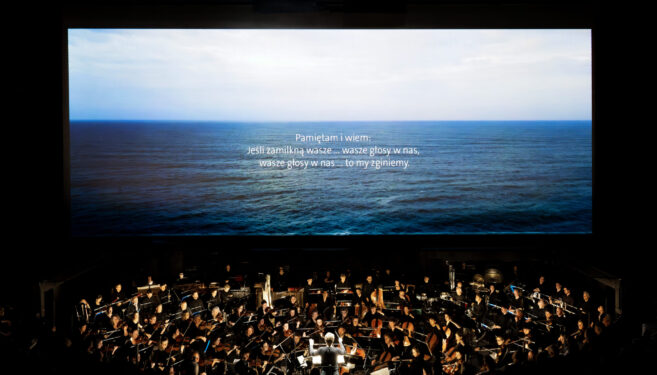
The Netherlands Philharmonic Orchestra and conductor Adam Hickox have already established themselves as Weinberg specialists; the performance was masterful. The DNO chorus, in a sort of requiem role, was once again in excellent form, as always.
The superbly acting soprano Sylvia d’Eramo, who recently sang Mimi in Dallas and before that Musetta at the Metropolitan Opera, portrayed the role of Marta, and she did so excellently with her versatile voice. Her two arias were breathtaking. Mezzo-soprano Jenny Carlstedt delivered a strong, accessible portrayal of Lisa, who is constantly haunted by her past. Her singing was tight, and her acting effectively conveyed her emotions, particularly shame.
Tenor Nikolai Schukoff made a very convincing impression as the diplomat who is primarily preoccupied with himself. Well acted and sung with great conviction. Baritone Gyula Orendt was great as Tadeusz. During the violin scene, he was accompanied by violinist Niek Baar. Eva Kroon (Hannah) deserves special mention and praise — what a professional! The smaller roles were not problematic.
Die Passagierin. Strong staging. Impressive singing and excellent acting. Superb musical quality.
Olivier Keegel