
DNO - Die Passagierin - Monika Rittershaus
The Passenger (Die Passagierin)

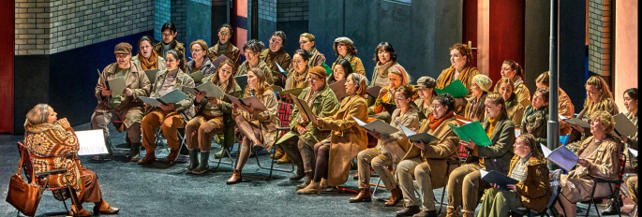
The Passenger (Die Passagierin). *The Passenger* (1968; based on the book by Auschwitz survivor Zofia Posmysz) is his best-known (aria-poor) work, based on an Auschwitz experience. The opera takes place on a cruise ship, where two former “inhabitants” of the Auschwitz concentration camp meet. One is Lisa, who worked as a guard in the camp and is now traveling to Brazil with her husband, a diplomat. The other is Marta, a Polish Jewish woman, who was imprisoned in Auschwitz when Lisa was a guard there; Marta’s fiancé, Tadeusz, is with her. The opera explores the emotions of the main characters on the ship in the present and, in flashbacks, in the concentration camp.

DNO - Die Passagierin - Monika Rittershaus
Die Passagierin

Die Passagierin. De Passagierin (1968; gebaseerd op het boek van Auschwitz-overlevende Zofia Posmysz) is zijn bekendste (aria-arme) werk, gebaseerd op een Auschwitz-ervaring. De opera speelt zich af op een cruiseschip, waar twee voormalige “bewoners” van het concentratiekamp Auschwitz elkaar ontmoeten. De ene is Lisa, die als bewaakster in het kamp werkte en nu met haar man, een diplomaat, op weg is naar Brazilië. De andere is Marta, een Poolse Jodin, die in Auschwitz opgesloten zat toen Lisa daar bewaakster was; Marta’s verloofde, Tadeusz, is bij haar. De opera vertelt over de emoties van de hoofdpersonen op het schip in het heden en, in flashbacks, in het concentratiekamp.

Siegfried
SIEGFRIED

Siegfried. Alexander Soddy, heard again in bringing off the score with flair, offered a truly symphonic version – the big passages never hurried, measured stiffly, but colorful with variations. sprightly version of this chapter in the Ring saga.

Scylla et Glaucus
Scylla et Glaucus

Scylla et Glaucus. Nevertheless, none of this detracts from the artistic achievements of the singers.
Chiara Skerath impressed as Circé with dramatic intensity and virtuosic coloratura in her aria “Il me fuit, hélas” – for us, perhaps the musical highlight of the evening.

Die Walküre
Die Walküre

Das Rheingold at La Scala. Overall, not a bad rendition of Wagner’s prelude to his Tetralogy. Lots of nice touches from McVicar, but also many ideas that were only able to satisfy the need to stage an episode, playing all straight out. Doing for the sake of doing. The weakness lay in the lack of an overall concept. True, better perhaps this version from those elsewhere that go astray, towards the ridiculous, towards what is estranged from Wagner himself. Perhaps, yes, the Ring is impossible to stage. Might there be a curse upon the ring?

Les Enfants terribles. Opéra de Lille. 2026. Photo Opéra de Lille.
Les Enfants terribles in Lille (Nederlands)

Les Enfants terribles Hypnose, fascinatie en de betoverende kracht van deze repetitieve muziek, nooit hetzelfde en toch altijd hetzelfde. Muziek die die tijdloze wereld oproept waarin deze tragische helden zouden willen leven; muziek die ons in haar ban houdt, in de dubbele betekenis dat zij ons als het ware gevangen houdt en ons verleidt.

Les Enfants terribles. Opéra de Lille. 2026. Photo Opéra de Lille.
Les Enfants terribles

Les Enfants terribles Hypnosis, fascination and the spellbinding power of this repetitive music, never the same and yet always the same. Music that evokes that timeless world in which these tragic heroes would like to live; music that captivates us: in the double sense that it imprisons us, so to speak, and seduces us.

Eugene Onegin
Jevgeni Onegin in Sydney (Dutch)

Jevgeni Onegin in Sydney. De productie van Tsjaikovski’s ‘Jevgeni Onegin’ door Opera Australia, geregisseerd door Kasper Holten, is een complete ramp – een mislukking van epische proporties.

Theory of Flames
Theory of Flames

Theory of Flames. Filmmuziek schrijven kan van der Aa als de beste: hij maakt gebruik van spannende harmonieën en trefzekere ritmische patronen. Er zit vaart en grote, drijvende dynamiek in de muziek bij het filmgedeelte.
Opera vraagt echter om een driedimensionale klank, drama en ontknoping. De scenes op het voortoneel kennen weliswaar schitterende harmonieën (met name de scenes met koor), maar de monologen en dialogen doen verticaal aan, als een ladder waar men op- en afklimt.