
I Capuleti e i Montecchi. The story of Romeo and Juliet, best known from Shakespeare, has earlier Italian sources. The Guelf Tebaldo must marry Giulietta, but vows revenge on the Ghibelline Romeo, who has murdered Capellio’s son. Romeo, disguised as a messenger, apologizes for the murder and asks Giulietta to marry him as a reconciliation. In her room, Romeo proposes to run away, but she refuses, and in the next scene preparations for her wedding are made, interrupted by the Montecchi rascals storming in. Doctor Lorenzo offers Giulietta a potion that brings her to apparent death, while Romeo and Tebaldo are about to fight each other. At Giulietta’s grave, Romeo takes poison and dies, while Giulietta comes back to life. When he drops dead, Giulietta dies anyway (at least according to Bellini and librettist Romani).
I Capuleti e i Montecchi.
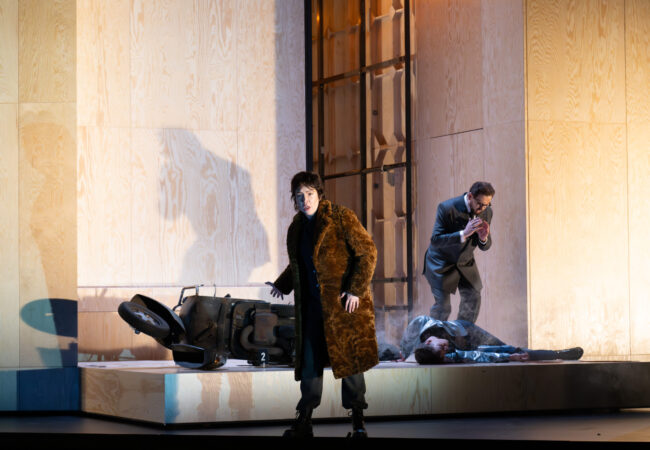
Despite the “fight director,” these fight scenes were completely ridiculous.
I Capuleti e i Montecchi
Director’s terror launches attack on Bellini
Music: 5 *****
Direction: 0
I Capuleti e i Montecchi Lyrical tragedy in two acts. Music Vincenzo Bellini, Libretto Felice Romani, Musical direction Antonino Fogliani, Romeo Vasilisa Berzhanskaya, Giulietta Yaritza Véliz, Capellio Jerzy Butryn, Tebaldo Julien Dran, Lorenzo Bogdan Talos, Choir of the Dutch National Opera, Netherlands Philharmonic Orchestra, Choir rehearsal Ad Broeksteeg, Director Tatjana Gürbaca
I Capuleti e i Montecchi
“Even a hero can sometimes have a misunderstanding, for which he can be held responsible, ” said the eminent Dutch writer Marten Toonder in 1980. We can assure you that even people of simple origins are not immune to sometimes serious misunderstandings.
In our high school we were not yet taught modern Media Literacy (we learned it ourselves with the help of a transistor radio, listening to Radio London and Radio Caroline) and Citizenship – the essence of which we learned during our Wednesday afternoon trips to the famous Amsterdam Red Light district, where the principle of Eigen Volk Eerst (Our People First ) still prevailed among the providers of certain services at the time, an aesthetic proof that the statement “everything used to be better” rarely holds true.
Shakespeare
We mastered the subject of English, as well as outdated subjects such as French, Math and History. Before the final exam, we received advice from an unexpected source to study the English writer Shakespeare. Good advice should not be ignored, but taking Shakespeare in hand seemed an unnecessary and sleep-inducing burden. Therefore, we opted for a shortcut: Romeo and Juliet from the Classic Illustrated series. An excellent reference work that resulted in a solid B on the final exam.
Slapjacks
Based on the above literature review, we had an idea that things were fierce between the Capuleti and the Montecchi in 13th century Italy. A civil war with thousands of deaths, torture, burnings, and so on. Misunderstanding! Sources from 13th-century Verona do report violence, but they do not mention deaths, and certainly not among the Capuleti and Montecchi families. (This is also where the director’s murder and manslaughter historically misses the mark; see below). Catenaccio was an early presence among the Italians. The Capuleti and Montecchi were part of a broader struggle between factions, namely between the Guelphs and the Ghibellines. The Guelphs favored the pope, the Ghibellines the emperor. Or vice versa. The mythical status of the rivalry falsely magnified the idea of mass bloodshed, while the actual historical impact was much smaller. So not a romantic tragedy like Shakespeare’s or constant bloodshed like the director’s, but a political-ideological struggle in medieval Italy. The rivalry was less about personal feuds and more about power, influence and urban dominance.
As everyone knows by now (fallacy 2), Bellini’s I Capuleti e i Montecchi has little to do with Shakespeare’s Romeo and Juliet. The libretto is not based on Shakespeare, but on Renaissance Italian sources. Therefore, there is no balcony scene, no playful childhood friendships and hardly any humor. The focus is on political rivalry and tragic love.
Our advice is this: it is better to listen to Bellini’s opera, with a much tighter, more emotional core: less plot, more musical intensity. Shakespeare may have richer psychology and dramatic layering (we didn’t notice any of this in Classics Illustrated), but Bellini draws from a firmer source with its pure, elegiac atmosphere. As an aside, it is always better to choose Bellini when in doubt, with perhaps an exception if Jennifer Lawrence invites you to dinner.
“All things are wearisome”
Bellini wrote I Capuleti e i Montecchi in 1830 on the initiative of impresario Alessandro Lanari, who had him deliver a new work under great time pressure. So much time pressure that Bellini integrated about half of his earlier opera Zaira into Capuleti. Better well-picked than infinitely dull re-composed (Meyerbeer, an effective soporific). Bellini’s mood did not improve, “All things are wearisome” he repeatedly quoted Ecclesiastes 1:8. In one of his letters to friend Francesco Florimo, he complained about rushing, about the reuse of material (the aforementioned Zaira) and about his quarrel with the inadequate tenor Rubini. He further complained that the Capuleti finale “almost drove him crazy” (“mi sta facendo impazzire”).
Putting all this aside, I Capuleti is and remains a delight to the ear, as are all of Bellini’s operas. He may be no Donizetti, but it is no Bizet either. The opening chorus makes a lidded impression right away. And Romeo’s cavatine “Se Romeo t’uccise un figlio,” with its remarkably warm, almost pleading tone, is an absolute highlight. Romeo and Giulietta’s ultra-lyrical duet “Ah! quante volte” could rightly be called the heart of the opera. From the second act, we like to refer to the funeral duet and Romeo’s death scene. Simple, pure, high impact.
The torture called Carmen
And, Capuleti limits himself in time i.e. length of time! Anyone who has ever had to sit through an entire Carmen (family of the chorus members) knows how important it is to escape in time to a catering establishment and position a Dutch Jenever next to a Belgian beer.
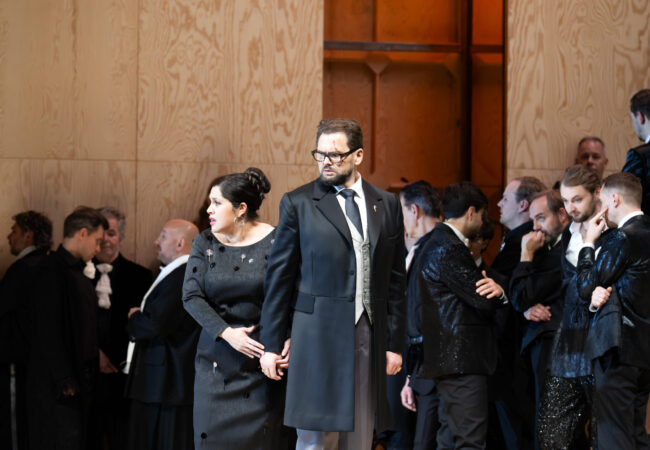
I Capuleti e i Montecchi was staged at De Nederlandse Nationale Opera, and naturally we were concerned that Bellini would have a place in the vicious circle of opera in Amsterdam. The fact that director Tatjana Gürbaca, who recently disposed of a disastrous La Traviata in Amsterdam, was at the helm did not exactly reassure us. Nevertheless, we entered the Stopera with an upbeat mood and an always positive attitude. The palace of lies on the Amstel, the so-called Stopera (housing for Opera and municipal government), is run on the municipal side by an extremely leftist strong woman who is not up to her task, and on the musical side by a slightly less strong woman who is not up to her task either, Sophie de Lint. On the municipal side, unwelcome reports disappear into a secret drawer; on the musical side, unwelcome reviewers are censored away. If the Russians come, they can take over Amsterdam’s Stopera infrastructure in its entirety.
“Questioning unconditional romanticism.”
Dutch National Opera has informed us that in its staging of I Capuleti e i Montecchi – with an otherwise monstrously ugly and clichéd setting – director Tatjana Gürbaca unfolds a Romeo and Juliet story “in which the unconditionality of romance is questioned.” What would that mean, questioning the unconditionality of romance? Nothing, of course. Nonsense from a pseudo-intellectual with a limited worldview.
The question, of course, is: how does one get this textual diarrhea out of the pen! More extended-cord nonsense can be found in the interview with Gürbaca https://www.operaballet.en/online-programmaboeken/i-capuleti-e-i-montecchi#tijdlijn We wish you strenth..
Of course, Tatjana Gürbaca, a typical one-trick pony in all her directing, raped the libretto in every bodily orifice she could find with composer Vincenzo Bellini and librettist Felice Romani, like the door-to-door vacuum cleaner salesman taking a gamble toward an innocent housewife’s Lady Garden.
Label scam. But no sign of enforcement.
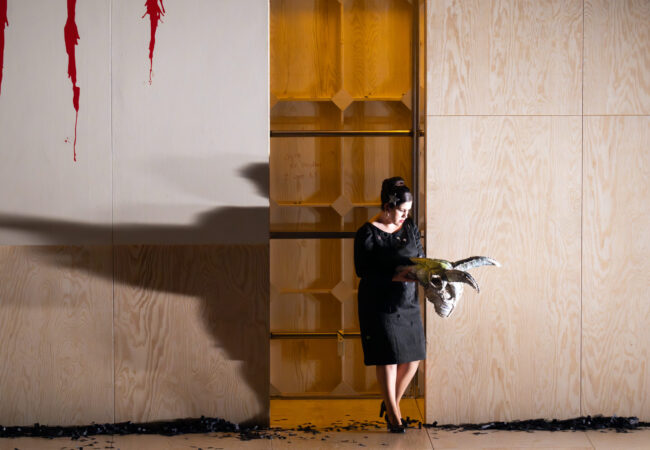
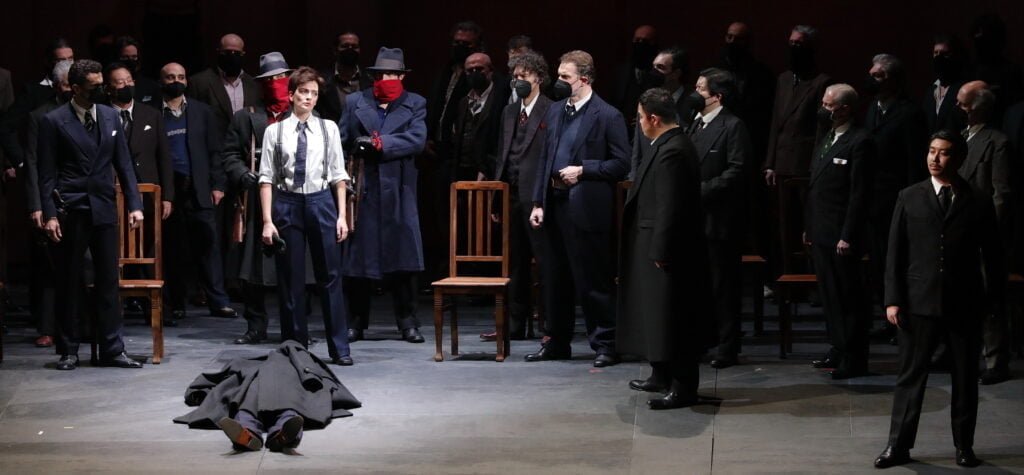
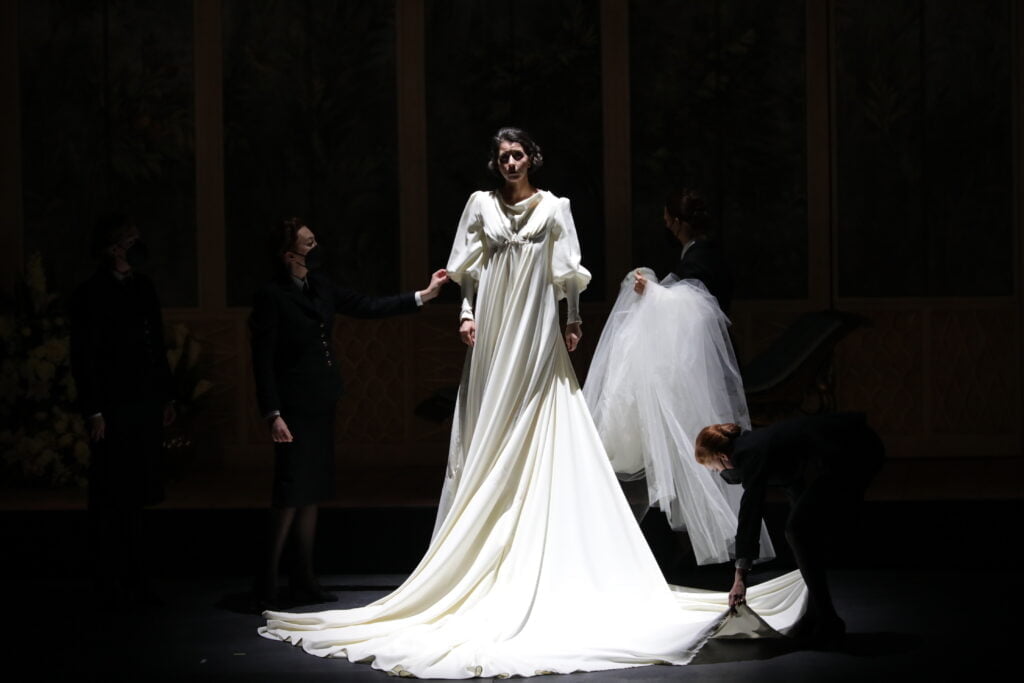
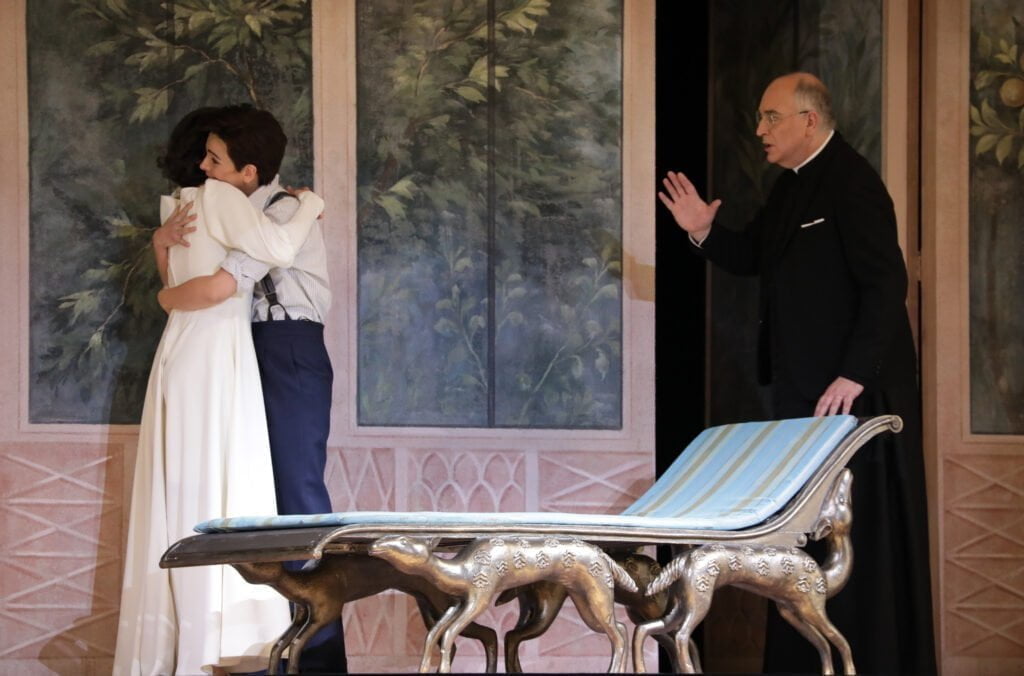
Just a sketch of the Umfeld: Gürbaca’s opera is set in the 1950s and the Capuleti and the Montecchi are criminal organizations (i.e.: with sunglasses, of course). And Julia stays alive (because she is a woman, probably). We’ll leave this new label scam for the rubbish it is.
Brainfarts!
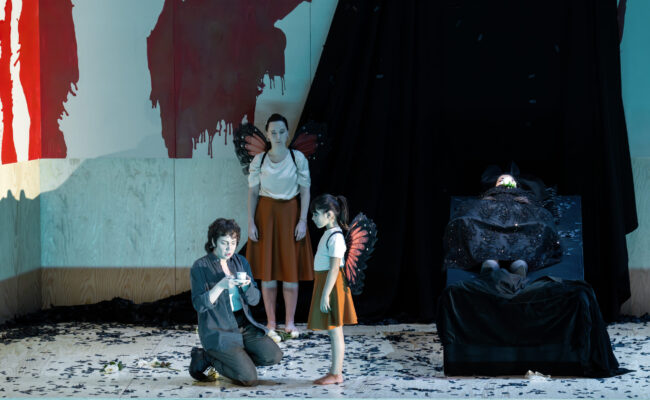
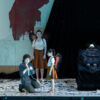
Nevertheless, let’s address the most clichéd trope in directing: the main characters walking around with their younger versions, as if it were Black Friday at the clone factory. We’ve seen that a thousand times. There’s Julia in three versions, ranging from ‘just out of elementary school’ to ‘help, I’m pregnant’ – that pregnancy must have occurred somewhere between the 13th and 20th centuries. The youngest Julia hands out the poison as if it were a free sample. Meanwhile, the little Juliets flutter around like hyperactive garden elves with butterfly wings on their backs. The toe-curling choreography and play with lighting, not to mention all the other absurd ideas, appealed to our tolerance of foolishness. And there’s no shortage of that in the Palace of Lies at the Amsterdam Opera, as evidenced by Gürbaca’s almost identical direction of her Amsterdam La Traviata. In short, the directing was disgusting and bastardised by egomania.
Bellini stands in the way
What Gürbaca could not avoid was Bellini’s music. The soloists, chorus and orchestra were all of the very highest level. That made up for a lot.
Yaritza Véliz was a revelation in the role of Juliet. She was gorgeous, beautiful and wonderful. This Chilean soprano indeed has all the vocal qualities and technical ability necessary for bel canto: purity of timbre, excellent breath control, a sense of melody, clarity and precision in vocalises, a comfortable range, and above all, flexibility that allows her to convey emotion simply by varying her timbre or dynamics, with high notes that would do the greatest singers proud.
Vasilisa Berzhanskaya, playing Romeo, was excellent too. The young Russian, who graduated from the Bolshoi Opera Studio in 2017, switches smoothly between mezzo and alto with impressive assurance in both the low and high registers. Her coloratura technique is exemplary and her Italian diction and phrasing are almost flawless. Her breath support and delicate dynamics, especially in the moving final scene, left us momentarily awestruck. Moreover, in our opinion, she is the best actor in the entire cast; every scene in which she appears is imbued with verisimilitude, tension and emotion.
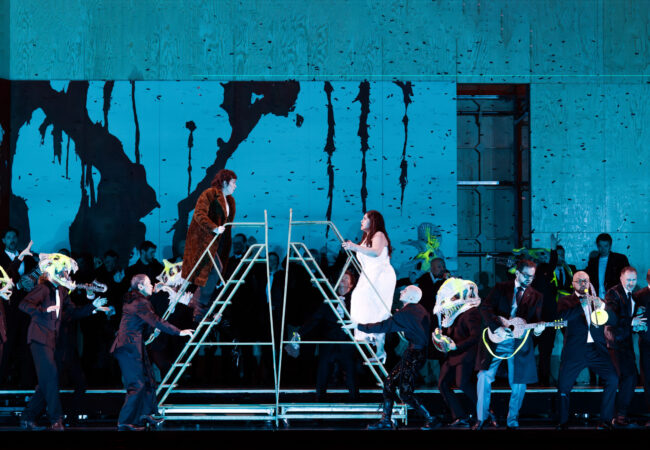
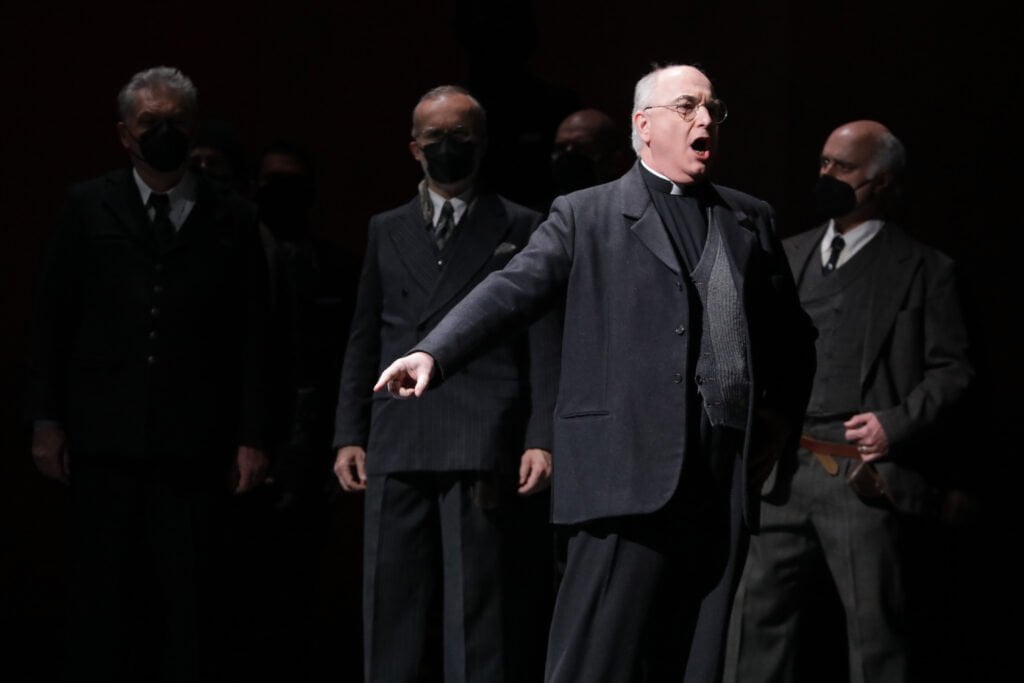
Bogdan Talos, Jerzy Butryn and Julien Dran played the smaller roles of Lorenzo, Capellio and Tebaldo respectively, and matched the protagonists qualitatively well. The NedPho Orchestra was, as always, in top form. Antonino Fogliani, a bel canto celebrity, took charge of the musical direction, conjuring up the most beautiful melodies from the orchestra pit. NedPho under Fogliani. Enjoy the experience!
Mixed feelings
A premiere whose direction, bastardized by egomania, was lousy to the same degree that the music was brilliant. Visitors with neurodivergent mental states found it challenging, while music lovers enjoyed it immensely.
Olivier Keegel

I Capuleti e i Montecchi









Elke keer kijk er naar uit, heerlijk om te lezen.🎼🌷🌷🌷🌷🎼
Ich bin diese Zeitverlegungen auch so satt. Es funktioniert in den seltensten Fällen und ich sehe einfach auch keinen Mehrwert darin. Danke für die Rezension. Sehr angenehm, dass Sie zuerst den musikalischen Teil bewerten und dann erst auf die Inszenierung eingehen.