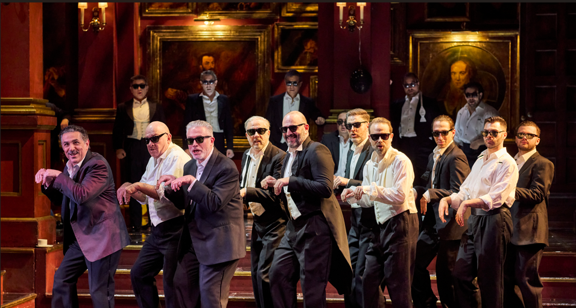
The secret opera connoisseur. Das Syndikat sagt NEIN! ( The Syndicate says NO! )
Read More →

The secret opera connoisseur. Das Syndikat sagt NEIN! ( The Syndicate says NO! )
Read More →
Norma. Bellini\\\’s Norma is rather ambiguous in musical terms. On paper, the orchestra often seems sober and \\\’standard\\\’ bel canto, but in an excellent performance, the work can be mesmerising. Norma is entirely dependent on top-quality vocals. Bellini writes long phrases that offer little \\\’foothold\\\’ to singers who do not have exceptional legato. \\\’Casta diva\\\’ unfolds deliberately simply and slowly, but with too broad a vibrato, the aria becomes a series of loose, beautiful notes. This applies equally to the following cabaletta \\\’Ah! bello a me ritorna\\\’: if the tempo is too mechanical, virtuosity turns into routine and the music only sounds accelerating \\\’because that\\\’s how it\\\’s supposed to be\\\’.
Read More →
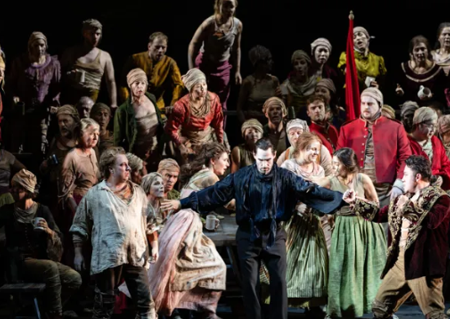
Lady Macbeth del distretto di Mcensk. As for the soloists, Sara Jakubiak is a deeply moving Katerina in her vocal and physical performance. Najmiddin Mavlyanov plays a seductive Sergei, indifferent to what he provokes and inexorably sets in motion. Alexander Roslavets imposes a brutal, primitive, and disturbing Boris. Around them, remarkably, each role is played with rare intensity.
Read More →
I Capuleti e i Montecchi. Yaritza Véliz was a revelation for us in the role of Julia. Brilliant, beautiful, and magnificent. This Chilean soprano possesses all the vocal assets and technical skills required for bel canto: purity of tone, excellent breath control and a feel for melodic lines, clarity and precision in the vocalises, a comfortable range and, above all, a flexibility that enables her to convey emotions simply by varying her tone, dynamics or use of voice, with floating, ethereal high notes worthy of the greatest singers.
Read More →
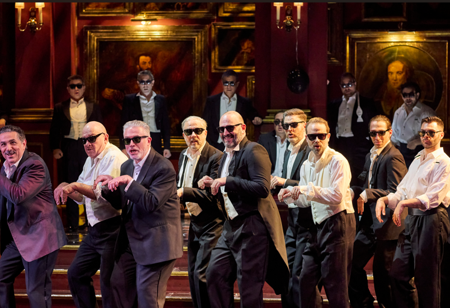
Die Fledermaus. The audience responded with consistent enthusiasm, even if a full standing ovation did not materialize. Musically and theatrically – especially in the direction of the principals and the choreography (direction: Anna Bernreitner, dramaturgy: Jana Beckmann) – the work was of an extremely high standard. One had the impression of extremely thorough rehearsal, which had brought great enjoyment to all involved, and of an authentic creative flow that never felt forced. The isolated boos for Patti Basler and the production team at the curtain call were, to us, incomprehensible.
Read More →
Così fan tutte at La Scala For so many reasons, especially today, it is certainly more than a curiosity to ask ourselves what Wolfgang Amadeus Mozart would have thought of this Robert Carsen staging of Così fan tutte for La Scala. It would be slightly hazardous to believe that we might sense the composer’s reasoning powers or even imagine the demands he had put upon himself while creating any of his great works.
Read More →
Il Cappello di paglia di Firenze is a lyrical adaptation of Le Chapeau de paille d\’Italie, a five-act comedy by French playwright Eugène Labiche, which premiered in Paris in August 1851. The play is still regularly staged to great acclaim and is considered a classic example of a comedy full of misunderstandings and dramatic twists and turns, with a script brimming with witty repartee.
Read More →
Hänsel und Gretel. Hänsel und Gretel is classed as a children’s opera is a truism. Yet the sight of what felt like half the audience being under ten years old was still surprising – and initially raised the fear that things might become lively and restless in the auditorium. The opposite occurred: with admirable concentration, the young audience followed the action.
Read More →
Artistic directors think only in terms of ‘stars’ to hire, and audiences turn up enthusiastically to hear a successful performer, regardless of the piece being performed. In opera, the situation is even more peculiar, as the attraction is often the stage director themselves. They try (in my opinion, clumsily) to rekindle interest in productions that seek originality in staging through modernizations, abstractions, and reinterpretations.
Read More →
Aida. Tijd voor -even tussen door, wij wilden u niet meteen al overbelasten- een uitbarsting van artistiek misgewas, dead on arrival. Het doek valt tussen de eerste twee scènes van de eerste akte en de zaal wordt verlicht (dat de verantwoordelijke de pestpleuris mag krijgen, pardon me (uit te spreken: mie) French, waarna er een gesluierde stoet spoken voor het gordijn tergend langzaam voortschrijdt, begeleid door een onverstaanbare Fernstimme met een Jane Birkin Je t’aime moi non plus timbre. Het Open Podium bij dorpshuis De Zwaan in Uitgeest heeft briljantere ideeën. Gelijksoortige waanzin tussen alle onderbrekingen? En zo kom je dan wel aan je drie uur en een kwartier.
Read More →
Lohengrin. Then, too, we have Lohengrin and Telramund fight their duel in the air, hanging by ropes. This is not because the costumes of all the characters portray them as moths attracted to the electric power plant’s kinetic energy, but because Sharon somehow finds Lohengrin as a Peter Pan archetype, a boy who wishes to never grow up
Read More →
Tosca. Amsterdam, klein Toscane, bracht een Tosca in 1958, 1959, 1960, 1961, 1963, 1964, 1965, 1969, 1973, 1974, 1978, 1985, 1998, 1999, 2022, 2025. In 2025 staat Tosca nog een keer op het programma, maar nu met “simulaties van geweld, seksueel misbruik, moord en suicide”. Jippie!
Read More →
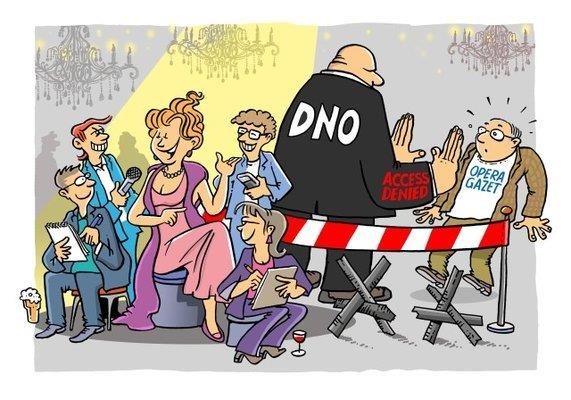
DNO “Toxic ideology on art”. “Her first major solo decision was to cancel an already booked new performance of Verdi’s Otello because of ‘the progressive understanding that an all-white team, including the performer of Otello, is problematic. This no longer felt right with the current changes in our society … Otello in a contemporary form can only be done in a team of color.’ (…) So a white tenor, in her opinion, cannot play the role of a general from North Africa who becomes jealous of his wife.”
Read More →
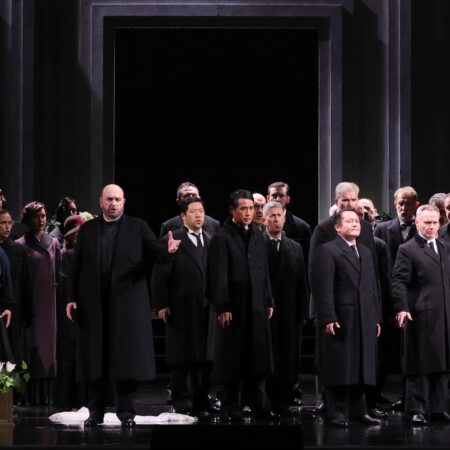
Norma. This ‘theater-within-a-theater’ structure was pre-announced by the stage director in his article for the La Scala program ‘Norma Revolutionary’, in which the personage Medea is mentioned seven times, almost as much as Norma, nine times. True, the theme of infanticide is a major theme linking the two operas, but it goes no further than that.
Read More →
Yes, Hurwitz can be provocative, but that is exactly what is needed at this moment in time. His criticism is always musicologically sound and demonstrates a keen musical ear.
Read More →
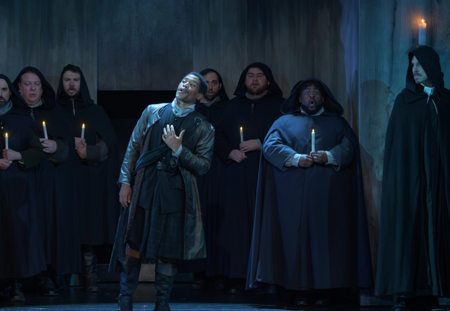
Der Evangelimann. The story takes place in a Benedictine monastery in St. Othmar. It is the early nineteenth century. There we find the clerk Mathias, who is in love with Martha, his boss’s daughter. Highly inappropriate, of course, and Mathias is logically dismissed. Now follows a twist that can be called unique in the world of opera. There is someone else in love with Martha, namely Mathias’ brother, Johannes, but Martha wants nothing to do with him. Brother dearest does not accept this, and in revenge he sets fire to the monastery. (To clarify: this is the action of a lone wolf, not a terrorist attack on a Roman Catholic institution.) A Marinus van der Lubbe-type situation ensues, because it is not the pyrophilic brother but Mathias who is identified as the perpetrator: 20 years in prison, and court verdicts were not appealed at that time. After his release, Mathias travels around the country as a preacher. His brother Johannes, a classic villainous baritone, has become a wealthy businessman through shady dealings and has settled in Vienna. That he eventually becomes seriously ill is an undeniable case of reaping what you sow. Thirty years after the fire in the monastery, the two brothers meet again. Matthias —a preacher, after all!— forgives Johannes, allowing the latter to die in peace.
Read More →
Katie Mitchell. But now to the other celebration. Katie Mitchell is quitting opera directing. No more operas will be judged according to strict feminist standards. The misogyny of Mozart, Donizetti and Handel will have to be tackled by other misguided souls, and Mitchell herself now has plenty of time to work on the long-awaited maintenance of her sense of insignificance and the healing of her narrowed “Weltanschauung.
Read More →
Stage Directors. What, you may ask, is the REAL purpose of Regietheater? Those sitting at the VERY top no longer care to foot the bill for art and culture. The method, then, is to destroy it, piece by piece, until the audience stays at home, rummaging through their audio recordings and dusty DVDs, looking for a taste of art from a bygone era.
Read More →
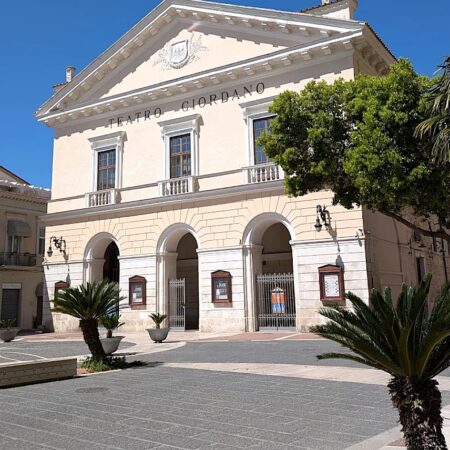
Conductors. I once worked with a well-known mezzo-soprano who was singing Eboli in Don Carlo for the first time. During rehearsals she said she found the slow section of the ‘O Don Fatale’ quite slow. At the premiere, the con-ductor slowed it down and wound down the tempo so much that King Kong with three lungs could not have mastered it. She then paid dearly during the soaring climax at the end.
Read More →
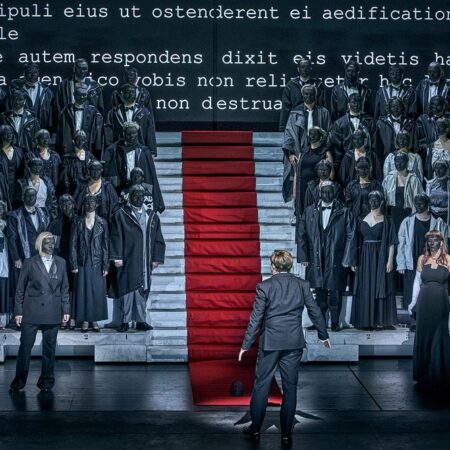
About bad nerves and stage fright. Suppose you go out to give your performance and everything goes to hell in a handbasket. The page-turner gets the hiccups, the stage lights go out, you sit down in front of the or-chestra only to discover that your zip is half down, your shoelace is broken, your bow tie is in your other jacket, you brought the wrong score to church, you are suddenly TOTALLY hoarse from allergies. Etc, etc, etc, etc, rinse, repeat.
Read More →