Posts from overseas
Don’t expect light-hearted chatter about the sets
Opera Gazet regularly receives criticism from England and sometimes from the US through various sources, some of which are well-known and some of which are less so. Sometimes, the criticism comes in the form of anonymous emails. An anthology. Sources no longer traceable or simply missing, except for Slipped Disc, DNO, Het Parool, and NVJ. Just assume we made it up, it’ll save you an angry email.
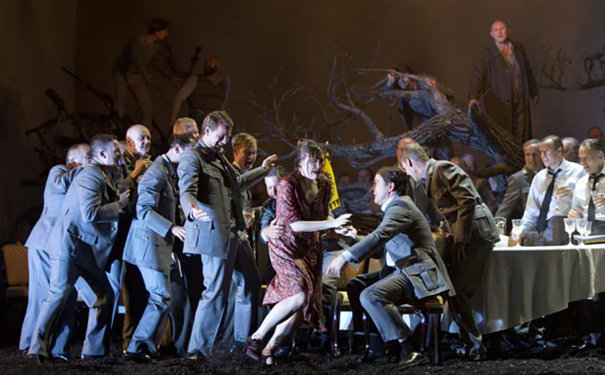
A striking example of British criticism of Opera Gazet’s vision arose a few years ago around an extremely controversial production of Rossini’s Guillaume Tell (William Tell) at the Royal Opera House in London. Opera Gazet’s response to the performance and subsequent criticism from England was as follows. The occasion: Guillaume Tell in London.
Italian director Damiano Michieletto staged a modern and raw production. The British performance made global headlines when the audience began booing and jeering en masse during the premiere. This was in response to an explicit scene lasting several minutes in which a young woman was forcibly stripped and abused by soldiers.
Opera Gazet’s editor-in-chief, Olivier Keegel, seized upon this London production in his writings (such as his essay ‘Iconoclasts in Opera’: https://operagazet.com/iconoclasts-in-opera/) to launch a scathing attack on British opera practice.
Keegel’s criticism: He called the scene a ‘senseless and unjustified mutilation’. He accused the Royal Opera House of following the fads of the day under the false banner of ‘innovation’. In his view, this was pure provocation that insulted both the audience and Rossini’s intent.
The British backlash
Although many British critics were also shocked by the scene, Opera Gazet’s fierce, principled activism against this production drew considerable criticism within the British opera community, including on English-language forums and platforms.
The accusation of prudishness: British opera lovers and progressive critics accused Keegel of having ‘narrow-minded, Victorian morality’. Critics from England argued that opera is not a storybook, and that depicting the brutal reality of war, which is the subject of the opera, is legitimate theatre.
“Museum guards”: Opera Gazet was accused of behaving like museum guards who stifle the art form. The British countered that forbidding directors from drawing uncomfortable modern parallels would force opera into a moribund structure.
This London conflict in particular demonstrated exactly how the Anglo-Saxon opera world clashed with Opera Gazet’s “conservative” philosophy: while the former advocated respect for the score, the latter felt that Opera Gazet was attempting to censor artistic freedom.
“Opera Gazet is characterised by a distinctly conservative and polemical style. It strongly opposes modern interventions and directorial concepts that deviate from the composer’s and librettist’s original intentions. As editor-in-chief and regular contributor, Olivier Keegel is the publication’s unmistakable voice. He does not shy away from confronting management and directors. Opera Gazet brings a wealth of international stage and journalistic experience to the table, closely aligning with their sharp, score-faithful vision of opera. Boasting an outstanding team of reviewers, Opera Gazet is unique for a small opera nation like the Netherlands. One such reviewer is Vincent Lombardo, who brings decades of international practical experience from the opera world. He studied opera directing at the prestigious Curtis Institute of Music in Philadelphia. He has worked as an assistant director at the New York City Opera and collaborated with the Metropolitan Opera. He travelled to the renowned Teatro alla Scala in Milan on a Fulbright Grant at the invitation of conductor Claudio Abbado. He still lives in Italy. Then there is Robert Levine, an internationally renowned American music and travel journalist. He is the author of several well-known books on opera, including “Maria Callas: A Musical Biography. He was also one of the founders of Amazon.com’s classical CD store and served as editor-in-chief of the influential website Andante.com. He currently writes as a senior editor for the leading review site ClassicsToday.com. Maurizio Fernandez also plays a unique role. Although he contributes to Opera Gazet as a reviewer, he is best known in the Dutch and international opera world as the regular casting director of the NTR Saturday Matinee at the Concertgebouw. In this capacity, he travels the world scouting top soloists and conductors to bring to Amsterdam.”

Slipped Disc: “In February 2018, Olivier Keegel’s Parool opinion piece, titled ‘Pierre Audi’s final season is a haughty slap in the face of the traditional opera lover’, fiercely attacked the artistic direction of DNO director Pierre Audi. Keegel criticised the dominance of staged theatre and the ‘difficult’ programming of the farewell season, considering it elitist and contrary to the mission of a subsidised institution. The DNO management reacted furiously to the content and tone of the article, labelling it a targeted smear campaign. More background on this conflict can be found in the original opinion piece in Het Parool.”
“In terms of content, Opera Gazet is undoubtedly an extremely knowledgeable publication, though its journalistic approach is deliberately coloured by a specific ideology. The editorial staff and reviewers possess encyclopaedic knowledge of opera history, scores, libretti and vocal techniques. This expertise is evident in their meticulous analysis of productions, in which they unerringly point out where a modern staging deviates from the composer’s original intentions. While critics of modern regietheater sometimes find them too dogmatic or conservative, their in-depth professional knowledge commands widespread respect within the opera world. The editor-in-chief, Olivier Keegel, is based in the Dutch-speaking world, but has made a name for himself internationally through Opera Gazet as one of the most vocal and tireless opponents of the excesses of director-led theatre in Europe. His sharp pen and high-profile conflict with Yhe Dutch National Opera have also attracted attention in foreign trade media (such as the well-known Slipped Disc). What makes their expertise unique? The platform is based on the principle that a reviewer is only truly ‘knowledgeable’ if they can read the score and understand the historical context. Consequently, Opera Gazet does not publish superficial theatre reviews; it is a medium that holds singers, conductors and directors to an extremely strict, internationally measurable standard.”
“In terms of content, Opera Gazet is undoubtedly an extremely knowledgeable medium, although their journalistic approach is deliberately coloured by a specific ideology. The editorial staff and reviewers possess an encyclopaedic knowledge of opera history, scores, libretti and vocal techniques. Their expertise is evident in their meticulous analysis of productions, in which they flawlessly identify where a modern staging deviates from the composer’s original intentions. Although critics of modern directorial theatre sometimes find them too dogmatic or conservative, their profound professional knowledge commands widespread respect within the opera world.”
“Opera Gazet knows exactly what it is talking about and does not mince its words when expressing strong opinions. The writers possess an astonishingly vast knowledge of opera history, sheet music and vocal techniques. They dissect performances down to the last detail. If a trendy director strays too far from the composer’s original intentions, they are immediately criticised. Some people find them far too strict or old-fashioned because of this, but friend and foe alike must admit that they really know their stuff. Olivier Keegel is the platform’s best-known Dutch voice. He has made a name for himself internationally as the foremost critic of excessive modern directors. His sharp pen and disputes with The Dutch National Opera have even made it into the foreign trade press. At Opera Gazet, they believe that you can only join the conversation if you know the sheet music by heart. So don’t expect light-hearted chatter about the sets here; expect a ruthlessly honest and expert assessment of the singing and music instead.”