
ELEKTRA
Düsseldorf
May 29, 2026
Musical Director Vitali Alekseenok Elektra Magdalena Anna Hofmann Chrysothemis Liana Aleksanyan Clytemnestra Linda Watson Aegisthus Cornel Frey Orestes Richard Šveda Orchestra Düsseldorfer Symphoniker Director Stephan Kimmig
Music: 3.5 *
Direction 0.5 *
After the fall of Troy, General Agamemnon finally returns home, but he is unable to enjoy it for long. His wife Clytemnestra and her new lover Aegisthus immediately have him killed and seize power for themselves. Their daughter Electra is furious; she roams the palace like a walking storm cloud, with only one thing on her mind: revenge. Her sister Chrysothemis tries to calm her down, but Electra continues to hope for the return of her brother Orestes.
Clytemnestra, meanwhile tormented by guilt and nightmares, even seeks advice from her own daughter. Electra plays along cleverly and predicts that Orestes will one day avenge their father’s murder. When it is then reported that Orestes is dead, Clytemnestra breathes a sigh of relief — a little too soon, as it turns out later. Orestes is still alive, appears unexpectedly on the scene, and first deals with his mother and then with Aegisthos. Electra celebrates her long-awaited victory with a frenzied dance, until she literally collapses.
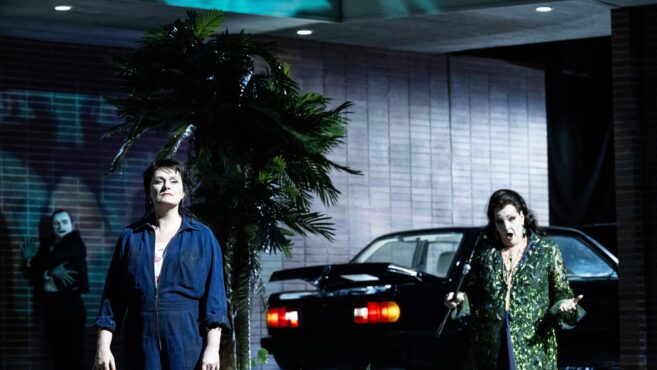
This opera by Richard Strauss is anything but subtle: the music surges forward, motifs recur constantly, and the protagonist, Elektra, remains at the center of the action almost without interruption. The work is one great clash of emotions, familial hatred, and psychological tension, culminating in the recognition between Elektra and Orestes — followed by a finale that is both triumphant and unsettling.
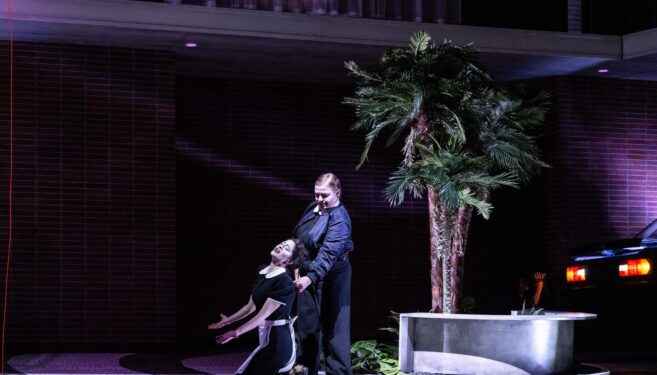
Elektra and Salome
Elektra and Salome are both intense operas by Richard Strauss, but they differ considerably. Salome (1905) has a more seductive, mysterious, and fluid atmosphere. Strauss makes the orchestra sizzle with exotic sounds, soaring harmonies, and sensual dance rhythms that slowly build the tension. The famous “Dance of the Seven Veils” sounds seductive and colorful. Even in the madness, the music often remains stylish and almost enchanting.
Elektra (1909) is much grimmer and fiercer. The sound of the orchestra is harsher, heavier, and sharper. Here, Strauss pushes the music almost over the edge, with clashing sounds, blaring brass, and nervous rhythms. While Salome still has something seductive about it, Elektra feels like a dark fever dream full of revenge, rage, and trauma. The singing is also extremely demanding, especially the title role, which requires an enormous amount of power.
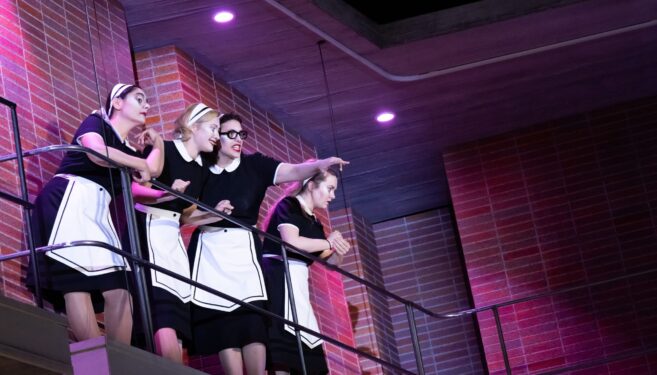
Catastrophic mess
We saw a really bad show on stage. It was upsetting and really boring. Even if a production is really bad, there’s usually something a bit funny about it. Take Trump, for example. He occasionally makes a sensible decision and can even be on everyone’s wavelength for five minutes. But when a production totally falls apart, bewilderment gives way to a kind of masochistic holism – a sense of perverse perfection of a level rarely achieved even by the Dutch National Opera. You look around, and you see opera lovers who are clearly unhappy, and their eyes convey their complaints: “Why am I here?” they ask, a hint of exasperation in their voices.
To add to the dystopian picture, there are the brainless culture snobs (they walk through a museum with their hands behind their backs) whose haughty heads, adorned with Hoffmann Natural Eyewear glasses, radiate something like “damn interesting”… The arrogance spews from the chariot of their vanity; those snobs are not people like us: “Just look, Friedrich, how restless the common folk are.” “Of course, those poor sods don’t get it again, Amalia.”
But the mocked common folk have a very sharp eye for the quality of what’s on offer, because “you can dress up a pile of shit in purple, but it’s still a pile of shit.” The mass booing at the premiere was dismissed by the press office as an “(anti)claque,” just like director Andrea Breth did when her disastrous Macbeth (2015) was slammed in Amsterdam; it wasn’t Breth, the one who always mixes in “underlying psychological motives,” who was to blame, but the victim -the opera-loving audience- was made to take the fall.
Car Won’t Start
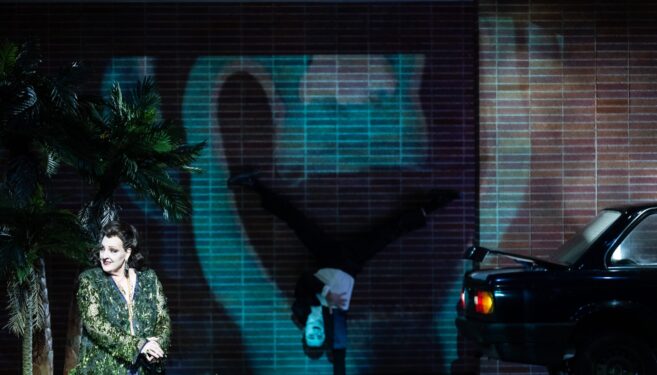
Director Stephan Kimmig must have thought, “I find Elektra a boring opera; let me use my direction to turn it into a unity of form and content.” And that was a total success! The performance was pretty boring, even with all the philosophical stuff and clichéd platitudes that only yoga ladies with two cats or some other mental handicap would believe. First of all, there’s no set, or at least, the set looks like it was designed by the Textile Arts Instructor at the School with the Bible in Birmingham, Alabama. They’ve gone for a drab factory building, a sandbox (the desert!), a few palm trees and, of course, a car. What would today’s “disorienting and urgent opera” do without a car?
Obviously, the chosen location wasn’t the original one, which was the courtyard of the royal palace in Mycenae.
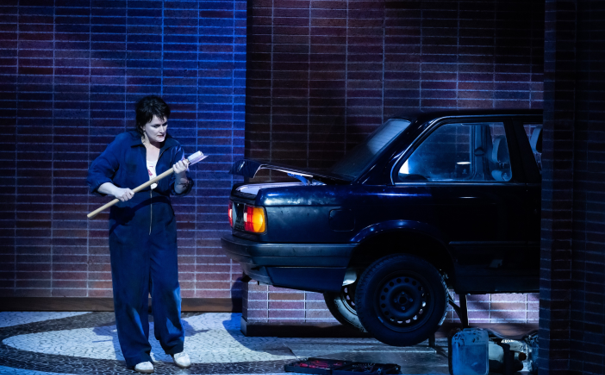
Nothing is happening on stage. And the costumes do everything they can to reinforce this sense of emptiness. Elektra is a car mechanic in overalls; she’s trying to fix the family car, but the damn thing just won’t start, so she simply sits down on a low wall to sing a little song. Of course, in addition to the car, the inevitable video projection was also present. In short: where are we here, what are the people doing here, and why not? What artistic catastrophe is unfolding here?
The staging of the characters is entirely in line with this. Elektra sings, sometimes standing, sometimes sitting. That’s about it. In short, director Stephan Kimmig has “brought the opera Elektra into the present,” but which present remains entirely unclear; the staging is an artistic monstrosity, cultivated yet irrevocably and immediately struck down on the hill of good taste. Thus, Strauss’s highly dramatic music is scenically ruined.
Elektra and Salome
Strauss’s Elektra premiered in Dresden in 1909; the composer was inspired by Hugo von Hofmannsthal’s play of the same name, Elektra. Four years earlier, Richard Strauss had written another “shocking opera,” Salome. The atmosphere in both operas differs greatly. Salome is sensual, seductive, and exotic. The music undulates and shimmers, full of oriental colors, erotic tension, and decadent elegance. Even in the violent scenes, there remains something hypnotic. Elektra sounds far more overwhelming and aggressive. In Elektra, Strauss employs a massive orchestra with fierce brass, sharp rhythms, and extreme dissonances. The opera revolves less around seduction (Salome) and more around psychological madness, trauma, and revenge. Vocally, Salome demands flexibility and sensuality, while Elektra requires an almost superhuman dramatic power. As a result, Elektra feels grimmer, rawer, and more emotionally exhausting than Salome. Dramatically, they also differ significantly. Salome builds slowly with tension and eroticism, while Elektra cuts right to the chase from the very beginning. Elektra is Strauss’s most uncompromising and overwhelming opera.
An die Musik
In stark contrast to the scenic misery stands the musical performance, provided by the Düsseldorf Symphony Orchestra under the baton of Vitali Alekseenok; he dives right in with full force in a compelling manner, delivering the furious and innovative Strauss sounds to us unadulterated; the flaring melodic lines, based on the Agamemnon theme, reach us unfiltered.
The singers hold their own bravely against these orchestral forces. More or less. Agamemnon is portrayed by the acrobats Aliaksei Liubezny and Pascal Siffert, whom director Kimmig likely knew from his work at the Düsseldorf-Gerresheim circus, on the grounds on Heyestraße.
Magdalena Anna Hofmann portrayed an Elektra who was less hysterical and more musically balanced than is often the case. Liana Aleksanyan sang the role of Chrysothemis with great dramatic impact; we were left to assume that the sounds she produced bore some relation to the German language. And Linda Watson, who has already proven herself in all the Wagner heroine roles, delivered a fine performance as Clytemnestra. Richard Šveda’s Orestes, not really a heroic tenor in our opinion, benefited from the orchestra toning down its volume during the solemn passages. Cornel Frey delivered a sharply defined Aegisthos with a penetrating and deeply felt character tenor. The singing in the smaller roles ranged from good to excellent.
CONCLUSION
A performance with a direction that cannot be taken seriously, set against a generally quite good musical performance. The cuts were most welcome.
Olivier Keegel