
The Secret Opera Lover
How an opera lover embraces modernity and secretly longs for a performance that accurately follows the libretto and episode.
There is a remarkable type in the opera world that you rarely recognize on the outside. He does not necessarily sit in the front row, he is modestly dressed, he does not loudly shout “bravo” or “boo.” On the contrary, he seems like the perfect contemporary opera goer.
He nods approvingly when the terms “deconstruction,” “reinterpretation” and “actualization” are mentioned. And when wine is drunk in the foyer afterwards, he always has a phrase ready that anchors him safely in the troupe: “This is 2025, not 1850.” But deep inside – beneath the layer of socially desirable modernity – lurks a carefully kept secret. Homesickness. A gentle but insistent longing for something that is considered highly suspect in opera circles of Today’s People: opera that is true to the libretto and the episode.
Opera as social identity
Opera, of course, is art. Musical drama if you will. Emotion in story and sound. Voices that raise people above themselves. But opera is also something else: an identity. A badge. A language that indicates to which tribe you belong.
In recent decades, the dividing line between two camps has become sharper. On one side: the adherents of so-called “regietheater” or “Regietheater” with a capital letter (not only in German texts), as if the word itself possesses aesthetic authority. Today’s People love alienation, concepts, symbols, dramaturgical interventions, even if the latter directly contradict the libretto. On the other hand: lovers of libretto-faithful productions, sets that refer to the original content of the opera in question, singers who dress and behave accordingly, and a stabbed bad guy who just drops dead instead of conducting an existential monologue with a surveillance camera.
A stabbed bad guy who just drops dead instead of conducting an existential monologue
The Secret Lover – let us call him Joris for convenience – officially belongs to camp one. He must. Not because he feels at home there, but because he feels protected there. Because yearning for authenticity is not just a preference. It is a risk.
Afraid of being old-fashioned
Joris’ fear is not that he will not understand an opera. Nor that he finds a performance “boring.” His greatest fear is more subtle; it is the social fear of being considered old-fashioned. In the cultural upper class, “modern” is not a neutral term but a moral benchmark. Modern stands for intellectual, relevant, daring. Hanging on authenticity and respect for composer and librettist stand for lazy, nostalgic, conservative. And whoever in the circle of friends inadvertently admits that he would rather see a Traviata with ball gowns than with naked extras and fluorescent light is out of luck, risking a pitying smile. Not that anyone will openly scold him. The exclusion is more sophisticated. It happens through small remarks:
“Yes, that kind of opera is more for the tourist audience.”
“Libretto-like is a bit … museum-like, isn’t it?” (another version of the classic “Opera is not a museum!”)
“Art is allowed to hurt a little.””
Joris then nods. He laughs along. He says something about “urgency” and “deeper layers.” And somewhere he feels uneasy because he is afraid. Not of discomfort, but of the judgment of his peers. For the moment when someone unmasks him as what he secretly is: a lover of authenticity.
The cliché as a shield
Discussions about Regietheater he carefully avoids. Not because he has no opinion, but because he knows that his real opinion is dangerous. If someone says, “Didn’t you think it was brilliant how Wotan sat in that wheelchair, as a metaphor for patriarchal power?”, Joris replies vaguely and disappears quickly to the bar. After all, he does not know what he thinks about that. Sometimes he even feels irritation – because he just wanted to see the supreme god Wotan, not geriatric symbolism. However, he does not look forward to saying that.
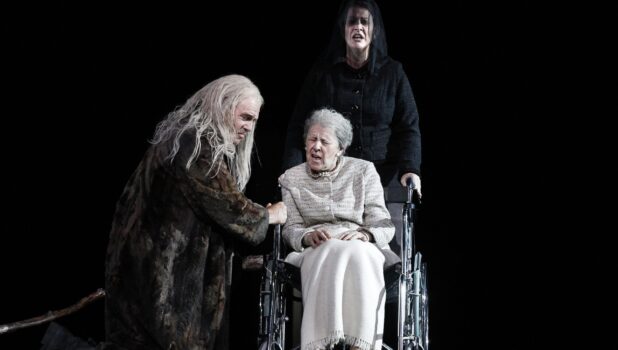
That’s why he uses the most social, the most unquestionable cliché there is: “You have to move with the times.” That phrase has a magical effect. It suggests progress. It asks no questions. It avoids conflict. It is a talisman against distrust. It is also a paradox: Joris says it because he is striving for a contemporary image, but in fact it is his way of not having to keep up with the times. After all, those who keep repeating that phrase will not have to explain where their preferences really lie.
The psychoacoustics of guilt
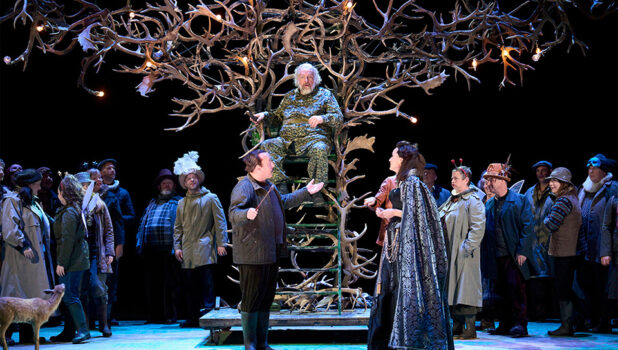
What is happening at Joris is more than taste. It is a clash between aesthetics and status. Authentic opera offers him an immediate emotional reward. The recognition of the story. The idea that music, text, and scene are one indivisible unit. The reassuring clarity of the theatrical contract: if someone is singing about the trees around him in a forest, he is in a forest. Not in a parking garage with a neon deer as an ironic nod to “nature as construction”. And yet with that desire, Joris feels a kind of guilt. As if he is giving in to something primitive. As if he is a cultural consumer who refuses his vegetables and wants only dessert. But opera is not a selective meal; it is an experience. And experiences require surrender, not distance.
“Modernly directed” opera can be sublime – no question. We think of revolutionary lighting techniques, video and even holograms. And this is quite different from directing that does not innovate but replaces: the story is exchanged for an idea of the story. The hideous word “concept” lurks. And Joris – clever as he may be – then misses something essential: the right to be touched without first having to read a distinguished article by a writer from the publicity department who has completed the course “proclaiming nonsense with a smile” with an A+.
The secret pilgrimage to Eastern Europe
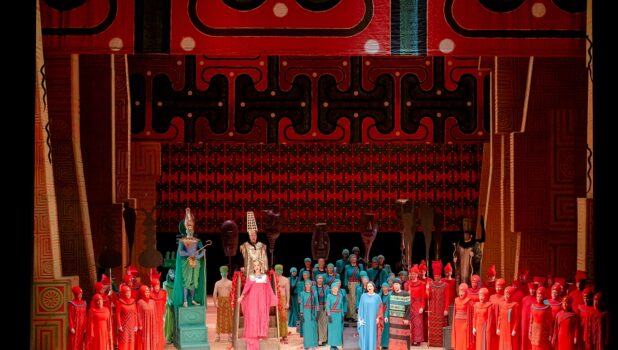
And now it really starts to get interesting, because Joris has a double life. In Holland (or Belgium, France, Germany) he is the modern enthusiast. But in his vacations, something happens. Then he does what anthropologists would call “ritual return,” as if returning to a sacred source. He travels to Eastern Europe because he knows what he can find there: operas that still believe the libretto matters. Performances where singers are not subject to a social statement but are simply characters. And sets that look like someone has actually taken the trouble to treat composer and librettist with respect.
He books for an opera in Bucharest, Sofia, Prague, Riga, Zagreb, Krakow -cities where he strolls around a bit by day and sits in a red-plush auditorium at night with an audience not ashamed to be touched. There, in the dark, he allows himself what he does not dare to do at home: enjoy himself without having to defend himself. He feels no shame when the choir stands in neat rows. He is not annoyed by the lack of irony. On the contrary: he exhales. As if the opera is telling him, “You may just enjoy Das Wahre, das Schöne, das Gute.”
Fear of exposure
But even there, he remains cautious. He takes few photos. He posts nothing on social media. No jubilant review on Facebook, no Instagram story with gold and chandeliers. At most, a vague photo of a square, a glass of wine, a facade. The opera stays out of the picture – leave no trace! Because he can already envision the disaster scenario: a fellow opera lover discovers his outings and says jokingly but viciously: “Do you go for those old-fashioned costume operas these days?” The added laugh makes the label stick.
The core: longing for simplicity is not stupidity.
What Joris actually experiences is a fundamental human tension. Regietheater often requires interpretation, distance, “reading.” Authentic art requires surrender. And surrender is vulnerable.
The desire for libretto-faithfull opera has nothing to do with conservatism but rather a desire for clarity. For stories that are not constantly undermined. For the feeling that you are not being assessed but taken along. True courage is not about “moving with the times,” but about daring to give in to aesthetic, pure pleasure.
Epilogue: a future without disguise?
Whether Joris ever gives up his double life? Perhaps he will forever remain a cultural secret agent: squeamishly modern in the foyer, authentic in the soul. But imagine that one day in that same foyer he suffers an attack of unprecedented courage…. That someone starts talking about “that brilliant alienation” and Joris calmly says, “Beautiful. But honestly? Sometimes I just love an opera that does what the libretto says.” Maybe then the judgment of Today’s People will not be too hard. Maybe someone nods understandingly. Maybe another will confess that he also secretly melts at an old-fashioned Bohème with snow.
Because in the end, opera is not what is offered to us circularly in Western Europe: a contest in progressiveness and incomprehensibility. In fact, it is an art form that has been about aesthetics and emotion for centuries. And that, in fact, is never old-fashioned.
Olivier Keegel