
SIEGFRIED
Siegfried / La Scala April 4 2026
“Only the misanthrope fears misfortune”
Wotan, Wanderer
Siegfried, Act I
SIEGFRIED
Wagner’s Art
Poor Wagner! In his own unrelenting pure creativity, he twitched fingers in somnambulistic agitation, flittered through night’s shadows in gardens, and sifted upon the sands of lost antiquity in an effort to breathe life into the opening bars of music for a new opera. There is not one of his works whose first few notes (this also goes for individual Act beginnings) do not unconsciously bring us into uncharted territory by capturing our reactions, only then to haunt us as they unfold throughout the evening, and also beyond. The Lohengrin, Das Rheingold, Tristan and Parsifal Preludes stand out as revolutionary if only for their bold originality, linked as they are somehow to otherworldliness and the mysteries of Nature. Condensed, all these tone-paintings set the mood in inaccessibly abstract ways and were useful to Wagner himself in unlocking their deeper meanings found in celestial, mystical worlds. As an arresting sensation transformed itself into Art, Wagner followed suit, envisioning the realities of dramatic representation through emotions. Once defined, it was time for the composition of the music, even if at times leading Wagner on by inspiration alone, driving him beyond existing harmonic and chromatic possibilities. A fascinating curiosity might be addressed here – Wagner wrote the libretti of Der Ring in reverse order, not by plan, but rather as arising needs to justify and clarify the mythical tale’s background events leading to their consequences. Thus, we may also believe that while reworking his texts, Wagner was continuing to formulize musical themes in his mind much through pre-conceived intuition.
Coveted Dénouement
This discourse is of importance if we wish to experience the music of Siegfried with any hope of understanding its rarified beauties, its spontaneous evolution, as well as its unique position within the entire Ring cycle. Here, more so than in the other operas of the Tetralogy, Wagner depicts his characters as they partially attempt to regain their souls in apparent makeshift manner, ever evidencing the contemporary malaise of spiritual alienation. Yet they often do so subtly, at times even with underlying surprising humor and kindness, leaving us the chore of reaching into their inner selves, sympathizing by instinct with them through their traumas. The parade of Gods, Men, Supernatural, Chthonic, and Mythical beings marching before us towards their dénouement lay bare their flaws and failures within their societies, cosmologic or not. A stage director needs sense that the visual impact of those moments must both move (identification) or astonish (mystify) the spectator towards liberating catharsis.
La Scala’s Der Ring as staged by David McVicar follows these laws, and this shows high professionalism and respect for Wagner’s basic intentions. He finds no need to superficially modernize or revamp the source material in the hope of illuminating an audience, searching to communicate with us ‘today’. Yet, too, this should never result in either under-representing an opera poorly at times or making over-simplified choices by following all-too-literally Wagner’s own notes or staging indications in the performance score. Siegfried the opera, as McVicar sees it, brings us Wotan, a Wanderer never giving up his plan to maintain Valhalla, partially successful until his spear is smashed by the hero, Siegfried. With a Choreographer and Martial Arts expert on staff, one wonders how this moment could have been managed more clumsily. Wotan stands gaping, leaning awkwardly on the rune-inscribed spear as a charging Siegfried lightly taps the rod which somehow miraculously snaps, accompanied by weak flashes of fluorescent lightning. Ominous music depicts Wotan’s resignation, wherein he will now exit from Der Ring, a victim of his own errors. As related to the psychological portrayals related to the loss of power theme in Der Ring, we find Alberich dethroned as the King of Nibelheim, immortal Erda herself ageing and powerless, insisting that Wotan ask her Norn daughters to help him, and the somewhat obtuse dragon mortally wounded by the hero Siegfried, only to then turn back into the dying giant Fafner as he informs Siegfreid that it is Mime plotting his death. In this production, the archetypes are often called upon to dramatize their inner drives through invented pantomimes. Alberich appears as an Ionesco-inspired ‘shopping-bag’ homeless misfit, guzzling wine from a plastic petrol bottle, his trolly swollen with two golden King crowns and a desk-top globe; his 4½ minute mime ‘schtick’ of wandering about the stage aimlessly does not fill the time allotted – all is too interior, that is until a great moment when he clenches his fist desperately, menacing the world as if still a ruler, bitterly realizing that all has changed for the worse. An aged Erda, sleeping behind a giant ball representing Earth, is rolled into view, her long white wedding-like gown by now grey, her unkempt hair revealing a certain ‘Lebensmüdigkeit,’ She crawls about half-awakening from a ‘dream reality’ that is repeated for others throughout Der Ring. The staging is minimal as is the stage set, and we feel suspended by the very same absence of Time as they do, imminent life defeats does not draw them together as they are frightened and cannot comfort each other. It is an extremely difficult scene to carry off, yet we may however take a message from this scene: the Earth, in its Wisdom, will once again exhaust the once-ruling Gods, abandoning them to their destinies.
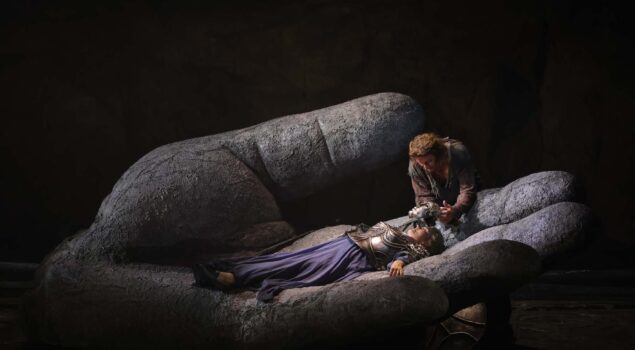
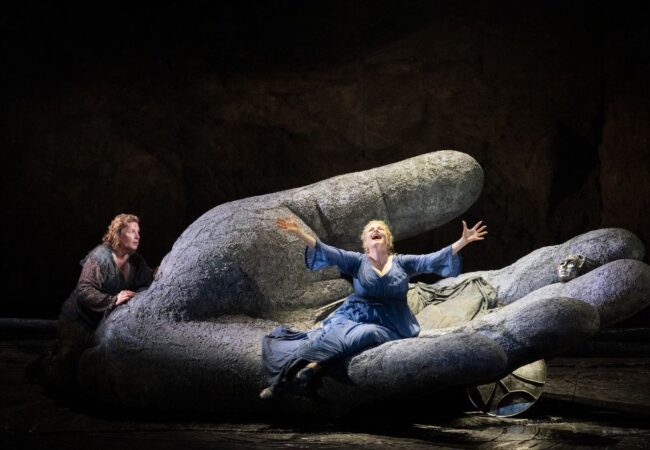
The scene immediately following, ‘Brünnhilde’s Awakening,’ whose representation may well define the musical and theatrical vision of an entire Ring production, unveils great psychological character changes right before our eyes as Siegfried and Brünnhilde emerge from long tunnels of Freudian hangups and move towards Jungian personality individuation. The rush of psychic energy flowing into Brünnhilde through Siegmund’s kiss is captured by Wagner, the Romantic, as no one else might have ever done. McVicar has her raising her arm upon the kiss; an odd gesture, bringing to mind that very same symbolic, pivotal motion a defunct Siegfried will make in Gotterdämmerung when Hagen attempts to remove the ring from his finger. Then she springs up popcorn like to that magnificent one note diminuendo f ˃ p chord played by the entire orchestra. Oddly, she stares at her hands, more like coming out of a coma than being magically awoken – “Hail to thee, oh Sun!” Odder yet, her faithful Grane (left onstage by McVicar) stirs and clip-clops in upstaging her, Siegfried dumbfoundedly starting at him.
Being this the last scene of the opera, and a long one it is, (13 minutes from Siegfried’s approaching the rock upon which Brunhilde sleeps until she wakes bathed in sunlight, then 30 minutes of distraught memories from their pasts mixed with declarations of love) it needed more than just immediate reactions through traditional operatic outbursts. The challenge is always to measure and control one’s gesturing, changing of position, and projecting complicated emotions. This is no ordinary love duet as it encompasses their pasts haunting them in a pressing manner, tearing them from past loyalties to present irrational emotions. What encourages them to follow their instincts is that which comes through a new emotion: fear. Brave Siegfried must overcome the fear that falling in love brings, as to resolve the conflicts he eternally harbors regarding the mother he never knew. Brünnhilde, daughter of Gods, here in love with Siegfreid for the second time, suddenly cannot accept being touched by a mortal, and steadfastly remains the Valkyrie warrior. Both thus go through a process of individuation, the integration of conscious and unconscious elements towards becoming an integral, unique individual through abstract reality. Though staged basically well and acted believably in revealing character depth, there was an abundance of the ‘forced’, a plea to ‘convince’ that was not necessary.
Wagner’s Interior Landscapes
Within the heart of any staging of Wagner’s Ring, there remains a singular, complex element, a primal protective emotion often triggered by detecting a threat, whether to oneself or another. It is ‘fear,’ and in Siegfried above all the operas in the Tetralogy, it takes hold. Almost everyone is seeking to save themselves, and even the budding of human love cannot change destiny’s course. For the rest, they are now all seen as caught up in the effects of that single vile act of more than greed – it was the dwarf Alberich being denied love. His bruised ego may be pinned to an emotion, but there is something deeper, and it is related to Man’s awareness of his fragility, his mortality. Yes, Schopenhauer’s tract, The World as Will and Representation that so captured Wagner’s interest, which brought itself into the throes of Der Ring’s meaning deals with the ills of Wagner’s Post-Industrial society, revealing man’s fear of dying and causing him to pursue power as offering both protection and pleasure. Yet, along with that power, one must deal, promise, compromise, even swindle and kill to hold on to its benefits, thus losing respect and honor for society’s values. In so doing, he voluntarily ‘wills’ his own end, that which he fears most – yes, Wotan’s realization in uttering those harsh, tragic words in Die Walküre: “The End! The End!” (Das Ende! Das Ende!)
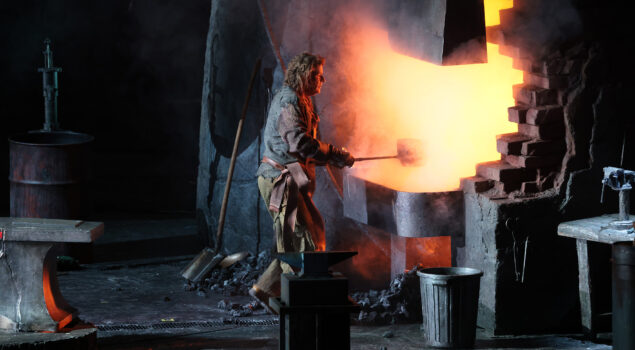
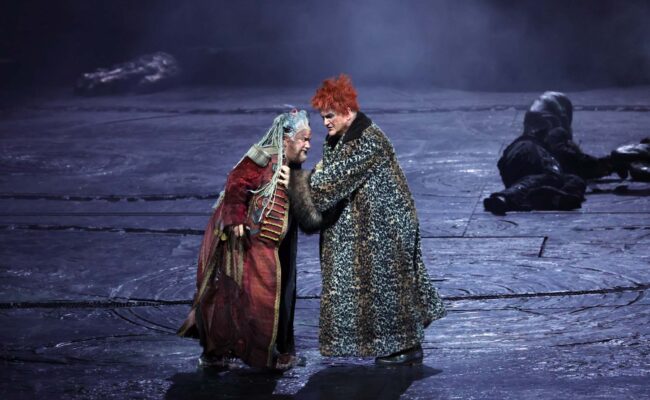
If a staging of Der Ring ever drifts from this principle of Man’s arrival to moral corruption for self-preservation (sounds all-too-Modern, no?), then the ‘dramatis personae’ may pass before us as arche-typal figures from a museum, or those classically drawn, operatic in the unreal sense. The four minutes of the Siegfried Prelude, intriguing and evocative if only for the fact that it creates an atmosphere before bringing us into the sword-forger Mime’s world, a deep forest and home to the gold-hoarding dragon, Fafner. We might ask Mime where he had his Ronald McDonald hair-do done, and where he bought the swanky leopard robe. Still, there are those strange, complicated harmonies that may perhaps represent his ruminations, his brooding, as we are often told. But Wagner never mentioned anything of this while rehearsing the premiere Ring; he was quoted as insisting upon the “scrupulous observation of every accent and dynamic marking,” calling for psychologic motivation that depicts all the forthcoming stage action, characters in their unrest, frustrated energies as created through “… the soft drum rolls the uncanny sensation of uncertain shifting ground.” Instead, McVicar invents an almost schizophrenic pantomime-ballet of frustration and hate wherein a hand knife becomes the sword he has failed to forge, enacting his murder of the dragon. At the anvil, he taps away with a small hammer as would an orchestral percussion player. All was simply out of place, over-theatrical, and creating an atmosphere that betrays the psychic tonal energy of an obsessed, plotting dwarf.
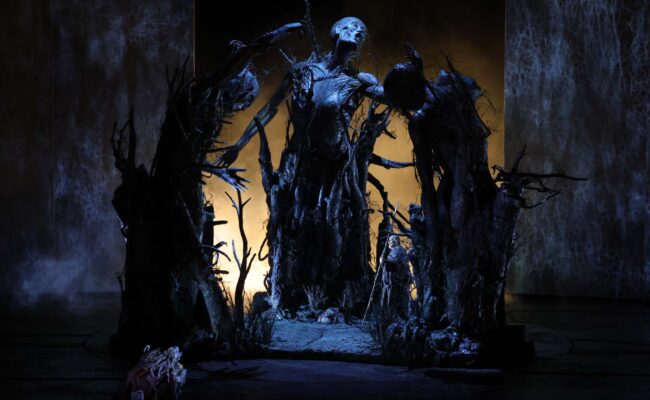
McVicar’s scenic solutions, done with Hannah Postlethwaite, and the handling of the fairytale animals were not enticing as one would have desired for this most fairytale forest episode of Der Ring. Here, yes, the use of technology in some way or another could have brought us into the bosom of Nature, expansive and constricted at will. Mime’s grotto should offer any human his protection in an alien environment, but the stage space is vast. An open-space kitchen belays no character, pizza dough was pounded stage right, and the ever-lit hearth stage left offered warmth. Next, the dragon’s lair yet to be seen was guarded by three tall oak trees, actually figurines of humans, and there were many interpretations to identify them. It did create the impression of being a graveyard at the entrance to Fafner’s cave, and the figures were ghostly, ghastly and gruesome, bent down as if by the weight of war, they depicted a violation of the natural world, by now destroyed, resembling three terrifying post-atomic Butoh (Dance of Darkness) performers. The dragon itself was a scorpion on wheels, 1850’s ‘scene effects’ in looks, coordinated by the underlying eight men in black tights. A large, bobbing human skull, resembling that seen in guarding the gold in the Nibelheim of Das Rheingold. When felled by Siegfried’s sword, it lay flat as an amusement park ride packed up to move on to another city, yet transformed back into Fafner, rising through a trap door. McVicar’s crew included Emma Kingsbury for motley costumes of little impact, David Finn who lit the vast open spaces delicately, S. Katy Tucker for bland though effective video projections. Gareth Mole (choreography) and David Greeves (martial arts) made minimal contributions.
Song and Self-Discovery
Siegfried brings eight characters before us, just about the same performers as in the June 2025 performances. Klaus Florian Vogt meticulously portrayed the boyish hero, by now a role sewn onto him whatever the costume. Once again, he fascinates us by exploring the dramatic and musical nuances of this still-blossoming hero. His youthful gestures belie his immaturity, and the light ‘heldentenor’ rings stentorian in character. Best of all, he changes tone and weight as he leaves the burly boy’s maltreating his ‘father’ Mime to express profound empathy in discovering a sleeping Brünnhilde. The phrasing of Vogt that follows is truly illuminating, sifting through the complicated emotions of Wagner’s text, and changing textures. We learn that it is not just a ‘kiss’ that awakens the Valkyrie, but Siegfried’s renewed fear – of himself, of human love. A woman’s presence before him brings along the sensation of her care, and he calls out for help from his Mother, whom he never knew. The tension, panic even, rises, and Siegfried only instinctively desires to take life from her lips, even at the risk of his own life through emotion. The conducting, singing, and staging here made this the high emotional-point of the entire evening, with Wagner demonstrating his dramaturgical skills in pulling off surprises by inverting a character’s understanding of himself – Siegfried’s newfound sensation of fear…
The multifaceted role of Mime was carried out convincingly by Wolfgang Ablinger-Sperrhacke, though one may differ with moments of over-wrought staging. Recalling that the dwarf is both foster-father and mother to Siegfried, he here almost changes sex to accommodate both roles, and in an all-too-physical way; we see him dressing up as a woman seemingly pregnant, using overt feminine gesturing. Not effectively, we admit, and this is why perhaps Siegfried bangs a frying pan over his head. The range of communication was vast as brought out through the phrasing of each sentence, though it is true that much of this is already in the music. Deep is his understanding of the maleficent objectives he has in mind in order to gain power through re-possessing the ring. In the diabolical riddle scene with Wotan, he was remarkably fresh in his probing Wotan’s meanings, all in the name of saving his head, as too was his delusion and frustration in not learning who would eventually forge the sword Nortung.
Michael Volle, the star of Die Walküre, takes no back seat here. His Godly power is reduced, true, and this may have him appear less as a protagonist; yet he is a listener, even when speaking. Wisdom, this? Erda reveals more to him, he tells Alberich that he is out of the power game for regaining the ring. In a way, we may consider him to be ‘Wagner, the Wanderer’, still attempting to control the destiny of the world, as too, in shaping the composition of Der Ring. Volle is a master at shaping these dialogues, wherein the musical tapestry of the entire Ring cycle, before and after, is hung before our eyes. The voice is rich, expressive, sounding out the psychological Earth upon which he travels. As mentioned before, his Lieder performance skills are apparent, and thus, there is much that is poetic, even in his anguished outbursts. A magnificent portrayal of a suffering God, facing his defeat within an all-too-human world.
Camilla Nylund’s Brünnhilde is well-paced, as it need be for the great 30-minute duet. She truly looks the part of Wagnerian heroines, and her Isolde in last year’s new Tristan und Isolde at Bayreuth was a true success. We must remember this as Isolde is on stage for almost all the opera, while here, in Siegfried, ‘only’ for the last 30 minutes! Coming to know this soprano, one has the feeling that she needs a bit to vocally warm as the evening progresses, true characteristics one imagines of every Wagnerian singer in this role. Subtle was her physicality in leaving her Goddess state to assume that of a tender, human nature. As predicted, the final vocal outbursts were roaring, her ecstatic feelings for Siegfried genuine, receiving the most moving applause of the evening.
The dwarf Alberich, Ólafur Sigurdarson, whose theft of the gold set the action of the entire Ring in motion and the Giant-turned-dragon, Ain Anger, hoarding the gold after felling his brother belong to the slimy greedy category of humans. Both sang convincingly well in portraying their inner frustrations and motivations; total Wagnerian performers we may think. Moving was Fafner’s change of character after being slain by Siegfried, and now, no longer a monster, revealing Siegfried’s death by Mime’s hand as a dying gesture, be it out of a sense of guilt or simply a request for vengeance. The amplified cave-dwelling Giant came off well sonically yet made the performance chilling through his menacing voice. Alberich, here a sort of dethroned King Lear or Richard III, pulls a child’s wagon behind him, and from which he pulls a golden crown that, once upon his head, only manifests his fall from grace. His voice gave depth to his ugly, mischievous, greedy appearance, now a lost soldier, or perhaps circus-master as his coat suggests.
As for the elements of Nature in contact with humans and Gods, Erda, Christa Mayer, and the Forest-bird, Francesca Aspromonte, we understand Wagner’s ability to capture the unreal in all too human ways. Erda’s music as sung (as it was in Das Rheingold) is deeply moving, measured through her accumulated wisdom and noble expressiveness mysterious, here mellow, pensive. The staging did her little justice as she was on the floor for much of her scene, as when standing, also too fixed, lacking appropriate gestures. The Forest-bird rightly tended to lean towards the naive, the childish. Her brisk, truly bird-like bending of the head was a warm touch. She carried a small wooden bird, actual size, to talk to Siegfried, and at other times, a stage dancer flew the bird through the air as if a kite. The voice was well-placed and characteristic of innocence, and here a bit less soubrettish than in the June.
Alexander Soddy, heard again in bringing off the score with flair, offered a truly symphonic version – the big passages never hurried, measured stiffly, but colorful with variations. sprightly version of this chapter in the Ring saga. Actually, his pacing was approximately 10 minutes longer than standard versions, yet the ‘tempi’ were sprightly, flowing and never seemed to drag. His rendition of the Forest Murmurs and Brünnhilde’s love melody (taken from Siegfried’s Idyll, an orchestral piece by Wagner composed for chamber orchestra for his wife Cosima’s birthday) were extremely well-balanced, especially so with the woodwinds. Overall, the orchestra played well, evenly raging through true ff passages, and expressing elegance in phrasing throughout.
All told, an enjoyable, colorful Siegfried, faithful to McVicar’s conception that human greed is at the base of all our actions, as carried out through the virtuosity of the truly Wagnerian performers within that forest of contaminated Nature, so violated by the darkness of the souls of those tragic figures freely pursuing their hidden desires through illusion.
Vincent Lombardo
Vincent Lombardo, American and Italian citizen, was born and raised in New York, where he completed his studies in theatre at the City University, and successively opera studies at the Curtis Institute of Music in Philadelphia. He was a full-time member the stage directing staff of the New York City Opera, collaborated at the Metropolitan Opera as an assistant stage director, studied mime with Marcel Marceau, and took his own solo pantomime performance My Silence to over one hundred universities and theatres in North America. After leaving the conservatory, he pursued doctoral studies in Japanese Noh and Kabuki Theatre at the State University of New York, and staged Gounod’s Faust for the Wilmington Opera, plus numerous State University productions, among them: The Tales of Hoffmann, The Marriage of Figaro, The Magic Flute, and Don Giovanni.
In 1978, he was invited by Maestro Claudio Abbado to collaborate in the Stage Directing Department of Teatro alla Scala, for which he was awarded an International Fulbright Grant. He subsequently continued his tour of My SIlence in Italy, performing in Milan and at the municipal theatres of Cremona, Piacenza, Bolzano, and Ravenna. In 1981, he was invited by Maurizio Scaparro, then director of the Venice Biennial, to perform his solo pantomime ‘Zarathustra Circus’. The Kabuki actor Ennosuke Ichikawa III asked him to participate in the First International Seminar on Kabuki Art in Bologna, organized by ATER.
As a playwright, he has many original plays to his credit, mostly fantasies and fables influenced by Jean Piaget’s exploration of the child’s epistemological learning processes and their relationship to the buried creative desires in adults. Many of them entered the finals of Italy’s ‘Premio Riccione’, and some were performed. He has two published ‘libretti’ to his credit: one being a version of a Heinrich Böll novel, The Lost Honour of Katherina Blum (Sonzogno Ltd., Milano), the other, a between-the-lines-investigation of the Mozart-Da Ponte Don Giovanni, which he projected in an operatic version (Azio Corghi, composer) for the Salzburg ‘Mozart 2006’ celebrations (Da Ponte Institute).
In recent years, he has lectured for the Austrian Consulate in Milan, notably on Gustav Mahler and W. A. Mozart’s Die Zauberflöte . As a musicologist, he has written various articles on the psychology of music for the magazine Musica & Arte – Quaderni del Museo Teatrale alla Scala , directed by Mario Pasi of the Corriere della Sera, and was asked to cover the Bayreuth Festival on numerous occasions.
At the same time, famed stage director Giorgio Strehler invited him, as a playwright, to attend many rehearsals at the Piccolo Teatro. Recently, he has begun to collaborate with the magazines The Classic Voice and L’opera, contributing monthly reviews, but also articles on unexplored aspects of operatic works and history, one such being an examination of the Taoistic elements in Puccini’s Turandot .
In relation to his articles on music and psychology, he was asked to oversee the Italian versions of How the Mind Works (Mondadori, Milano 2000) and Blank Slate (Mondadori, Milano 2004) by Prof. Stephen Pinker, director of the Institute of Cognitive Science and Dean of the Faculty of Psychology of the Massachusetts Institute of Technology (M.I.T.).
Currently, he writes poetry and is active in the stage direction of operatic theatre. Living in Milan, Italy, he travels throughout Europe, contributing essays and reviews for the following online and news-stand magazines: L’opera (Milan), Opera Wire (New York), Opera Gazet (Amsterdam).