row]
Götterdämmerung / Der Ring
La Scala’s closes out its fairy-tale of Man’s greed
“What would live in song immortally,
must in life first perish.”
Friedrich Schiller
“To recall an image from a dream is to know of one’s other mind,
as in restoring an episode of a film, frame by frame.”
Anonymous
Liberties and Responsibilities
In closing out a Ring cycle, Götterdämmerung should be an ‘event’ of sorts. Yet La Scala’s production, as staged by David McVicar, is seemingly weighed down by almost too-simplified representations of the cycle’s climatic moments, perhaps revealing that they are somewhat impossible to realize. Let us not alone hark back to the Valkyrie’s all-too-human acrobat-steeds in Die Walküre, hoofing about noisily on their spring-coiled moon-boots, but bear witness to animals transmuted during the Ring cycle: a bear as a roving trophy-rug, ravens costumed Halloween-like hoisted up and out of sight, gossiping rams and a dragon perhaps escaped from a Chinese New Year’s parade. The true challenges a director must address are those moments that pass before us during any of Wagner’s characteristically long stretches of psychologically-imbued symphonic interventions, preludes and overtures (scene changes or standstill dramatic moments which were not intended to be accompanied by wayward, inserted pantomime action), or Wagner’s monologues anticipating Freud in their retelling of tragic, episodic happenings from an unconscious that must touch upon an audience’s emotions, or highly charged, emotional scenes which cry out for evocative, revelatory denouement, holding our attention until that cataclysmic, prophesied end of the world unravels the Gods – yes, Ragnarök, The Twilight of The Gods.
The premise of this Ring is one: the greed of Gods and Men causing their own downfalls. Though plausible, this is represented principally by the proscenium curtain, reappearing incessantly throughout the evening as smaller scene-dividing backdrops, depicting a blackened open-palm hand protruding towards us menacingly. Is this enough? The scenery was also the creation of McVicar, and it will act as physical leitmotifs sustaining the continuity of the saga as we will see, often over-clarifying the director’s messages. Though surely not an easy task, there were no radical scenic interpretations here, for better or for worse. Through Wagner, then, the operatic characters of this fable-like epic must act as a bridge transforming their legendary heroics into phantasmagorical episodes that supersede reality, not only because they are Gods, but as victims of irrational impulses. Be it here that their acting was more than credible at all times, fervent at white heat when needed, a production’s details (costumes, scenery, and stage action) should have taken us beyond the ordinary, creating outer psychological landscapes that reveal the character’s inner anger and turmoil. The use of pantomime is fundamental in Der Ring, and we read of Wagner’s insistence during rehearsals that certain gestures, as well as an over-all sense of timing, be mastered. How often during the rehearsals of the premiere Ring of 1876 did he ask that all be controlled by ‘sublime calm’ and ‘never any suggestion of hurry’ as ‘sharply-defined leitmotifs hark back to previous events.’ We will recall that our daily relationships to Time today become ever-accelerated though technology, and thus we as must adjust to, say, that 5½ hour operatic kermess known as Götterdämmerung. There are always universal values to be upheld, characteristics of a ‘present’ that may not represent us all, and thus, the choices and interpretations of the stage director must aim to deny us of our pre-conceptions, while also asking for our full attention. We must also hold McVicar responsible for what seems to be his intention to make this Ring generically accessible. While a noble intention, we must conclude that much stage action here is unsatisfactorily pulled off, and at times unnecessary, as if fearing that much of this complicated Nibelungen tale would be lost to the spectator.
Space, Synergy and Solutions
The first criteria related to the theater space housing an entire Ring is to link the landscapes across which the drama will almost unobservedly flow. The main observation is that McVicar’s scenery pieces are too often rooted into the center stage area, and, as placed, remain confined visually ever-present, creating a limited sense of spatial depth. Beyond these elements of rocky heights, globes and walls, there is no panorama to link the acting area to the world at large, save for tall flats as walls or simple masses. Thus all brings our focus upon a lump of a mountain rock, the top part of a swathed globe, a staircase unit, a clump of trees or a series of pillars, around which the singers must repeatedly move in circles. Then, as if for contrast or effect, there is a sudden jump to an empty stage, suggesting at times surreal landscapes in modernist proportions. The revolving center stage disk turns rocks, forests and castles around, true, but often for no other reason than creating movement per se, and rarely in response to the drama’s needs
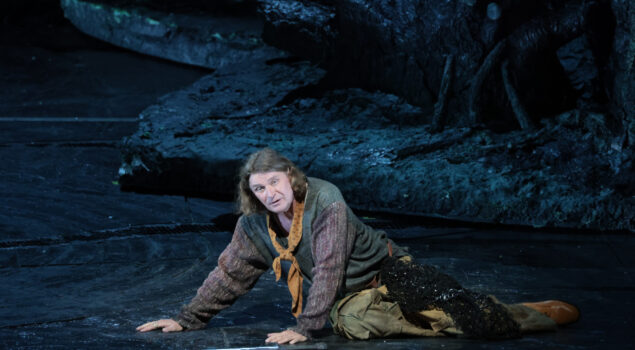
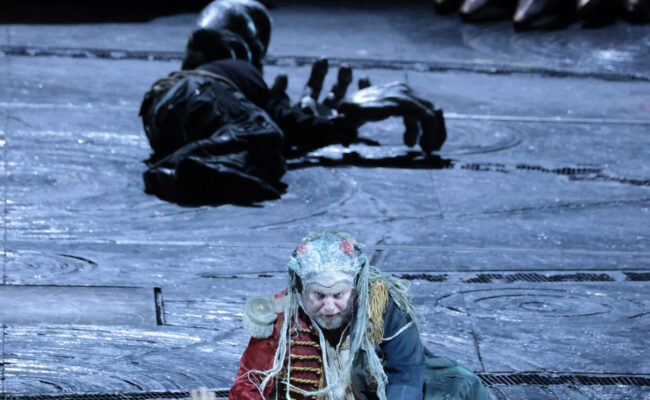
The first two scenes of the Prelude drift about Brünnhilde’s rock (Erda’s prone face, at first thought by some to be Wagner’s plaster death mask). For 16 minutes, we are to watch the Norns (from the Old Norse = ‘to twine’), Mother Earth’s daughters, weaving the rope of Time and Man’s Destinies. It is a scene dense with tension, their telling of Man’s violation of Nature by Wotan’s cutting off a branch of the World Ash Tree to carve out a Rune-inscribed spear, as to the drying up of a nourishing sacred spring. Wotan’s saga of falsehood and trickery in his quest for power unfolds, yet not much is communicated, and sadly this bed-side story in itself loses our interest. Here, garbed in their sober evening opera-dresses, they belie their entrenchment in cosmic history as their physical movements seem reduced to drowsiness without the strains of concentration. The red cord of destiny resembles those thick ropes used to moor huge ships to a pier, and though it may have been effective, the Norns do nothing with it – even at the moment it snaps (here actually made to break as if a strong-man circus stunt) representing the end of the God’s pre-determined existence and the ceasing of the old-world order. In all, the Norn’s braided hair was the only effective touch in a scene devoid of the mythical mysteries entwined in representing the world’s destiny.
The rock revolves about itself, and we return to Brünnhilde’s ‘bed’ nestled within the palm of a stone hand, the very same seen at the bottom of the Rhine when Der Ring began. But it is Siegfreid sleeping there now, and as awoken by Brünnhilde there is an outpouring of most beautiful love music; yet Grane is there, too, upstaging much of the action while being caressed by the Valkyrie. True her close, almost-human relationship is in the text, and we also know of the anti-vivisectionist Wagner’s own great love for animals, yet the illusion of this acrobat becoming a horse is blurred. But then, there is a moving moment when Brünnhilde climbs to the top of the rock to watch Siegfried begin his Rhine journey towards the Gibichung’s Hall: immersed in thought, she stares in anguish at the ring on her finger in horror, understanding that higher forces are at play. We needed more of these manifestations of inner emotions.
The First Act brings us within the halls of the Gibichung’s palace. Again, we have a large piece of scenery in the center stage area: the top half of an immersed swaddled globe, perhaps ceremonious furniture and a symbol of power, and taking up much space. We mention this as almost most of the action in this scene, the monologues also, takes place atop it, creating monotony. A huge semicircle, Medieval upstage wall, its doors half-open, constitutes the residence, wherein two space-dividing walls made of bones (their enemies? a symbol of their corruption?) close in on us. The staging here holds its own, establishing the relationships between the brothers and sister, Hagen, Gunter and Gutrune, and their manipulation of the gullible Siegfried. A simple touch reveals the psychology of Gutrune as she embroiders a long sash that will remain upon the globe for the whole scene, representing it seems her domestic simplicity and willingness to marry. Yet, Gunter and Hagen have no such traces of personality characteristics, and they must remain standing all the time, as does Siegfreid.
We are then brought to Brünnhilde’s rock again, where she is now visited by her sister-Valkyrie Waltraute, whose monologue is one of the most memorable in all of Wagner, perhaps most of all for the text. And not because she acts as an affectionate go-between in her sister Brünnhilde’s interests, nor because she asks her to restore the Ring to the Rhine, but for the sincerity and decency of her human principles. She has disobeyed her father Wotan out of her desire to save the Gods by asking that the ring be returned to the depths of the Rhine, and she movingly tells Brünnhilde how a sleeping, whispering Wotan asked her to. Now comes a brief moment of great theatrical effect. As in Greek Tragedy, when news is brought to us by a messenger (Waltraute) telling of what we have not seen on the stage, we hang on every word in frozen concentration. Wagner offers us a saddened snippet of Freia’s ‘golden apple’ music, symbol of the font of the God’s longevity, and Brünnhilde, who justly had remained rapt in listening, sits on the ground before her sister, back to the audience, and we can only look to Waltraute’s face, so warm in happiness for her father’s moment of peace. In all but a sentence she tells her sister “… when his two ravens return, and bring him good news, then for the last time would he smile.” The horns emit a noble, melancholy theme, marked pp, and then suspended in continuous diminuendo. In a small way, this is what opera alone can create, music offering the sung word its fullest expression. This is especially effective in the music of the short scene that follows. Siegfreid, disguised by the Tarnhelm is acting for Gunther, who will become Brünnhilde’s groom. The rock rotates again for the last time in this Act, the palm upon which the Valkyrie slept in now tragically broken into pieces. The effects of Siegfried’s almost ventriloquist voice and the power of the music depicting Brünnhilde’s faithfulness and refusal to part with the ring carry the scene. The acting was noteworthy.
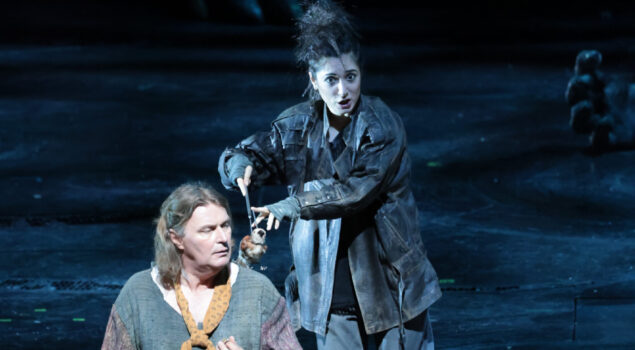
The Second Act as written by Wagner is as conservative as much operatic action, yet also the most psychologically trying as the rapid turn of events take place with great emotional force as sentiments clash and uncontrollable rage erupts. There, too, what with a rousing chorus, a double-wedding in course torn to shreds as the Gibichung clan’s deceitful plans are exposed by Brünnhilde through her frustrations in not understanding why Siegfried now wears the ring taken from her by a mysterious man (Siegfried disguised as Gunter) who braved fire to reach her. All will lead her to joining Hagen and Gunther in vowing revenge through powerful, menacing music even by Wagner’s standards. The staging captures all the tensions inherent within the music, especially focusing on Gunther’s presence as his buried humanity rises to the surface, pleading not to partake in the plot to kill Siegfreid, though his weakness of character has him giving in. In a distant way, the libretto is here almost as concocted and unbelievable as Verdi’s Il Trovatore, laden with improbable twists of Fate leading to tragedy.
First off, we find a troubled Hagen during a nightmare, or so it seems. His father Aberich, robber of the ring who sold his soul for power, appears through whirls of morning dew as if an image in Hagen’s dream, only to speak as if he also were sleeping. All is conveyed in a Jungian ambiance as their unconscious wills relate to the principles of ‘persona’ and ‘masks,’ wherein even they must justify themselves in acting out their roles through society’s laws. It is effectively staged, as even a guilt-ridden, perturbed Alberich appears in a would-be straight jacket. The depths of their Shakespearean ‘strange mechanism of the mind’ plotting surface as they focus on their mission to regain the ring of power. McVicar’s scenery picks up on this: five pillars are topped with masked faces, recognizable Gods entangled in Wotan’s struggles as already seen throughout this Ring. The effect is totally surreal, and there are strong touches of Salvatore Dalí. Wagner is interested in other priorities, and through the music he suggests their deceits and betrayals are about to burst forth. A wonderful canon for eight unmuted horns representing the arrival of dawn’s light brings forth a huge skeleton skull, wheeled in at snail’s pace, a premonition of impending doom. This is followed by a chorus invited wedding guests, here accompanied by a dozen dancers with Kendo ‘shinai’ sticks. McVicar uses them for effect, yet one of Wagner’s most potent group sings need not the robust banging of sticks upon the stage to prove their force to us. For the rest, the nuptial scene was well-handled, with all its tension and misdeeds revealing Siegfried’s betrayal, which we know was caused by a magic potion that had him falling in love with Gutrune. Now, the vengeance trio is in full stride, and Brünnhilde, Hagen and Gunter take the oath that will have Siegfreid die. The Valkyrie is so totally confused, wounded in sensing Siegfried’s betrayal that she reveals his only weak point – his back.
Reinventing revelations
The series of eventful scenes of the Third Act leading monumentally to the end of the cycle should dutifully and directly unwind what the Gods and men created by destroying the natural order of the world. The expected Apocalypse is visualized, yet should not totally bring on a catastrophe as the Greek word ‘apokálypsis’ means ‘revelation’. Our experience in the theater today almost always means unnecessary action, invented in weak attempts of make the scene even greater. Sad, because Wagner’s music creates the action as the melodic unfolding of leitmotifs heard thus far find their place within the universe of Der Ring: the Rhine maidens now must convince Siegfried to restore the ring to Nature; Hagen’s hunting party is organized to locate and kill the hero Siegfried; the Gibichung brothers die, and their sister Gutrune is destined to mourn. And then, most of all, the order of the Gods will end as their castle burns into extinction. McVicar avoids superficiality, distortions, and the all-too-personal displacements which often tragically destroy the essence of the original creation itself, yet adds a plethora of un-needed touches that contrast with the music itself.
The Rhine maidens’ scene is 16 minutes long, and here something must be visualized in order to avoid their appearing monotonous, while also bringing us back to their underwater paradise of Das Rheingold. Gone are games amongst themselves, as with teasing the hapless Alberich in his amorous pursuits. Here, they are moving less sprightly, all too realistically, even, and though we may feel that they too have lost a love-for-life without the presence of their gold, they no longer create sensations akin to their underwater presence. Siegfried also is land-locked, and blue lights alone do not convey the depths of their world.
Hagen’s hunting party wanders across a bare stage of a forest, with a huge boar hung by its feet above the stage. Hagen’s spearing of Siegfreid is not credible as the hero hardly turns around enough to watch those Batman-caped ravens flying off to Valhalla. Then, we come to a most questionable staging of Siegfried’s ‘Funeral March,’ wherein Sieglinde and Siegmund returning from the beyond; she with a 20-foot-long white linen shroud used to symbolically embalm the son she last saw while giving birth. Then, for seemingly hours, the parents break into tears, their bodies shaking violently in emotion. Wotan the Wanderer also returns, broken spear in hand, approaching Siegfried’s corpse, then only to fall to the ground in shock upon discovering who has been killed. None of this was needed.
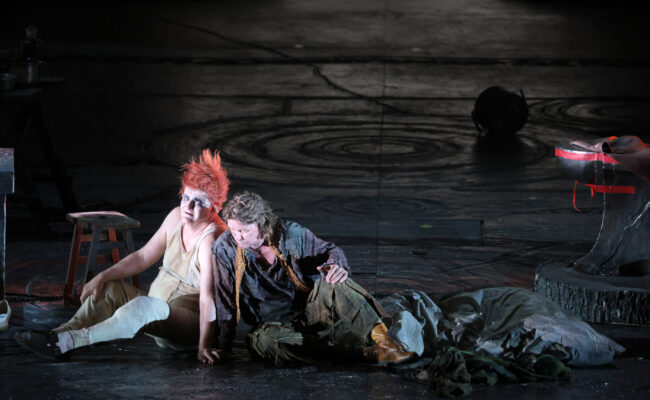
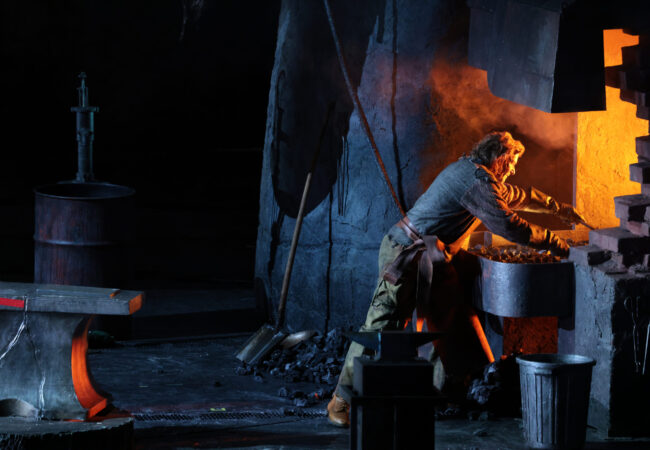
The last pages of the score blaze with McVicar’s modifications, and in quick succession. Brünnhilde grabs Hagen’s spear from his hands, pushing him down to the ground, then igniting the ring backdrop curtain which catches fire. Grane the acrobat has his metal head apparatus removed, and he walks to his Valkyrie goddess for hugs, until, child-like they run to kneel at Siegfried’s pyre. Flaming screens close in on their immolation, and an atomic bomb, video-game combustive explosion image destroys the universe. The stage becomes blue, and we are on the river bottom of the Rhine. The dancer representing the gold returns, ever-twirling, and the Rhine maidens rush in on their leitmotif only to circle him somewhat emotionlessly. Hagen arrives for his “Keep away from the ring!”, and in grabbing the dancing gold is pushed away, again falling to the ground all too easily. Then, the cherry on the cake: a succession of uncalled for characters pop up, as if in an Alain Resnais film. The Valhalla staircase appears, and we see a shattered Wotan again, sitting at the top. We know full well he will roll down gratuitously to the bottom. Wait! There is another message. Alberich strolls in, perhaps joyfully, stepping towards the gold which caresses him peacefully, and as in forgetting those bygone times. The background scrim of that menacing black hand appears, only then to fade as, in silence and approaching darkness, the spinning gold disappears into the depths.
Meritorious singing-actors
Attending a Ring populated by great artists is indeed rewarding, and such was the case with this version of La Scala. Those “actors able to sing,” as Wagner called his vocal artists were just that. However, in this Ring, they were asked to fill in the time and space laid bare by the directing, having them move to and fro in over-emphasizing their reactions with stock gestures. Nor did the costuming help as it was consistently hybrid through the Tetralogy. Yet, we must also state that the strenuous demands of physically engaging in their demanding roles were in no way evident, and that it was pure theater that came across.
The Norns (Olga Bezsmertna, Christa Mayer, Szilvia Vörös) and the Rhine-maidens (Woglinde/Lea-ann Dunbar, Wellgunde/ Svetlina Stoyanova, Flosshilde/Virginie Verrez) were matched up evenly, but sometimes wore upon us by the lack-luster staging, as mentioned. The Gibichung hoard here were the family Wagner might have had in mind: King Gunther (Russell Braun), Gutrune (Olga Bezsmertna) and Hagen, the dwarf Alberich’s son (Günther Groissböck). The bass of Groissböck offered endless, energetic volume, probing and perturbing in his portrayal of this frustrated, threatening yet insecure man, an ever-present evil character.
Gutrune came across as the simple, delicately weak woman, betrayed and deceived as she was. The scene in front of Siegfried’s corpse where she realizes that his love for her was under the influence of the portion, and that Brünnhilde was his true bride created that dramatic standstill of a moment that Wagner sought. King Gunther, a complex character, ably manifested his confusion in at first going along with Hagen’s plot to kill Siegfried, only to agree to deceiving both his sister and Brünnhilde. His vocal portrayal was characterized by deep psychological entrenchment. The dwarf Alberich (Johannes Martin Kränzle) returned as that ‘little man’ among us who after being mocked and turned down as a lover seeks vengeance upon the entire world. An important character, he appears and reappears throughout the cycle. His ‘dream’ encounter with Hagen was resonant and possessed him through all the complications of guilt his theft of the ring in Das Rheingold have brought about to the world. In all, a consistently well-balanced character portrayal, The Valkyrie Waltraute (Nina Stemme), a true Wagnerian singer, was genuine in pacing the of her discourse, perfectly pitched in intensity, heart-felt; in all, a sensitive reckoning.
As with all the cast, we were offered many of the best Wagnerian singers performing today, and Siegfried (Klaus Florian Vogt) and Brünnhilde (Camilla Nylund) did indeed render this Götterdämmerung memorable. They were harmoniously matched as to voice and stage presence. This may sound trite, but it is not always to be expected, given the sheer super-human force of energy required. Vogt’s tenor has convinced us in many roles, and not only those Wagnerian. There were no signs of reaching out for notes, all seemed effortless, yet dramatic, as too his stage appearance easily lends itself to Romantic heroic roles. His death scene contained all the emotions of one facing the end yet happy to have loved. Nylund indeed carried the show as it should be, proving throughout the entire Ring to be all of a demi-goddess and immortal shield-bearer. Seen and heard throughout the world, her Brünnhilde in many ways carries the register, energy, and volume needed for this grueling of roles – so entrenched is she in Wagner’s most moving portrayal of the woman who by sacrificing herself, will allow love to rule the world again.
Maestro Alexander Soddy, as commented upon with reference to the preceding operas of the cycle, brought off what is dramatically gripping in the music. This entails pacing, and most of all, a sense of Wagner’s theatrical instincts, wedding music and drama. Thus, the brass snared and lamented when needed, as the strings led us on through true ‘glissando’ and moving ‘pianissimo’ at all times. The preludes, overtures, scene-changing orchestral stretches throughout Der Ring, as well as Siegfried’s ‘Funeral March’ and ‘Rhine Journey’ were all of great interest, and one was diverse from the other interpretively. In the future, Maestro Soddy will surely bring more variety and flair to the demands of the score, as expected in a normal growth process of any career. The La Scala chorus, led by Alberto Malzzi were true to standard as one of the best in the world.
As stated, the scenery was dutiful yet not always engaging to the eye, the costumes (Emma Kingsbury) too motley (rambling from the Shakespearean to the post-Punk – the stage director’s will, one imagines), the lighting (David Finn) well done, the video effects (Katy Tucker) less so, though the flames and nuclear explosion as the world seems to end were captivating. The mimes, actors and dancers indeed put their best foot forward in executing their at times difficult personified routines. The horses, ravens and rams were sources of disturbance, uncompelling, yet through no fault of their own.
Vincent Lombardo
Vincent Lombardo, American and Italian citizen, was born and raised in New York, where he completed his studies in theatre at the City University, and successively opera studies at the Curtis Institute of Music in Philadelphia. He was a full-time member the stage directing staff of the New York City Opera, collaborated at the Metropolitan Opera as an assistant stage director, studied mime with Marcel Marceau, and took his own solo pantomime performance My Silence to over one hundred universities and theatres in North America. After leaving the conservatory, he pursued doctoral studies in Japanese Noh and Kabuki Theatre at the State University of New York, and staged Gounod’s Faust for the Wilmington Opera, plus numerous State University productions, among them: The Tales of Hoffmann, The Marriage of Figaro, The Magic Flute, and Don Giovanni.
In 1978, he was invited by Maestro Claudio Abbado to collaborate in the Stage Directing Department of Teatro alla Scala, for which he was awarded an International Fulbright Grant. He subsequently continued his tour of My SIlence in Italy, performing in Milan and at the municipal theatres of Cremona, Piacenza, Bolzano, and Ravenna. In 1981, he was invited by Maurizio Scaparro, then director of the Venice Biennial, to perform his solo pantomime ‘Zarathustra Circus’. The Kabuki actor Ennosuke Ichikawa III asked him to participate in the First International Seminar on Kabuki Art in Bologna, organized by ATER.
As a playwright, he has many original plays to his credit, mostly fantasies and fables influenced by Jean Piaget’s exploration of the child’s epistemological learning processes and their relationship to the buried creative desires in adults. Many of them entered the finals of Italy’s ‘Premio Riccione’, and some were performed. He has two published ‘libretti’ to his credit: one being a version of a Heinrich Böll novel, The Lost Honour of Katherina Blum (Sonzogno Ltd., Milano), the other, a between-the-lines-investigation of the Mozart-Da Ponte Don Giovanni, which he projected in an operatic version (Azio Corghi, composer) for the Salzburg ‘Mozart 2006’ celebrations (Da Ponte Institute).
In recent years, he has lectured for the Austrian Consulate in Milan, notably on Gustav Mahler and W. A. Mozart’s Die Zauberflöte . As a musicologist, he has written various articles on the psychology of music for the magazine Musica & Arte – Quaderni del Museo Teatrale alla Scala , directed by Mario Pasi of the Corriere della Sera, and was asked to cover the Bayreuth Festival on numerous occasions.
At the same time, famed stage director Giorgio Strehler invited him, as a playwright, to attend many rehearsals at the Piccolo Teatro. Recently, he has begun to collaborate with the magazines The Classic Voice and L’opera, contributing monthly reviews, but also articles on unexplored aspects of operatic works and history, one such being an examination of the Taoistic elements in Puccini’s Turandot .
In relation to his articles on music and psychology, he was asked to oversee the Italian versions of How the Mind Works (Mondadori, Milano 2000) and Blank Slate (Mondadori, Milano 2004) by Prof. Stephen Pinker, director of the Institute of Cognitive Science and Dean of the Faculty of Psychology of the Massachusetts Institute of Technology (M.I.T.).
Currently, he writes poetry and is active in the stage direction of operatic theatre. Living in Milan, Italy, he travels throughout Europe, contributing essays and reviews for the following online and news-stand magazines: L’opera (Milan), Opera Wire (New York), Opera Gazet (Amsterdam).