
Pelléas et Mélisande
A Perplexing ‘Succès d’estime’ for Debussy at La Scala
“The world is a generalized form of the spirit,
its symbolic picture.”
Novalis / Otto Rank, Art and Artist
“It is the dream itself that decides whether or not
to leave us its vanishing traces as we awaken.”
Anonymous
The Fragilities of A Mystery
There is truly something in the air at the conclusion of every performance of Claude Debussy’s Pelléas et Mélisande, and as sure as can be, it is always that uniquely emotional sensation of having all that we attempted to grasp during the performance just slip away helplessly as if the mere whispers of an ebb tide. Theatrical reality can be as fragile as that, yet as a reflection of life and our identities, it must always in some way make a solid statement through the actions of the characters, a testimony to their adherence to life itself in all its mysteries and complications. Thus so, having shared within ourselves the reactions to those dramatic events perceived as lying somewhere between us and the stage, we are purged through catharsis and ever rewarded through an eventual deep sense of resolution, of hope, as too accepting a realization of failure, a sense of guilt, all leaving us with uncertain ideas of both our past and future. It is a difficult opera to understand first off, to come to appreciate in its being rather long, post-Wagnerian in its complicated use of symphonic leitmotifs, claustrophobic, yes, in its atmosphere, and so challenging to represent on the stage.
The composer Debussy understood all this when encountering the dramatic art of Maurice Maeterlinck as it would allow him to express the socio-psychological values his music already contained. The poetic humanity hidden within the play’s enigmatic word utterings and those outbreaks bordering on silence as a surge of emotion allowed the composer to underscore the evasive semi-dialogues wherein his music embraces all of what the characters never say, being also that which others in their presence fail to understand. It is the same for the opera-goer who, even though he can now follow the exchanges through subtitles, remains puzzled not by the plot development per se, nor for the character’s motivations, but for the seemingly illogical manner in which they choose to express themselves in both evasive and allusive manner. Let us recall that this masterpiece is all too often associated with Impressionism and Symbolism in a superficial manner, as also with the world of dreams so often emerging from beyond gauzy scrims partially obfuscating already vague and cryptic ambiances, be they imbued in Nature or surrounded by Medieval relics. This is all-so-characteristic of Debussy in his other ‘fin-de-siècle’ creation, Le Mer (1905), in which we may find clues for entering into the imaginary kingdom of Allemonde, however distant it be from our realities. Let us not forget the ever-present symbolic relations to flowing, yet unstructured water, floating as if commanded by rhythm itself. In his recollections, Debussy wrote of a distant sea as being only “infinite memories, worth more than those of the reality which suffocate our thoughts.”
Here, as in the world of Pelléas et Mélisande, dwells Art and the scenic resources of a shamanistic space waiting to be filled with psychological nuance floating upon harmonic resonances and rarefied chords. Thought of in this way, all is indeed Proustian in its concept of individual consciousness as related to memory and its failure to reconstruct the present. We have come to understand that dogmatic attachments to the realities created by artistic movements and their manifestos have very little to do with their own world of dreams as transmuted into a state of reverie and its at times anguished realities. For many, their own recollections of any first-hand experiences with Pelléas et Mélisande have them often believe that they must still wait for a production that will shed new light upon the opera’s true essences, whether related to our times or not, while also illuminating us as to what aesthetic values may be taken from the world in which those removed characters breathe. And then too, it is an opera of great contrasts, lengthy as drawn out over fifteen scenes, all mysteriously passing by as a silent parade absorbed in its own subtle droning, all seemingly slow paced, monotonous music. Magical is Maeterlinck’s creation as a fairy tale in a world of make-believe, yet macabre, as all Grimms Brothers tales tinged with phantasmagorical shadings in the manner of an E. T. A. Hoffmann exploring the boundaries between reality and the subconscious. Debussy’s efforts belong as much to a world of delicate hues as to the stark realities of black and white. The text is shrouded in its own mysteries, ever evocating subtle revelations as within disappearing morning clouds.
Translucent Atmosphere and Ambiguity
As the visual artist he defines himself to be, we have come to expect from Romeo Castellucci his brand of technological imagery, creating somewhat rarefied effects leaning heavily towards Minimalism. Before commenting on some of his directorial choices, let us examine the essentials of Castellucci’s own ‘Gesamtkunstwerk’ approach, wherein he often covers the roles of scenographer, costumer, and lighting designer. Be it pure theatricality or a sense of beauty that he is pictorially striving for, hints to the messages and meanings of the text must surface, and so they do here, right from the opening of the opera. There is no velvet red La Scala curtain, just a darkened fish-net scrim which will naturally separate us from the stage. Be it known that Mélisande herself will break that ‘fourth wall’ in the first scene, crawling under it in a sheepishly embarrassing manner. Before the music begins, we have here yet another gratuitous ‘pantomime’ bit, nowadays an almost obligatory director’s intervention: morning bird callings, followed by an infant’s piercing crying, then a nude, ballerina-like figure letting a metal object drop from her hands with a clunk to the stage floor. The birds may represent the forest revealing the mysteries of Nature, the infant perhaps Mélisande’s unborn creation, and her crown, a sure link to her real-world prison, let mysteriously fall into a spring. On the theme of water, we will return as it is so important to Maeterlinck and the Symbolist movement, here picked up all-too-literally on repeated occasions by Castellucci. Be it so, this pre-Prelude bit could only distract spectators, redirecting them from entering into Maeterlinck’s milieu through that tonal mist created by Debussy’s first notes. The composer knew full well how to represent this complicated, restless, delusional world, and thus these trifle effects failed to bring us into that distant, symbolic kingdom. The Prelude’s music purports three ‘leitmotifs’ – Golaud’s theme of manly possessiveness, Mélisande’s enigmatic personality as haunted by a mysterious past, and then the primeval forest, otherworldly as Dante’s ‘selva oscura’ in its suffocating gloom of shadowless agitation. Let us not forget that Debussy, the anti-Wagnerian, did pick up on the use of leading-motives that we will identify through the opera, and with indirect references to Die Walküre, Tristan und Isolde and Parsifal.
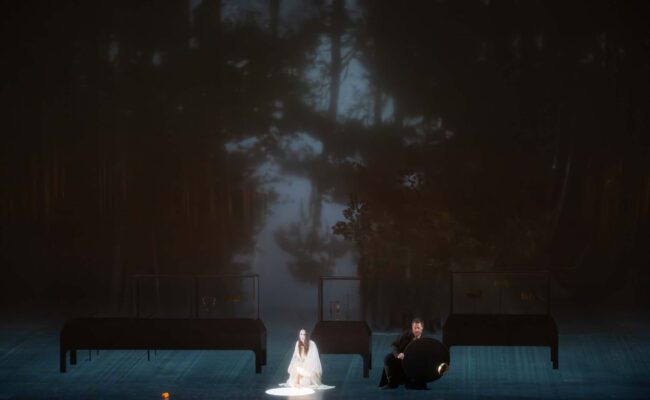
As lighting must create both atmosphere and emotion within theatrical settings, and especially for an opera as abstract in its remoteness as this one, we would expect even more as the fifteen scenes spread across Five Acts must contain its own luminary leitmotifs in a memorable way, perhaps novel through visual sentiment. This does not happen here as the Minimalistic effects akin to Castellucci’s known systems of highlighting objects often leave us with surrounding bare space, with hardly any hints to a stagnant castle’s atmosphere, nearly half the scenes, or surrounding woods where no light penetrates the foliage. On La Scala’s enormous stage, a sense of emptiness at times becomes slightly over-bearing, especially as that which remains does not catch the eye in an enchanting way, nor create lasting impressions as it should during this fairy-tale. There is much of the child’s world in Maeterlinck’s text and Debussy’s music – think of the composer’s Suite for pianoforte, Children’s Corner. All of the opera is minimally limpid, sparse, and a forcefully essential look takes on déjà vu proportions. But the ambiance asks to be in some ways populated, haunted perhaps, animated with a plethora of gestures, invisible movement if you will, as to embody a remote dream landscape for its strangeness alone. Here, we have moment after moment where light was focused on objects seen as if ‘illuminated for illumination’s sake,” and indeed the progress of the tale in itself is compromised. Yes, there were those Minimalist fluorescent bulbs hanging vertically, then two oranges on an empty stage hit by lights making them appear as little suns, or a chalk-white medieval bobbin floating in space, one foot above the stage, and more.
Our operatic experiences now tend to accustom us to a sparseness of ambiance, lit as be willed, perhaps with a singular, almost surreal object which should have a meaning, yet asking much in interpreting the motives of Castellucci who claimed in an interview that he wanted the audience to participate, to be free to imagine, concentrating on giving meaning to what was being witnessed. There is too much esoteric personalization, however, and all drifts into other realms of diverse historical contexts, far from the original, wherein much is substituted with meaningless, allusive comments. Often, we can only second-guess him, which, for some, becomes tiring over the span of a 2½ hour performance. Or, as many do, delight in the visual, accepting imagery as imagery itself. Suffice it here to examine the forest scene that begins the opera. Mélisande drops her metal Princess crown, but then, in a tree-less forest, we face a suspended white, seashell-like bobbin with threads suspended as if in nowhere. It will transfer itself to the second scene, a room in the castle, metaphorically resembling that sort of monolith from 2001, A Space Odyssey, obsessing us as it leads humanity onwards towards infinity. We can imagine that very few in the audience knew that the bobbin was perhaps substituting the crown of the Princess for a primal, subconscious symbol of a realm. And yes, too, it is also the power of fate spinning, that thread of human life dooming the lovers to their inescapable end. We also believe the bobbin symbolizes Maeterlinck’s seemingly timeless, suspended dream-like reality, swayed by the flowing Impressionistic score permeating the subconscious mind in lieu of a physical location. But here, the bobbin accepts its thread of embroidered letters coming from Golaud’s letter, enlarged and suspended in space. An interesting idea, yet once the immediate visive effect wears off, it is indeed a static scene; the threads-words as sentiments from a distant son take second place to the mechanical action of extracting them. In another scene, surreal to be sure, a large steel-roll industrial wringer is wheeled in. Though not essential, nor purposedly used, it churns as the elder King Arkel in a long ‘Wagnerian’ aria reclaims his health, and wishes to see Mélisande also happy, escaping that pallid grip of death by kissing the young lady’s cheek. Here, one wishes so that it all took place in a castle, where dark, somber medieval rooms hide thoughts or forgotten monologues.
The Unexamined Opera
Castellucci’s manner of shaping scenes is to put all in a visual vacuum, affording us hints of his interpretation through certainly aesthetic visions of physical beauty, yet the effects are not always accomplished and in syntony. Bordering on the surreal as Maeterlinck did, Castellucci often fails to bridge the gap from realism to the illogical unconscious, stripping away everyday logic to explore the subconscious, unseen forces, and the terror of the unknown. As Debussy’s suggested melodies were merely textures rather than a string of notes, the composer in this way follows the text, and even captures its essences in his own musical form. The stage director appears here to be doing the contrary, in having scenic encroachments that mount up one by one only to misbalance the whole. La Scala’s own video trailer sums this all up, and though it is indeed inviting, it reveals in its own way the balance between black and white, light and darkness wherein dream tussles with nightmare as separated from the whole. We are indeed being asked to react on our own, to abandon ourselves to immerge in the mechanics of pure theater, our contact with the life that surrounds us. In all, one senses an opera dressed as drama and music, moving, over-lapping, even floating about invisibly the physical world there upon the stage. Richard Strauss’ incongruous ‘pastiche’ Ariadne auf Naxos comes to mind. We must sense the ghosts of both realities in Pelléas et Mélisande, perhaps not knowing as spectators which one to give precedence to. As Socrates warned, a life lived without critical reflection lacks true value and meaning: “The unexamined life is not worth living.”
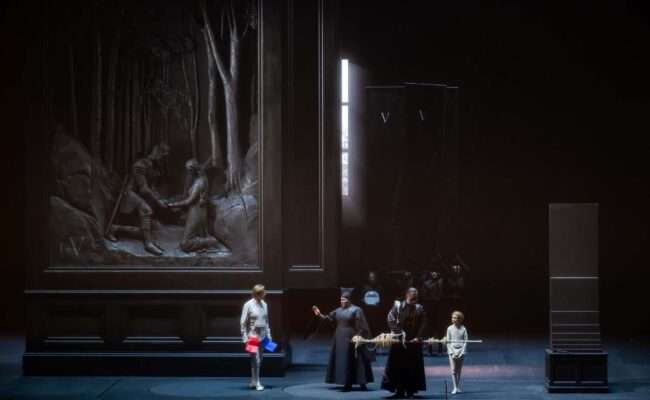
We began asking questions in Act , scene Two, as we were brought into a room in King Arkel’s Castle, months after Prince Golaud and Mélisande met, to then be married. This open space is soon crossed by moving walls, one upon which is chiseled with the remains of a lizard-like prehistoric reptile, the other with the iconic Pelleas and Mélisande themselves immortalized in a scene from the opera; marching back and forth we have foot soldiers with tall standards with the Roman numeral ‘IV’ (later ‘V’), which we also find in the bottom left corners of the bas-relief stone tapestries, and which will reappear throughout the opera. The letters cushion our brusque contrast with antiquity, representing the enigmatic nature of language and destiny in the opera, as also representing Maeterlinck’s original play wherein the disjointed fails to articulate his character’s true feelings.
As for the physical objects integrated into the opera’s progression, we find oranges just about everywhere, two goldfish bowls as a substitution for the fountain in the park, and a long blue ribbon attached to Mélisande’s wrist for the cavern scene. Oranges and circular forms may be seen as symbols of the subconscious character of the opera, representing life’s cycles of life and hidden illusions, though one may doubt that they will always be decodified as such in the spectator’s imagination. Mélisande holds one in the tower and often carries a basket of half a dozen, which will at times spill out, only to be clumsily gathered up as repetitive actions resembling post-Expressionist dance theater. The two ‘goldfish’ bowls never become a symbol of the fountain for many of us, nor does Pelleas dousing Mélisande with its water, as she likewise him, perhaps representing for some a baptism, or an act of purification. Nothing is truly mysterious here and much seems out of place. The long ribbon on Mélisande’s wrists in the cavern serves as a security device if nothing else (Arianna’s thread?) so as to avoid getting lost in Nature’s unknown world, a safety device for sure.
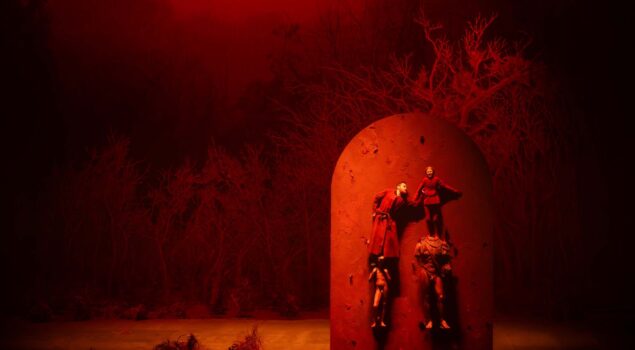
As part of the set itself, Castellucci’s designs integrate his willingness to capture an image seemingly diverse as unrelated to the text at hand. Golaud’s bed is hewn into rock, near another wall mass with his silhouette cut out, and into which, naturally, he will squeeze himself arbitrarily. He stays there for a moment, and in truth, there is no dramatic accomplished effect. If anything at all, his restlessness and inner turmoil is hinted at. In another scene, we have stone again, a sort of monument, a tombstone even, upon which Golaud will lay prone with his with his son Yniold. In a terrifying scene that ensues in a blood-red garden, the stone rises, and both father and son stand upon the heads of embedded figurines as the father drives the boy to spy on Pelleas and Mélisande. Surely, one of the best scenes in this staging. Yet we realize now, perhaps, that the act of image creating does not mean staging an opera.
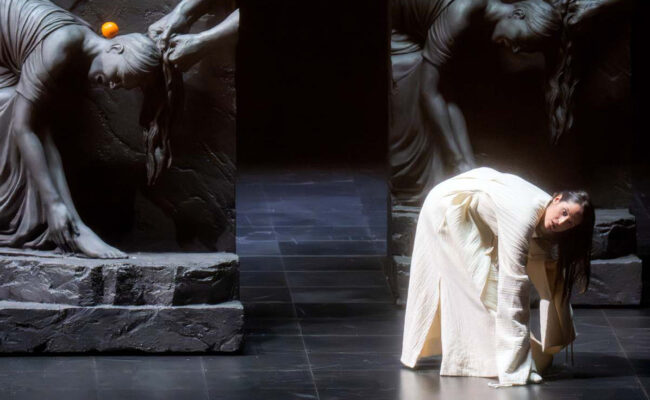
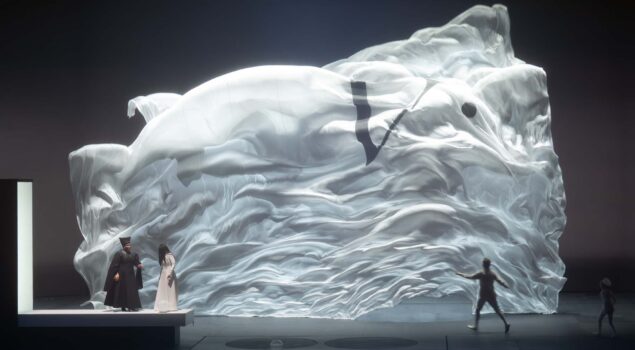
Two other scenes, high points in the opera for the spectator, are subject to Castellucci’s tinkering: the Tower Scene and the Love Scene in the park. Mélisande in a fairy-tale tower, an orange in hand, is to let her long hair float down to an enraptured Pelleas. The references to the Grimms Brothers’ Rapunzel go beyond the interpretations of Freud (Desire and Repressed Libido) and Jung (Individuation). The text remains highly Symbolist; Mélisande is as lost as she was in the forest years before. As the flow of love’s vocation heightens, she refuses a kiss and draws Pelleas’ attention to a rose in the distance in the garden, thwarting his advances. Her white tank top, a very ordinary blouse and lack of flowing hair do little to make this magical. Castellucci insists with his use of the symbol of water, taking the place of hair, but no, it is streaming white paint which stains Pelleas’s black shirt. Albeit always a magical scene, this version was for many a letdown, lacking the mystery of love’s emotions as all the action led nowhere. Worst of all, two small rotating disks beneath Pelleas’s feet had him whirling as if in dancing for joy, or was it love overcoming him, or even, a symbol of Mélisande’s hair embracing him? Suffice it here, limiting the numerous interactions in Castellucci’s version of the tale, to mention the insertion of two clown figures, Pierrot and Colombina, ‘maschere’ of the Commedia dell’arte who will free themselves from Maeterlinck’s abstractness, and let their emotions run the gamut. It is a picturesque scene to watch, psychologically tender beneath floating outlines of the phases of the moon, and yet it must stand isolated.
Pelleas (Bernard Richter, a Swiss tenor) was profoundly moving throughout the opera. In the Tower scene and the Pierrot/Colombina episode, he was engaging at every turn, and his amorous emotions liberated emotions were intensely poetic, filtered through the naïve gentleness of his character. Debussy’s vocal inflections arrived effortlessly – from the long cavern scene followed by that of the tower. Second to Mélisande, he is the character who remains on the stage the most during the opera. Vocally, the voice remained fresh throughout, never losing touch with his character’s poetic fragileness. Absolutely wonderful was his progressive withdrawal into states of melancholic vulnerability.
Sara Blanch was a superb Mélisande, attempting a diverse role, one requiring stamina, a middle voice, and total immersion in a character on stage for almost all the opera. She seems to be the same person on the outside, but is the victim of changing moods, and thus so it is in the music that we discover her performance’s beauties. Her inability to recognize the fact that she is dying is poignant. Though child-like and innocent, one thinks of her as a protagonist in a Noh drama, wistful, ghost-like, and not of this world. Her footsteps are almost non-existent, and all this regards her musical interpretation. She being extraneous to the milieu of Allemonde comes through, as too her innocent absence regarding the hate between Pelleas and Golaud. Her movements belie her inner psychological traumas, revealing her helplessness in attempting to control anything in her daily existence. The weight and expressiveness of her voice and vocal line make her a defenseless, delicate character trapped by fate and doomed by love.
Simon Keenlyside has portrayed Pelleas for many years yet has recently been taking on the role of Golaud, Pelleas’ half-brother. He moderates from hunter to husband, and with his slightly rough timbre, manifests a violence that is unleashed all the more forcefully in Act Four. We met him first when lost in thick woods, an awkward hunter, yet a good man whose downfall was to be caused by others and events. His music indicates his change of mood through instability and his need to change direction as a broken husband. His voice is dramatic and rich, forceful, and insistent when needed. It was a thought-provoking interpretation of change and desperation and sung with the utmost authority.
There remains King Arkel, his Queen, Geneviève, a Doctor, and a Shepherd. The Queen (Marie-Nicole Lemieux) appears somewhat as a matron here, helpful as a Duenna making the most out of pulling a thread from a suspended cloth letter from their son, Golaud, capturing the ‘words’ by wrapping them onto the suspended bobbin seen before in the forest. Her instrument is resonant, and her story-telling rich, with a touch of premonition, reduced by the staging which captures her with unflattering gestures, like dumping the remaining words of the letter in a wad upon the almost-blind, fatalistic King’s shoulder, more dutifully than regal. King Arkel (John Relvea) possesses a round and cavernous bass, as will be demonstrated as the opera progresses. Elegant, measured in stature, he demonstrates the poise and good sense of a benevolent, fairy-tale monarch. Allegra Maifredi, a member of La Scala’s children chorus, played Yniold, Golaud’s son from a previous marriage. She sang her important part with the utmost confidence throughout, challenging the ff. symphonic outpourings with full-throated courage. The remaining two roles of a Doctor and a Shepherd were taken by members of La Scala’s young artists program, Zhang Zhibin and Lee Geunhwa respectively, their bass-baritone voices rich and expressive.
“The truth… The truth…”
The overall impression, confirmed by attending various performances is that the public was convinced by this production, but much less so by Debussy’s creation in itself. Critics seemed to have lauded the staging but less so the singing, and yet there were those who felt the opposite. The reality seems to be that even today’s public arrives at the opera house not totally prepared to accept the dramatic and musical essences of this opera, to understand Debussy’s contribution in the name of Symbolist Poetry, and even more so, as a reflection of our lives seen through the ever-fragmentated colors of kaleidoscopic Impressionism. May we take something from Melisande, the eternal child, who courageously lives in her own world – or is it ours also? May we admit our past actions for what they were, yet not understand the mysteries of the present? Hough not recognizing impending death, she proves that she understands those around her perfectly. And she will die in telling the truth – she loved Pelleas yet swears they are not guilty. Questioning life and death is a game for the innocent, a reference to the Wagnerian principle of ‘redemption through love.” Yes, this is the magic of happiness in this tragic fairy tale.