La clemenza di Tito
26 April 2026, Zurich
La Clemenza di Tito. Opera seria in two acts by Wolfgang Amadeus Mozart (1756–1791). Libretto by Caterino Mazzolà after Pietro Metastasio.
Conductor: Marc Minkowski
Director: Damiano Michieletto
Chorus Master: Ernst Raffelsberger
Tito Vespasiano: Pene Pati
Vitellia: Margaux Poguet
Servilia: Yewon Han
Sesto: Lea Desandre
Annio: Siena Licht Miller
Publio: Andrew Moore
Extras Association of Zurich Opera House
Chorus of Zurich Opera
Orchestra La Scintilla
Performance attended: 26 April 2026 (premiere), Zurich Opera House
Music: 4****
Staging: 2**
La Clemenza di Tito
One of the chief attractions of this premiere – quite apart from our admiration for Mozart’s La Clemenza di Tito – was the prospect of hearing Pene Pati make both his role and house debut in the title role. We had not previously heard the tenor live, knowing him chiefly from his recital disc of French and Italian arias, ranging from Gounod, Donizetti and Massenet to Verdi and Meyerbeer. Even there, one is immediately struck by the beauty and evenness of the voice, the elegance of the phrasing, and the cultivated manner in which he deploys his resources. We were therefore especially curious to hear how these qualities would translate in Mozart.
For this new production, Zurich Opera secured Marc Minkowski, who for decades has stood among the foremost exponents of historically informed performance. The care lavished on the musical preparation was apparent from the opening bars of the overture: Orchestra La Scintilla played with precision, bite, and tremendous élan. There were one or two fleeting lapses of ensemble and intonation in the flutes at the outset – hardly unheard of with period instruments – but these did nothing to detract from the overall impression. Zurich Opera may count itself fortunate indeed to have its own period-instrument ensemble in La Scintilla. Under Minkowski’s direction, it once again proved its exceptional worth. The strings were precise yet flexible, the wind playing vivid and characterful, and even the recitatives seemed wholly integrated into the broader musical argument. It was precisely this marriage of clarity and dramatic momentum that made the evening so compelling on the musical level. Minkowski’s conducting combined stylistic assurance with a finely judged sense of theatre. Where the score demanded propulsion, he tightened the line with real urgency; in the more lyrical passages, he allowed the music space to breathe with tenderness and poise. The result was a sound world that took Mozart’s elegance every bit as seriously as the undercurrent of disquiet running through the score.
Particular mention must be made of Sesto’s aria ‘Deh, per questo istante solo’. Exquisitely supported by the orchestra and sung by Lea Desandre with extraordinary inwardness, it created a moment of rare intensity. One could almost feel the audience holding its breath, as though instinctively granting this intimate passage the silence it required. It was one of those unmistakable operatic moments that raise the hairs on the back of the neck – so moving, indeed, that it brought tears to the eyes of an acquaintance of ours. Such moments remind us of where the true power of opera resides: in its capacity to make emotion and wonder feel immediate.
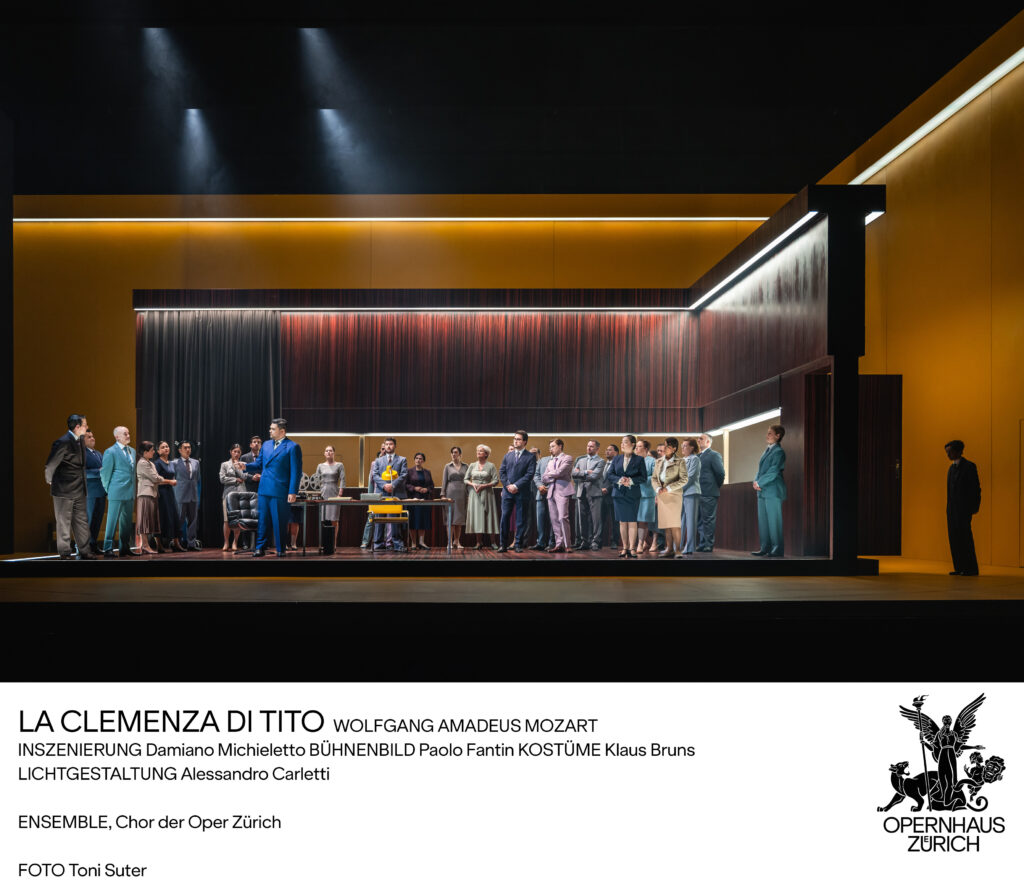
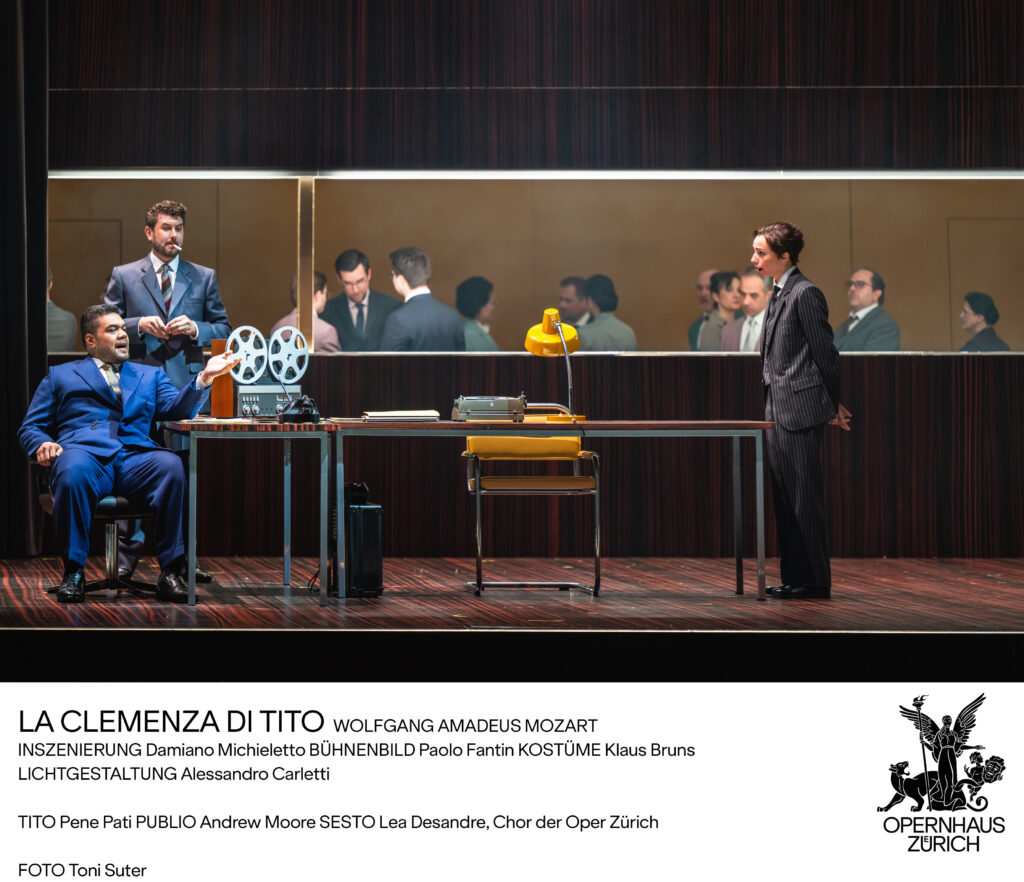
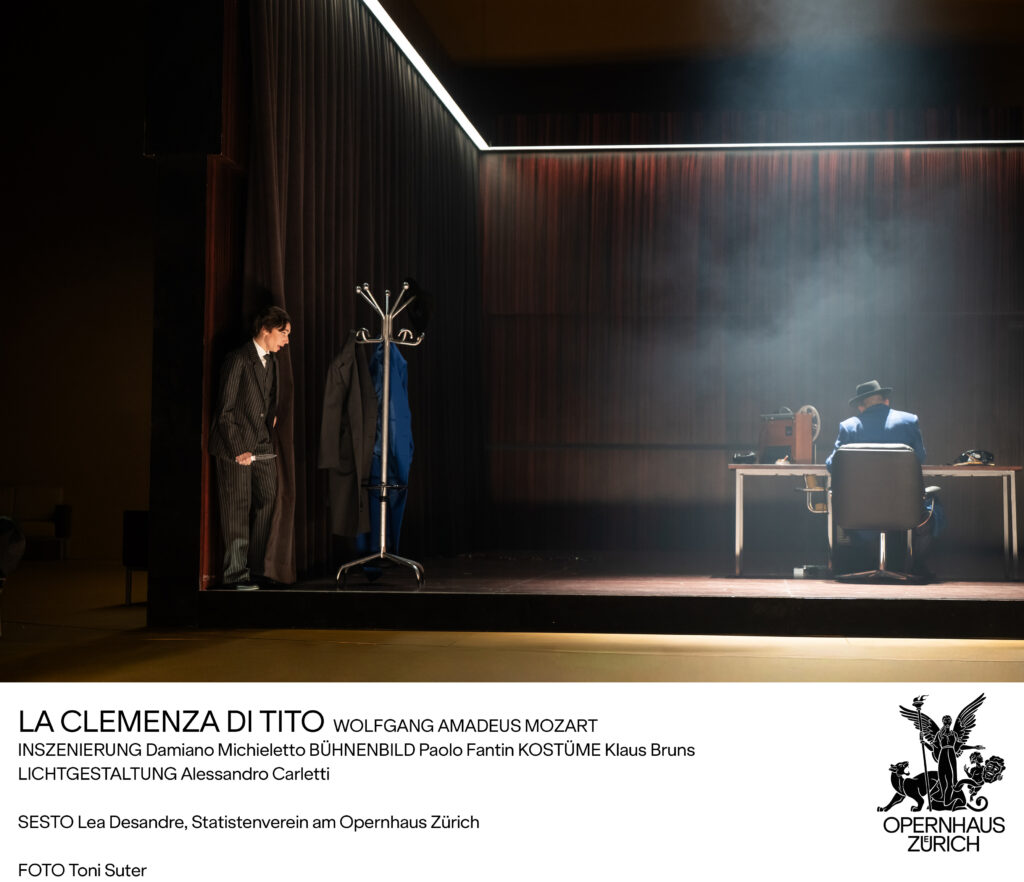
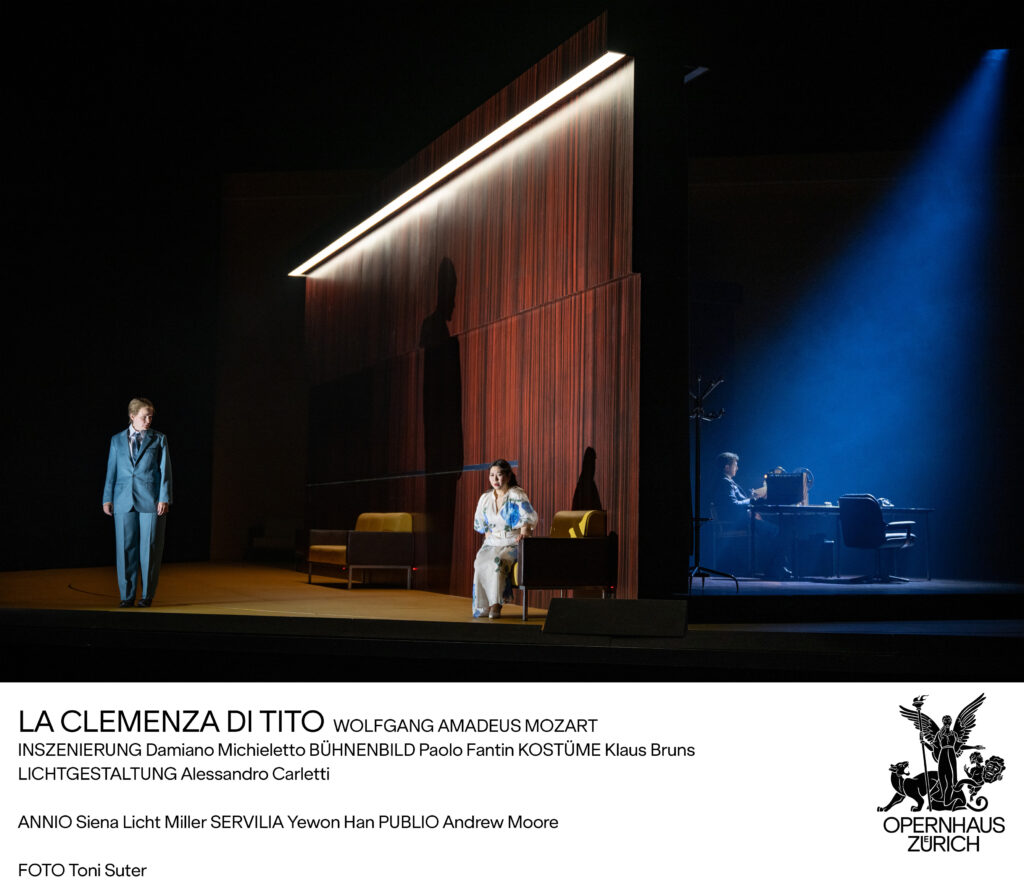
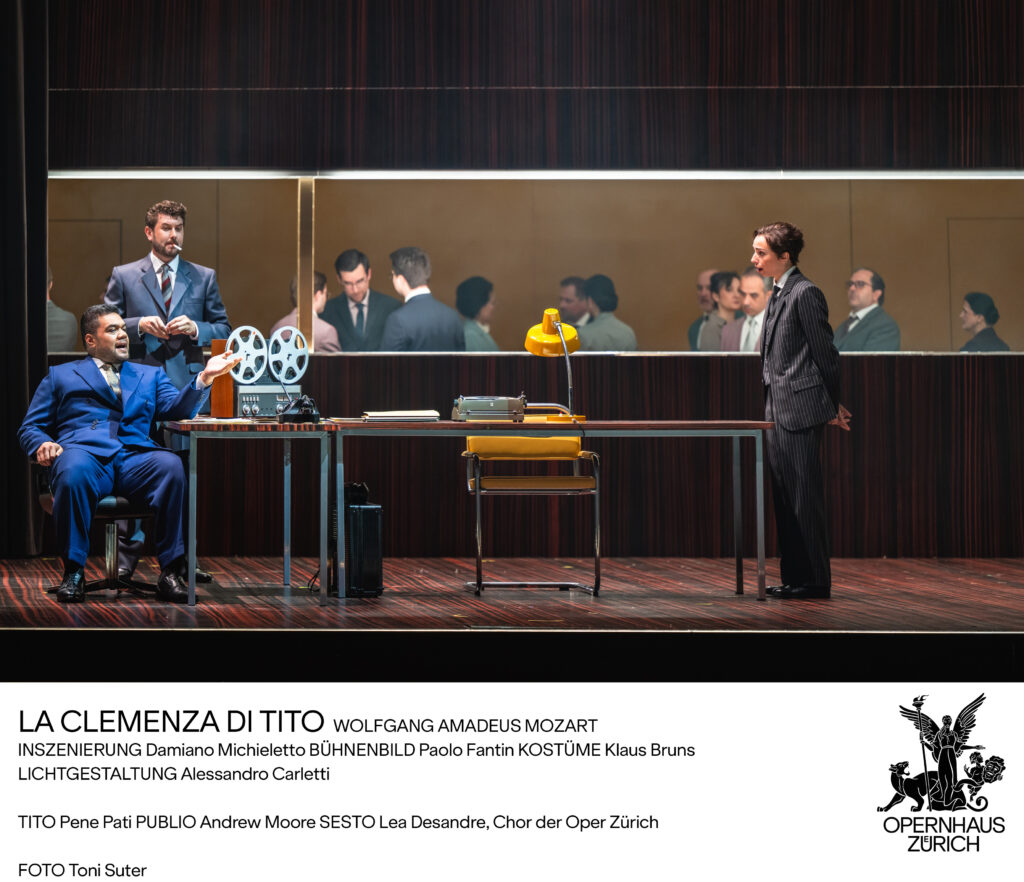
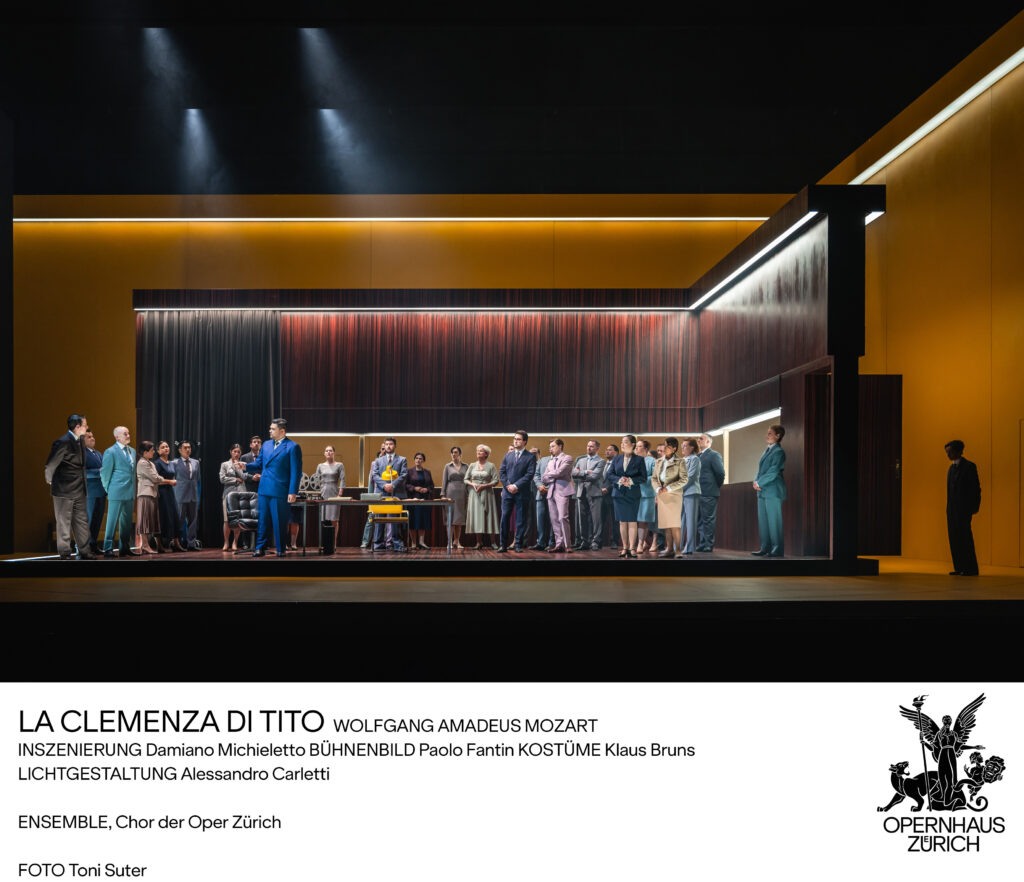
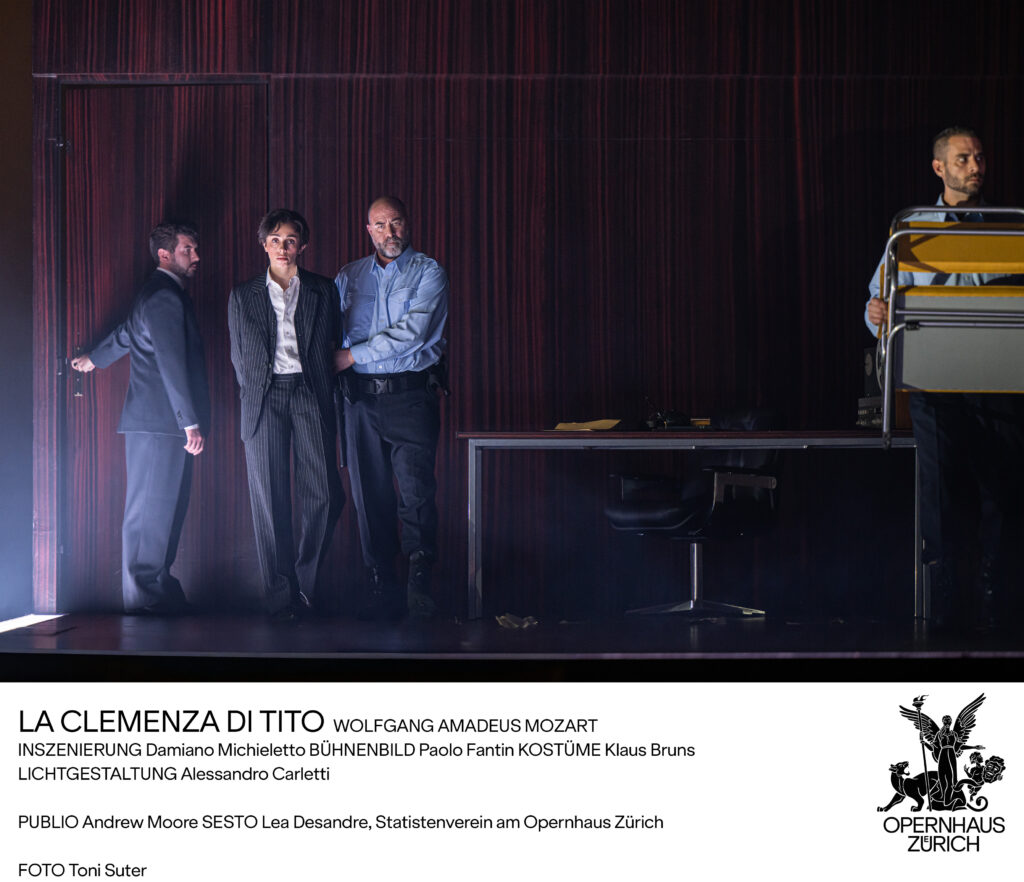
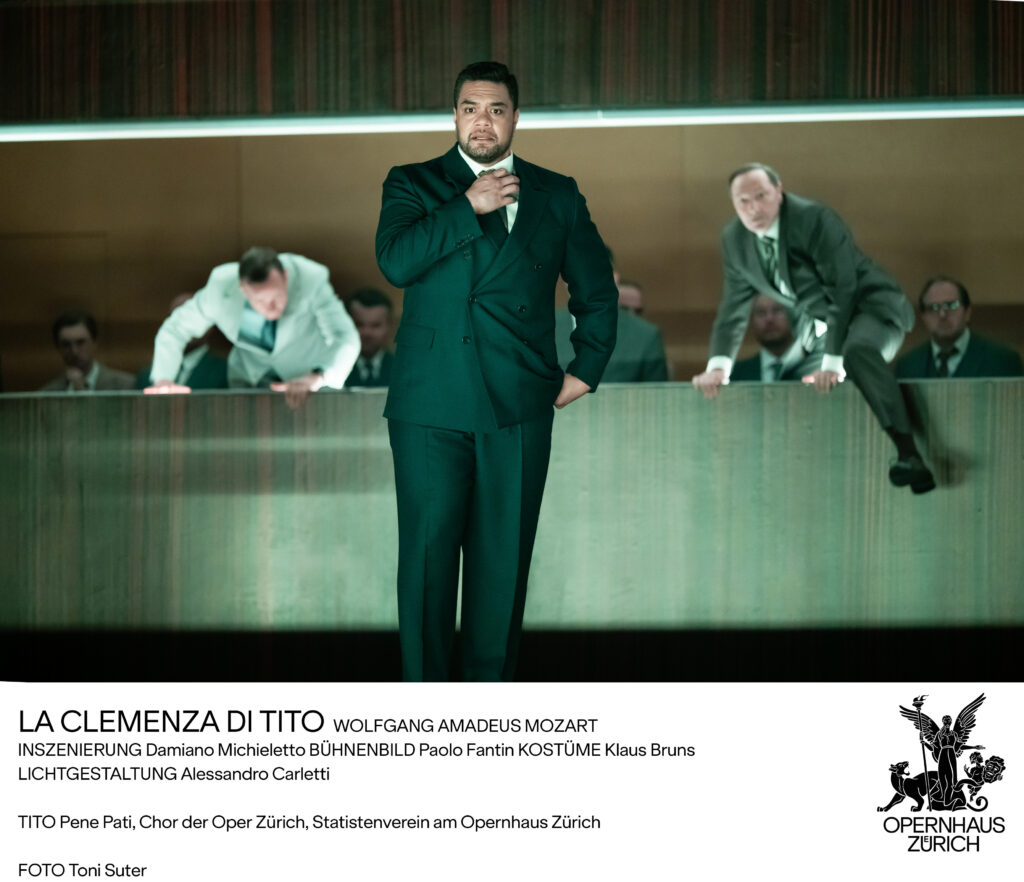
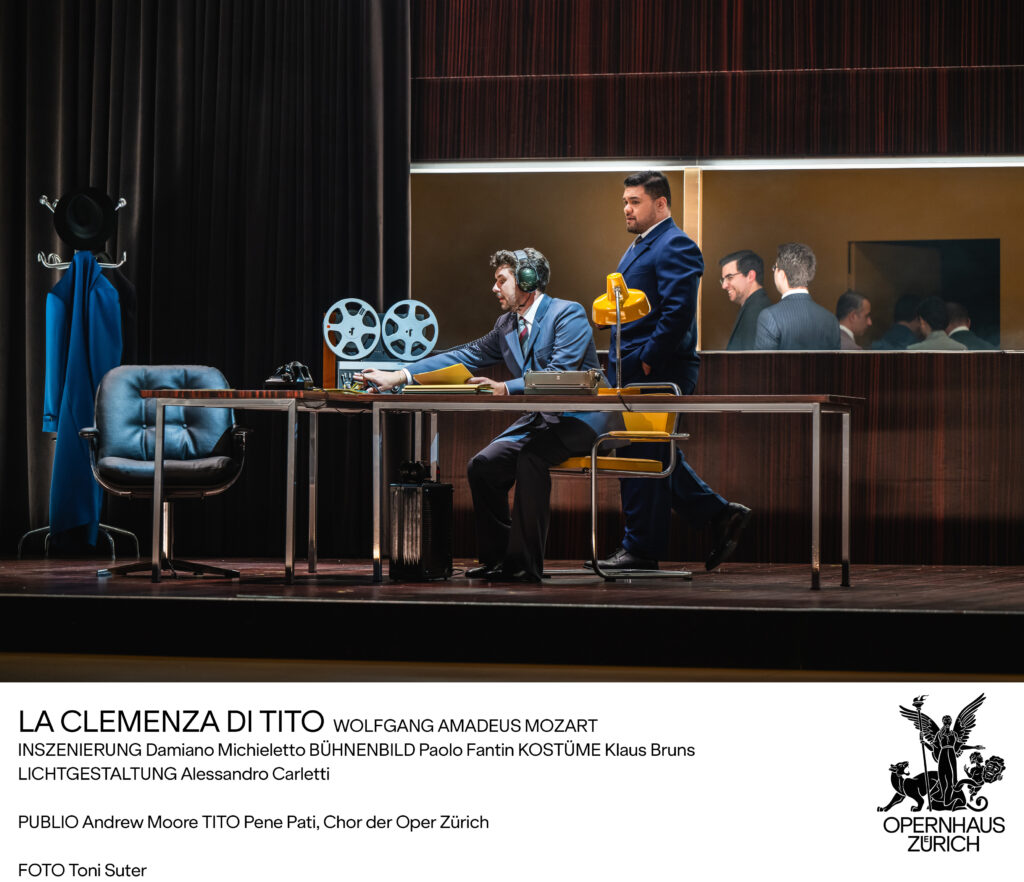
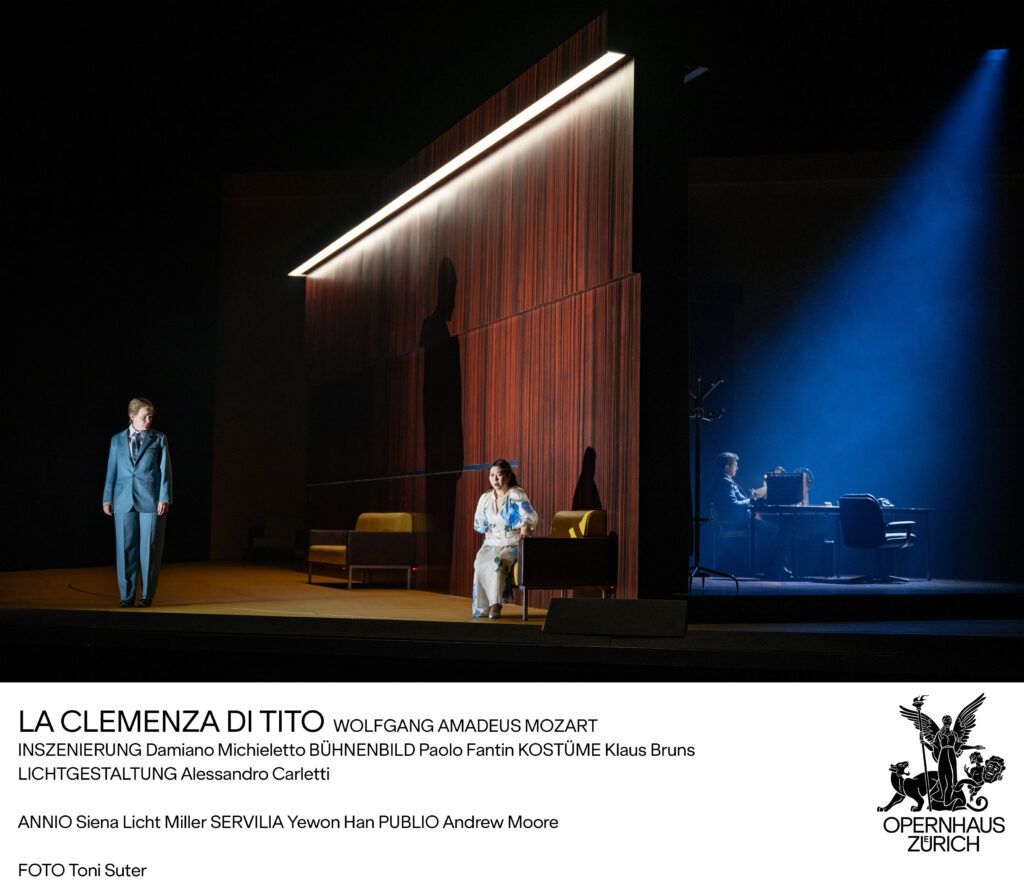
Unfortunately, no such praise can be bestowed on the staging, directed by Damiano Michieletto, with dramaturgy by Kathrin Brunner. It struck us as a serious misjudgment to bring up the curtain after scarcely a third of the splendidly played overture, revealing a stripped-down executive suite in a vague 1950s idiom, complete with wood paneling and leather armchairs in a kind of mid-century modern style (sets by Paolo Fantin). Michieletto plainly conceives the opera as a political thriller, conjuring an atmosphere not unlike Tinker Tailor Soldier Spy.
While the orchestra was still laying the work’s foundations, Publio, played by Andrew Moore, prowled about the stage in visible agitation, fiddling with glowing red electrical switches. The effect was as distracting as it was misplaced – rather like projecting a football match during the overture. The overture is not decorative accompaniment for directorial business; it is the musical preparation for the drama, and that moment belongs to the orchestra.
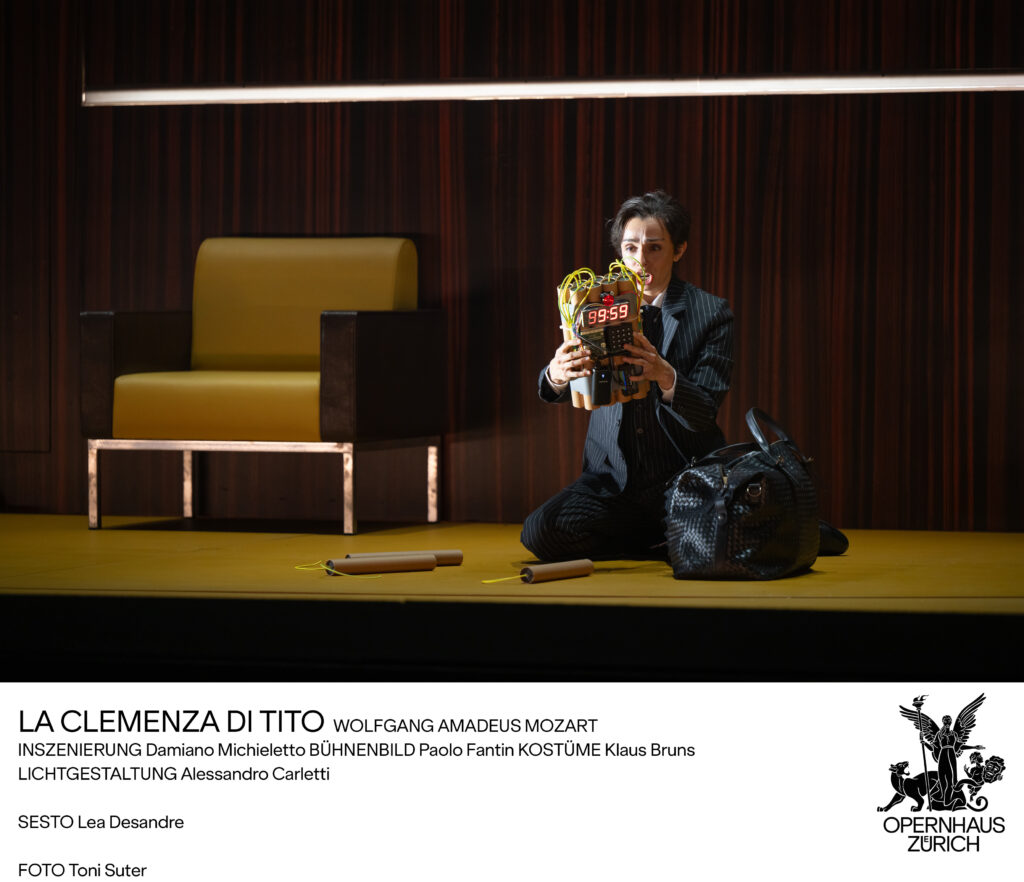
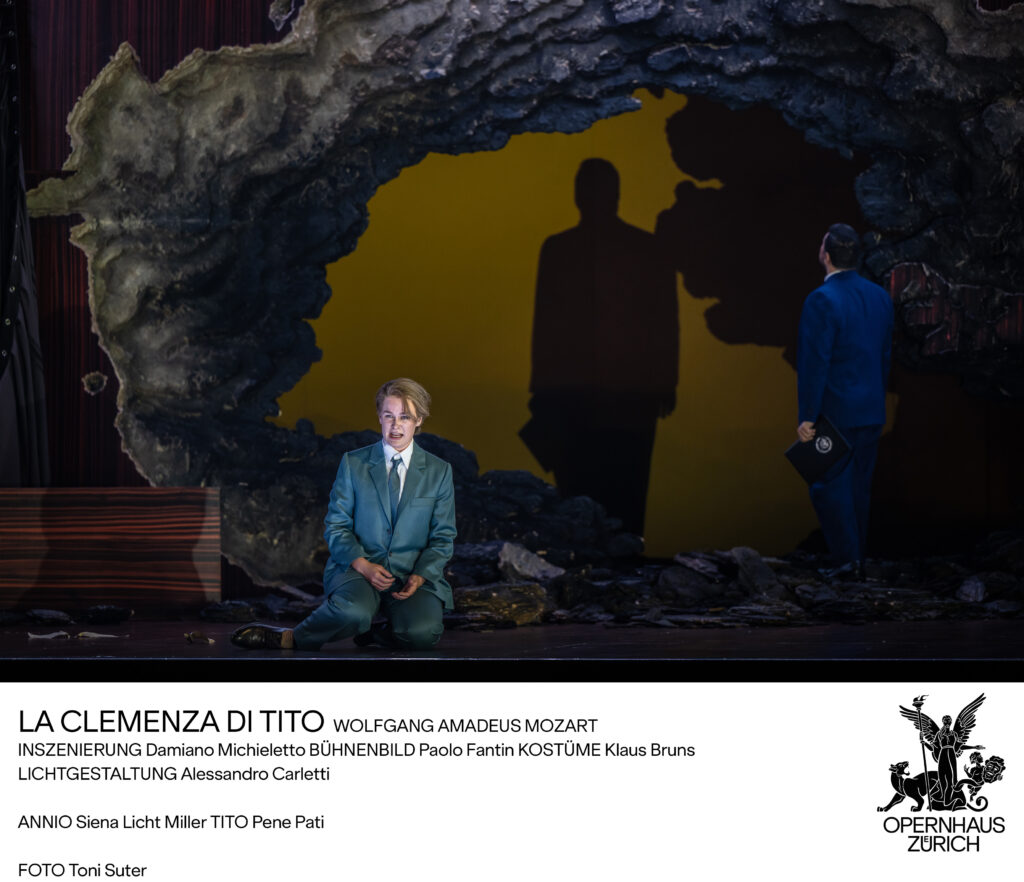
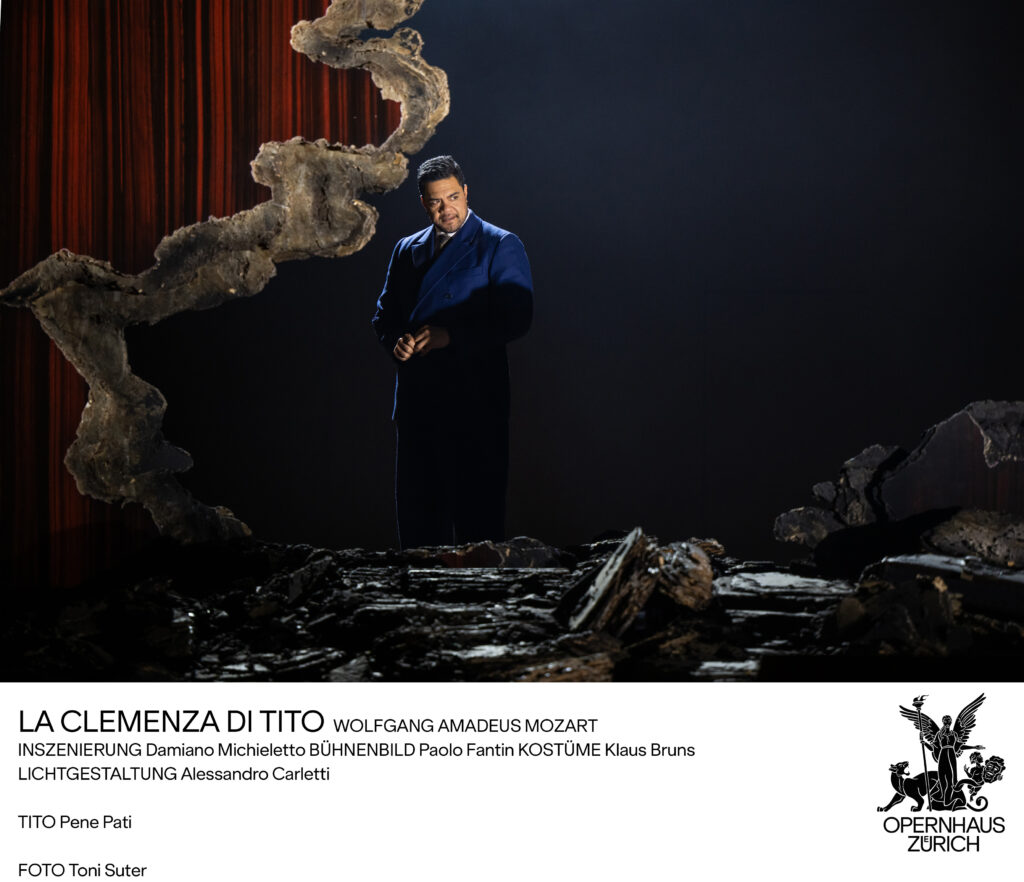
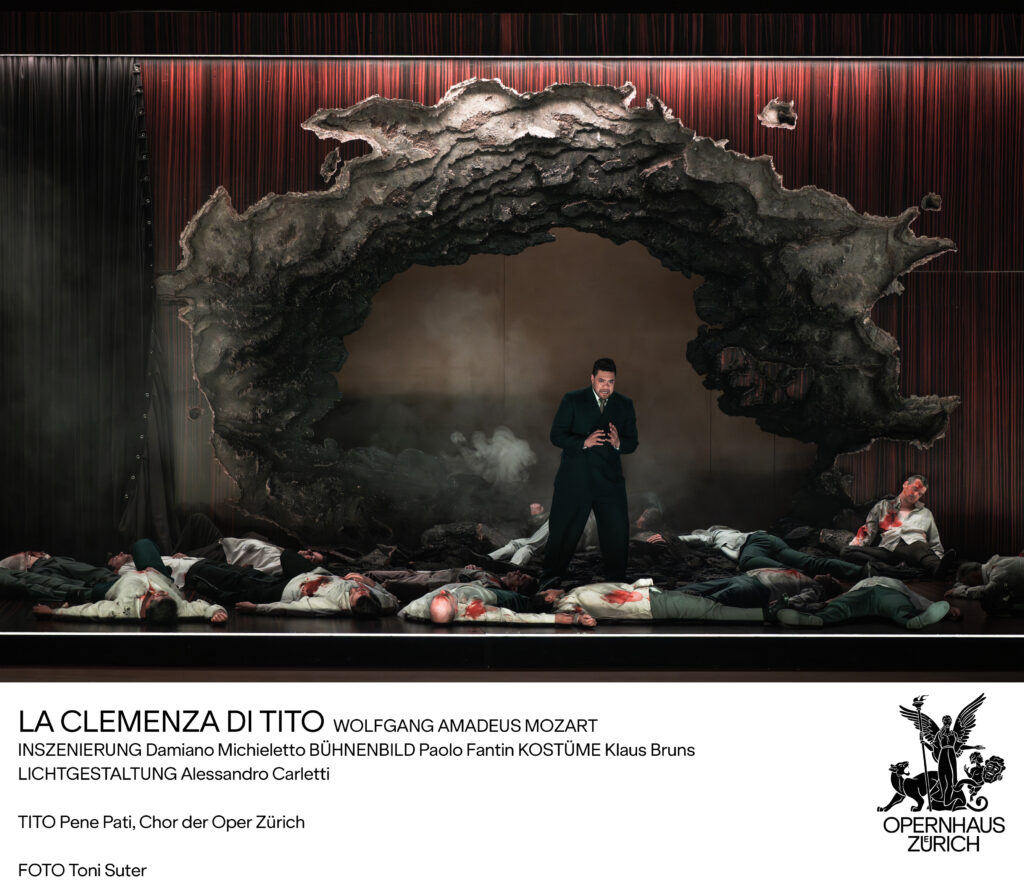
We were at least grateful that the Act I set was not actively ugly: it was neat, efficient, and competently made. It generated little genuine tension, however, and felt largely interchangeable. Nor did the use of the revolve strike us as especially imaginative. Perhaps this is partly because Zurich audiences have in recent seasons had rather more than their fill of revolving stages; in this case, at any rate, one almost found oneself longing for a painted flat or even a visibly executed scene change – anything, in other words, that might have marked the individual scenes off more distinctly from one another. Given the centrality of the burning Capitol in the libretto, we were especially curious to see how the production would handle this moment. What appeared, however, was distinctly underwhelming: a hole in the mahogany-paneled wall and a few charred fragments strewn across the floor, and there the matter rested. This rupture had supposedly been caused by Sesto’s dynamite attack. In one of the preceding scenes, he was shown handling a yellow stick of dynamite that looked less alarming than faintly indebted to SpongeBob SquarePants.
Studied and inert
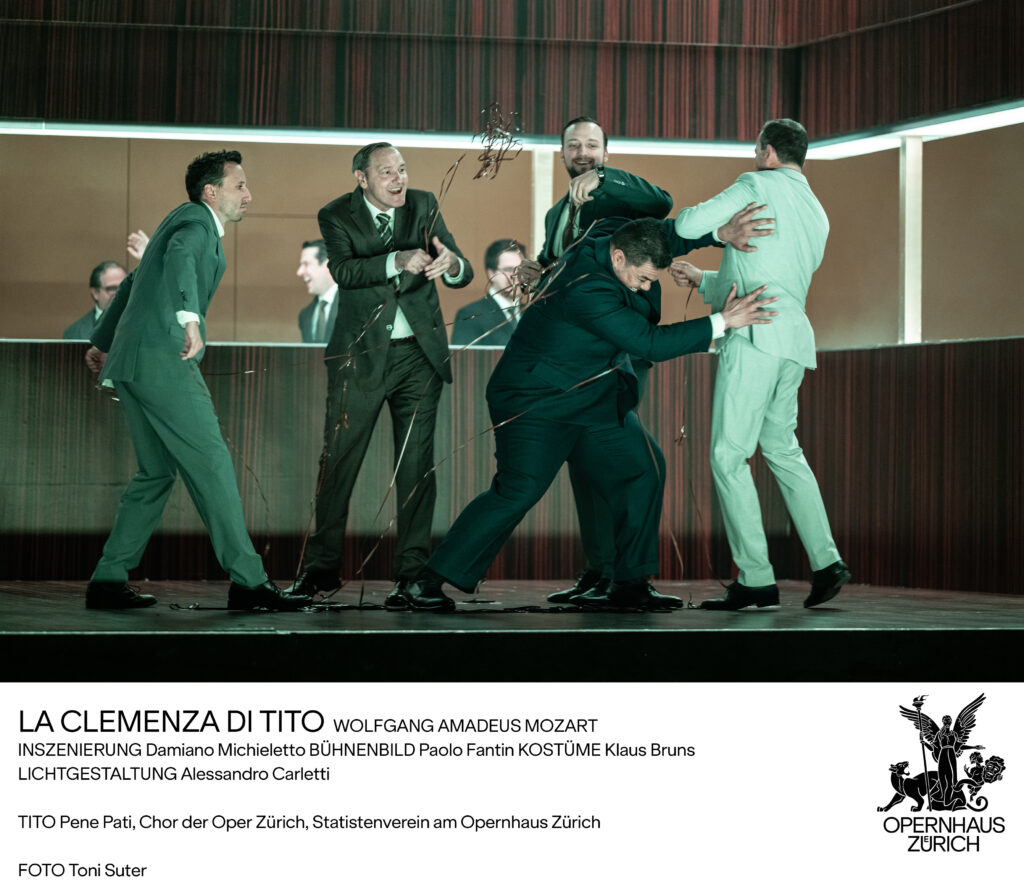
Tito’s audience chamber, or office, was correspondingly presented as a sober corporate interior with a large desk and matching furniture. Entirely superfluous, meanwhile, was the stage business during his aria ‘Del più sublime soglio’, when, in the manner of classic Regietheater, several suited men climbed through a gap in the mahogany wall, unwound strips of celluloid from film reels, and draped them over the head of the kneeling Tito as he sang.
Quite what this was meant to signify remained wholly obscure; more to the point, it felt studied and inert.
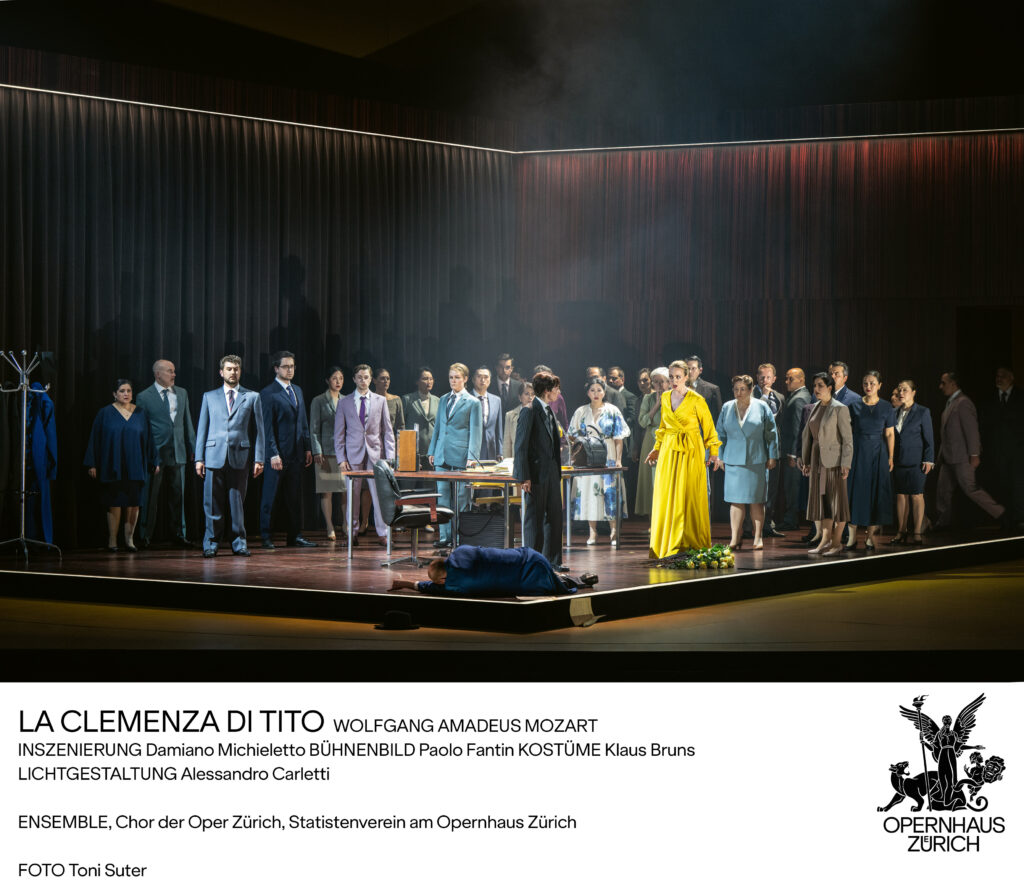
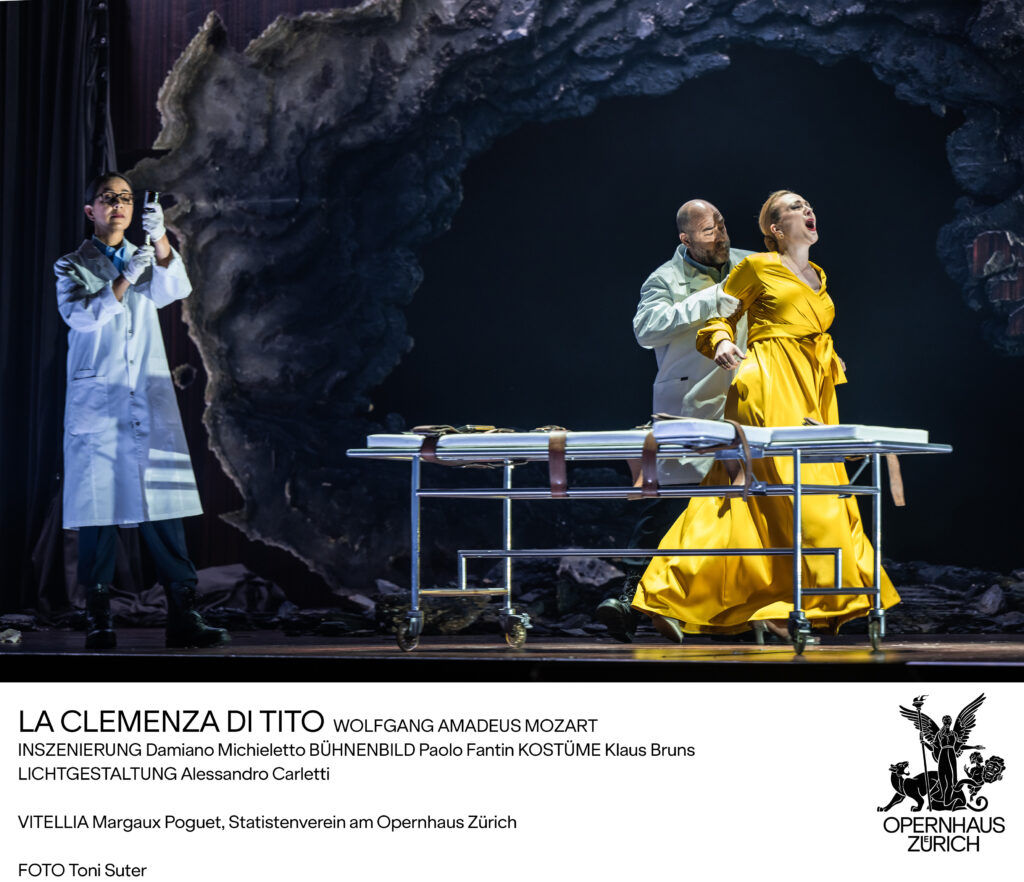
The courtroom scene, in which both public and court await a clear verdict on Sesto, was relocated to a modern tribunal. The chorus sat in two long rows of chairs watching the impending execution, which – in another all-too-familiar Regietheater gesture – was to be carried out by lethal injection. Two extras in white medical coats conspicuously prepared the apparatus, pulled on latex gloves, and laid out the instruments of death. Later, Sesto was wheeled in, strapped to a stretcher, and made to look as though he was about to be executed. However, Tito finally decided to show him clemency. The scene was plainly contrived for maximum effect, but in its blunt contemporizing it remained disagreeably one-dimensional.
Vocally, from good to excellent
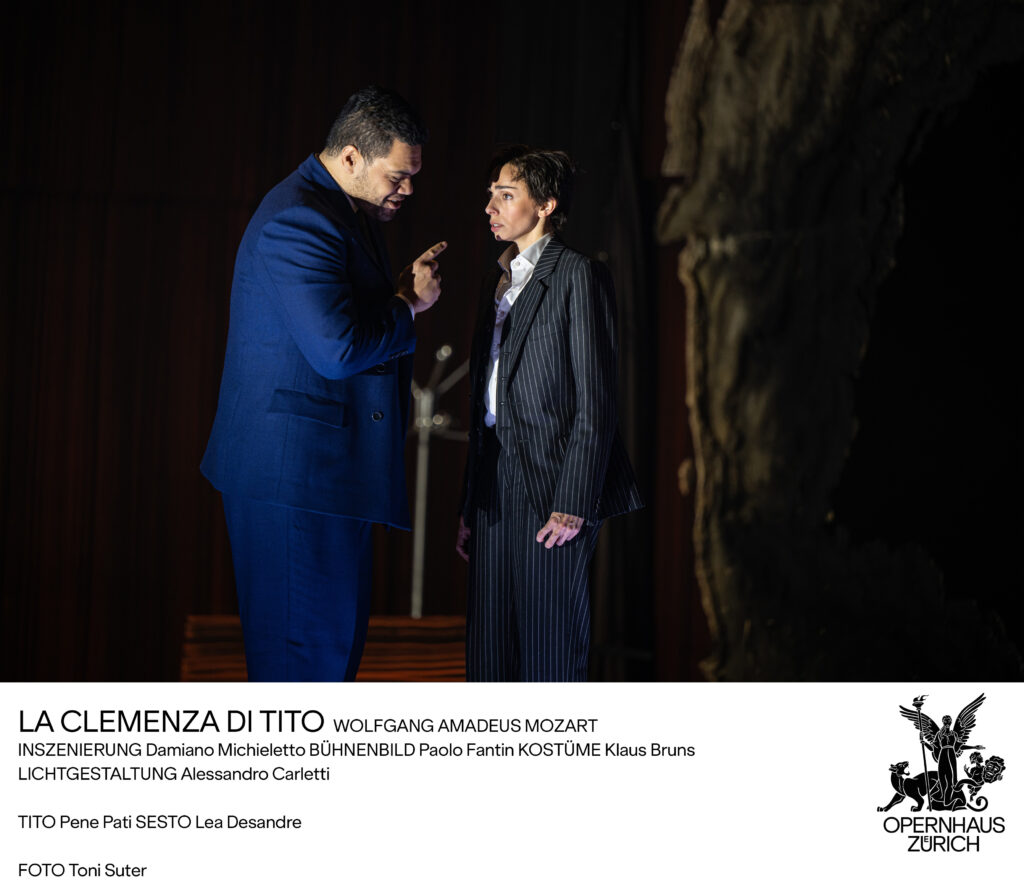
There is not much to be said of Alessandro Carletti’s lighting beyond the fact that each space was illuminated as required. Klaus Bruns’s costumes were of the sort in which a fair number of audience members might plausibly have wandered onstage without attracting notice: the men in suits, the women in elegant evening dress or business wear. They were certainly not tasteless, but neither did they possess much originality, and one almost hopes the principals were allowed to keep them, since they could have been worn to advantage beyond the theatre as well. On the credit side, the direction of the performers deserves acknowledgement: it was lively, theatrically alert, and responsive to the recitatives.
Vocally, the evening ranged from good to excellent. We had especially looked forward to Pene Pati in the title role, and he sang with his customary vocal security, stylistic command and a dignified, restrained, if somewhat detached, stage presence. The evenness of his production across the range was impressive, as was the beauty of the timbre, with certain notes recalling Pavarotti in color. Particularly striking was the solidity of his technique, securely founded on breath control and support. Even so, one occasionally found oneself wishing for a little more in interpretative terms; at times there was a suggestion of husbanding his resources. His great aria ‘Se all’impero, amici Dei’ was technically very accomplished, with rhythmically exact coloratura. The final octave, however, was delivered somewhat casually, and so failed to prompt quite the ovation one might have expected at that point.
Margaux Poguet made a vivid impression as Vitellia from the moment of her entrance. With dramatic intensity, fearless attack, and considerable expressive force, she hurled herself into the role and, in her sheer audacity and appetite for risk, at times recalled Abigaille. Her aria ‘Deh, se piacer mi vuoi’, especially the closing section taken at high speed, was thrilling – full of dramatic thrust, boldly seized top notes and machine-gun coloratura. To be sure, not every passage at that pace landed with complete neatness, but this scarcely diminished the effect. Particularly striking was her use of an unexpectedly sonorous chest register, at moments almost suggestive of Marilyn Horne, which lent the portrayal additional bite and emotional heft. It was tremendously impressive and undeniably exciting – though also the sort of vocal intensity that makes one wonder how benign it can be for the voice over time. The audience’s enthusiastic applause was entirely deserved. She was not, however, able to sustain quite the same intensity in the great rondo ‘Non più di fiori’. Here and there, one had the impression that the reserves were no longer what they had been earlier, as though she had begun to run out of steam a little. All the more surprising, then, that the chest register so tellingly deployed in the first act now sounded rather pale in the low-lying passage ‘Pietà di me’. Even so, Poguet brought the aria to its close cleanly and with musical command. That it did not receive a concluding ovation was also due to the fact that the performance pressed straight on without a pause.
The vocal honors of the evening – and the warmest applause – went, in our view, to Lea Desandre as Sesto, who in trousers, viewed from a distance, bore a passing resemblance to Timothée Chalamet. As we are more accustomed to hearing Sesto sung with a fuller, darker instrument, we initially wondered, after the first few phrases, whether her voice might prove a shade too clear and light for the role. As the evening progressed, however, it became clear what reserves she had at her disposal. For all its bright and lucid basic color, her voice possesses a remarkably dense and intense core capable of considerable amplitude. To this she added immense technical security, immaculate coloratura, and an extraordinarily complete musical and dramatic grasp of the role. In every aspect of the part Desandre made a vivid impression – whether in the intimate, vulnerable pages of ‘Deh, per questo istante solo’ or in the virtuosic closing triplets of ‘Parto, parto, ma tu ben mio’. Here she united technical brilliance with emotional truth, making both arias the true musical high points of the evening, as the audience abundantly confirmed with frenzied applause and cries of ‘brava’.
Lyrical radiance
Yewon Han brought lyrical radiance, sensitivity, and natural warmth to Servilia. She sang with a clear line and touching simplicity, giving the character a quiet yet deeply affecting presence. In ‘S’altro che lagrime’ in particular, she showed finely judged, intimate phrasing, all the more moving for its restraint. Siena Licht Miller was persuasive as Annio, with an attractive tone, stylistic ease, and a believable stage presence. In ‘Torna di Tito a lato’, too, she conveyed the character’s warmth and sincerity most effectively. Andrew Moore completed the cast effectively as Publio, bringing sonorous authority and dependable stage presence. The Chorus of Zurich Opera, prepared by Ernst Raffelsberger, likewise fulfilled its task with precision, cohesion, and tonal quality, fitting seamlessly into the evening’s overall musical fabric.
Special praise should also go to the continuo group – Enrico Maria Cacciari, Laura Moinian and Simon Hartmann – whose playing lent the recitatives both vitality and shape, and whose unobtrusive musical intelligence was felt throughout the evening. Robert Pickup’s contributions on clarinet and basset horn were especially memorable in the obbligato solos for Sesto’s ‘Parto, parto, ma tu ben mio’ and Vitellia’s ‘Non più di fiori’, both of which he shaped with admirable delicacy, tonal beauty, and a finely judged sense of line.
Musical triumph and theatrical disappointment
In the end, the evening left a mixed impression. Musically, this Tito was an occasion of the highest order, sustained by Marc Minkowski’s inspired conducting, the magnificently prepared Orchestra La Scintilla, and a cast that, on the whole, performed to a remarkably high standard. Particular praise should also go to the surtitles, whose translation of the sung text was of unusual quality and evidently much appreciated. It was therefore no surprise that the final applause for the singers and musicians was warm, unanimous, and enthusiastic. The production team, by contrast, had to endure some very loud booing from the upper stalls during the curtain calls – a clear sign that the staging had failed to convince. One could not help feeling that Zurich audiences are responding to the familiar reflexes of Regietheater with increasing fatigue. Once again, the evening demonstrated just how wide the gulf in opera can be between musical triumph and theatrical disappointment.