
LA FLÛTE ENCHANTÉÉ
Childlike enchantment, adult delight
Wolfgang Amadeus Mozart’s ʺThe Magic Fluteʺ at the Lille Opera
At the Lille Opera, at the end of the performance of The Magic Flute, directed by Suzanne Andrade and Barrie Kosky, the audience of over a thousand were beaming with joy, a clear reflection of what they had just experienced: childlike wonder and adult delight!
This final opera by Mozart, premiered in late September 1791, just two months before his untimely death, never ceases to fascinate, delight, move, and challenge. Each of these verbs indeed refers to one of the facets of the work.
It is an opera that is easy to get into, right from the start, without needing any prior knowledge or context. At first glance, it strikes us as a wonderful fairy tale. Upon receiving a portrait of the beautiful Pamina, Tamino, a prince who has just faced a dangerous serpent, falls in love with her. Her mother, the Queen of the Night, tells him that she is being held captive by the abominable Sarastro. But things are not quite as they seem. This Sarastro is surely not the man she describes. There will be trials to face, obstacles to avoid (thanks to a magic flute and magical bells), monsters, villains, moments of doubt (“Ah! He no longer loves me, I might as well die,” Pamina will say to herself). But Tamino and Pamina will be reunited; as for Papageno, he will find his Papagena. Happy ending.
But this opera is also clearly a coming-of-age story, a tale of initiation, which explores the path towards knowledge and wisdom, towards fulfilment. It has also been described as a Masonic narrative, reflecting Mozart’s involvement in Freemasonry through a wealth of characteristic symbolism found in both the libretto and the score.
In reality, it is all of these things at once, and that is why it speaks to everyone, regardless of age, social status, education, culture, or sensibility.
Musically speaking, as René Jacobs wrote, The Magic Flute is Mozart’s testament. It brings together all musical styles whilst highlighting what distinguishes them’. Thus, and I shall not dwell on this point, it contains lieder, opera buffa, opera seria, farce, fairy-tale opera, large dramatic ensembles, solemn episodes, and so on. A Mozartian palette that Riccardo Bisatti brought to life in all its diversity in Lille with the Lille National Orchestra and the Lille Opera Chorus.
This multifaceted world presents a challenge for its countless directors. Many of them tend to focus on a particular aspect of the work. Although this is somewhat reductive, it nevertheless leads to some fine successes.
In Lille, the production is a revival of a staging by Suzanne Andrade and Barrie Kosky that caused a sensation at the Komische Oper Berlin in November 2012.
The reason for this is that the staging concept and its execution are entirely original and thoroughly convincing.
Spoken parts replaced by panels
The directing duo embeds the characters within a wall of images: a huge screen in which doors open, through which the protagonists appear on various levels. This screen is the setting for a ceaseless projection of images and animation effects —inventive, offbeat, surreal, unexpected, masterful— and always in tune with the moods of the story’s heroes, who, for their part, appear to us as silent-film characters, in their appearance and their resemblance to figures such as Buster Keaton or Louise Brooks. The synchronization of it all is perfect and constantly elicits our amused reactions. Humor is ever-present, yet without compromising the more delicate emotional moments. As for the spoken parts, these have been replaced by intertitle panels accompanied by Galina Ermakova’s pianoforte. An excellent initiative.
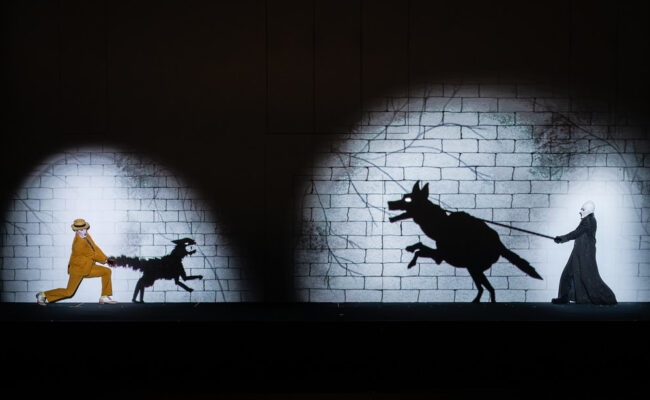
The large cast is also a delight. But because they are so seamlessly integrated into the production, the listener is not in a position to analyze each singer’s vocal performance in detail. They simply experience it without giving it a second thought. Nevertheless, Mingjie Lei possesses all of Tamino’s initial naivety and strength of character, Natasha Te Rupe Wilson gives us intense moments of painfully anxious love, Regina Koncz is a formidable Queen of the Night, Jarrett Ott a Papageno-Sancho Panza of sorts, Adrien Mathonat an imposing Sarastro in both presence and voice, and Elmar Gilbertsson a Monostatos with an unsettling and treacherous presence. Judith Fa-Papagena, Julie Goussot, Polly Leech and Alexandra Urquiola—the three Ladies—along with three boys from the Trinity Boys Choir, round out the cast perfectly.
What is remarkable about this production is that it appeals to everyone: a young audience, of whom there were many the other evening; an audience discovering the work for the first time; and an audience rediscovering a work they already know well. Childlike enchantment and adult delight!
Opéra de Lille – 16 May 2026
Stéphane Gilbart