
Les Enfants terribles
Philip Glass
Growing up can be a tragedy
Les Enfants terribles – at the Lille Opera
Bringing Jean Cocteau’s world to life
In their libretto, Philip Glass and Susan Marshall have captured the essence of Jean Cocteau’s novel. The aim was to portray young people on the cusp of an adult life they refuse to accept. They have risen to the challenge. Two orphans, Paul and Elisabeth, live in seclusion in their parents’ large flat, as if on an island cut off from the world. But the world catches up with them in the form of Gaspard, a friend of Paul’s, and Agathe, a friend of Elisabeth’s. They will dream, they will believe (or do they?) they are experiencing feelings, they will be unable to express them; there will be silences, lies and misunderstandings. The story ends with Paul’s suicide and Elisabeth’s death.
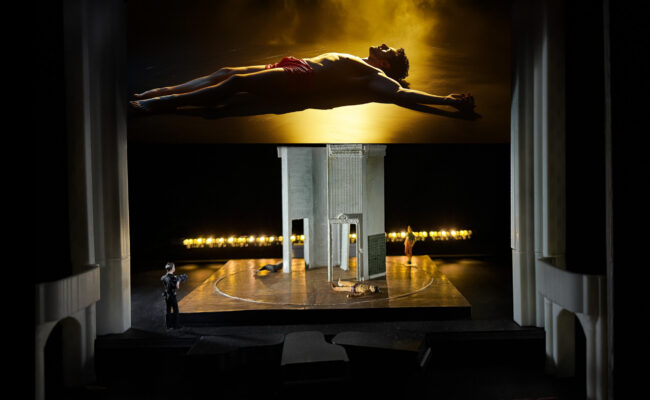
The rehearsal sparks interest
We are all familiar with Philip Glass’s major operas: the groundbreaking “Einstein on the Beach” conceived in collaboration with the visual artist and director Robert Wilson; “Satyagraha”, dedicated to the figure of Gandhi; and “Akhnaten” which I find so wonderful, dedicated to the Egyptian pharaoh. But for this work, literally ‘chamber music’, Philip Glass has decided to stick to three pianos.
A choice aimed at creating intimacy, at creating an enclosed setting, which corresponds to what the characters want and experience, to what will captivate and overwhelm them. Remarkable expressive possibilities come together in these instruments, whose trio multiplies the expressiveness.
Hypnosis, fascination and the spellbinding power of this repetitive music, never the same and yet always the same. Music that evokes that timeless world in which these tragic heroes would like to live; music that captivates us: in the double sense that it imprisons us, so to speak, and seduces us.
We must commend the remarkable work of the three pianists: Nicolas Chesneau, Flore Merlin and Nicolas Royez.
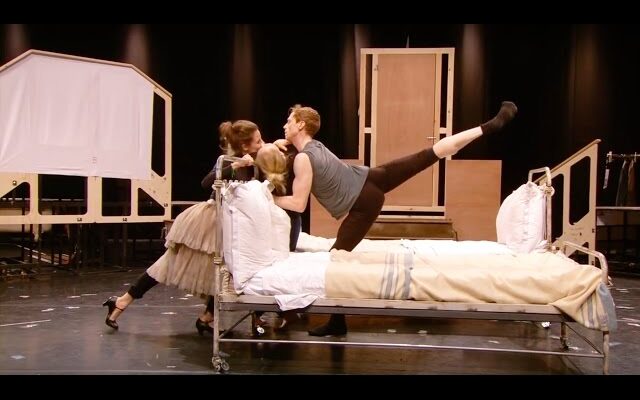
Les Enfants terribles. A dazzling and surprising production.
Matthias Piro, the director, and Lisa Moro, the set and costume designer, have devised a highly effective stage concept. On a revolving stage, the rooms of the house appear one after the other but take note: they are almost always different! It is dizzying – and the technical team at the Lille Opera deserves praise for their virtuosity in executing all these rapid transformations. The scenes unfold in the manner of film sequences. Equally masterful is the way the performers, fully attuned to the director’s staging instructions, inhabit this labyrinthine world, emerging here, retreating there, sometimes on the left, sometimes on the right or in the middle. One never knows where one or the other is to be found, which fits perfectly with this sad story in which everyone is searching for themselves just as they search for the other.
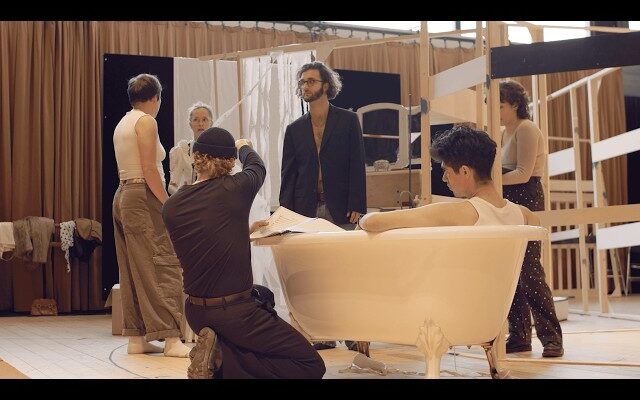
The performers are the characters
What makes this production such a success are its performers: they embody their characters in every way, capturing their highs and lows, and they have a masterful command of the stage. And, of course, they put all their vocal excellence at the service of the work and the director’s vision: Marie Smolka, Sergio Villegas Galvain, Nikola Printz and Abel Zamora.
The Lille Opera was sold out for this opera, which drew enthusiastic applause from the audience, including a good number of ‘young audience members’. An ideal production to whet one’s appetite for opera!
Stéphane Gilbart