Eugene Onegin | Opera Australia. Sydney 2026
EUGENE ONEGIN
Opera Australia, Tuesday March 17, 2026
Joan Sutherland Theatre, Sydney Opera House
Music — Pyotr Ilyich Tchaikovsky
Libretto — Pyotr Ilyich Tchaikovsky & Konstantin Shilovsky
Based on the verse novel of the same name by Aleksandr Pushkin
Conductor —Anna Skryleva; Director — Kasper Holten; rehearsed by Heather Fairbairn;
Music & Direction: 1 *
Dying a slow death
Contrary to popular belief, it is never actually fun to write a scathing review. The best critics are fans not only of the art form they are reviewing, but also of the community on both sides of the footlights — the artists and the audience. Thus, having to report that a dismal and frequently laughable evening was spent watching exceptional artists die a slow death in a production well beneath all of them is quite an onerous and unfortunate responsibility. Sadly, today is one of those days.
Egomaniacal regietheater vandal-inside-the-gates
Opera Australia’s production of Tchaikovsky’s Eugene Onegin, directed by Kasper Holten, is a hot mess — a misfire of epic proportions. Notwithstanding individual excellence amongst the cast, which is, blessedly, to be found across the evening, and of the which more will be said anon, the staging itself is so wildly excruciating, so agonizingly devoid of redeeming qualities, that it genuinely beggars belief that its director has, according to his biography, directed “more than 80 productions around the world”. One can only surmise from the evidence this production represents that Holten is precisely the kind of self-indulgent, egomaniacal regietheater vandal-inside-the-gates that Opera Gazet famously deplores.
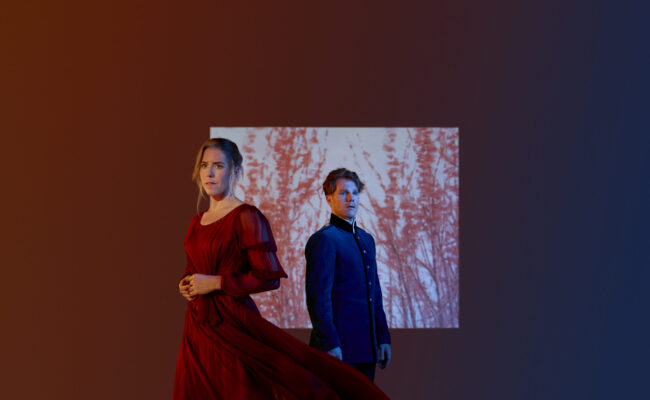
In the cunning disguise of a traditional-looking production design, Holten shovels forth a veritable mountain of meaningless redundancies, crass indulgences, and rank amateurishness into a single, somehow confidently presented, insult.
Again, not a jot of this is said out of a desire to be clever, or witty, to insult, or to demean, or to somehow play at superiority. Opera Australia can — and should — do better. It weakens itself by presenting such dross as an example of what it can do.
Doppelgängers!
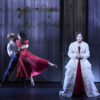
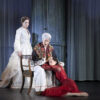
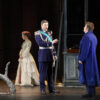
To specifics. Holten frames his production in the entirely unoriginal conceit of seeing the story in flashback (a 1990s-era Opera Conference production here in Australia, featuring Peter Coleman-Wright and Cheryl Barker, did exactly the same thing); he furthermore redundantly inserts two doppelgängers for Eugene and Tatiana — a conceit that emerges from no need, serves no purpose, and goes nowhere, and which more often than not was just plain confusing, with the older and younger versions of each character mixing and switching without any observable shape or structure. It was ham-fisted and half-baked from start to finish. Actors Brayden Harry and Keeley Tennyson did their best, but the odds were against them from day one.
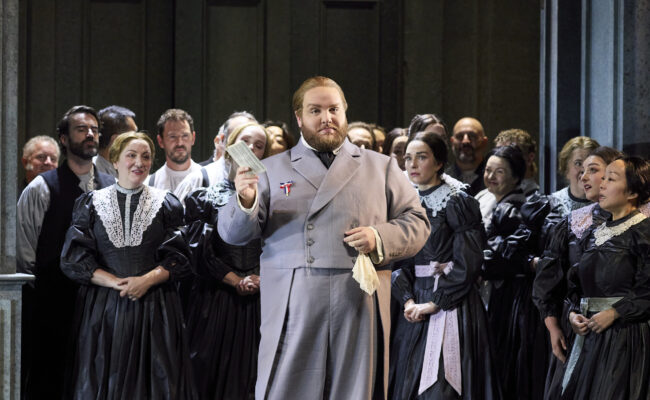
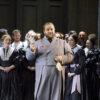
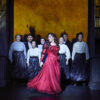
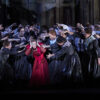
What passed for blocking seemed arbitrary and motiveless — movement for its own sake and never connected to any psychological or narrative need. Chorus blocking was tokenistic at best, bizarre at worst, and everyone was haplessly filling the gaps with semaphoring and mad feline scuttling in lieu of recognizable human behavior. In the absence of a director who understands human beings, the singers’ well-meaning attempts at acting were never permitted to exceed the level of a high school play. To be completely fair (which I always try to be), it is not the singers’ fault; Opera Australia, according to its own staff listings in the program, does not appear to employ one solitary soul to coach singers and directors in basic acting technique. No wonder the company suffers so at the hands of directors of this alleged “caliber”.
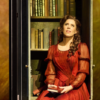
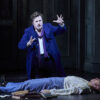
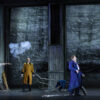
The only Inszenierungskonzept that worked was the structured abandoning of props from scene to scene — Tatiana’s books, a sheaf of wheat, a broken chair, and a tree branch from the duel scene, among other items. That said, leaving the principal tenor dead on stage from the end of the duel scene all the way through the third act to the final curtain call was a bit much. And while we are at it, what the actual xуйня was happening during the Polonaise, when the Onegin doppelgänger was being set upon by a hit squad of grey ballerinas?! Seriously…
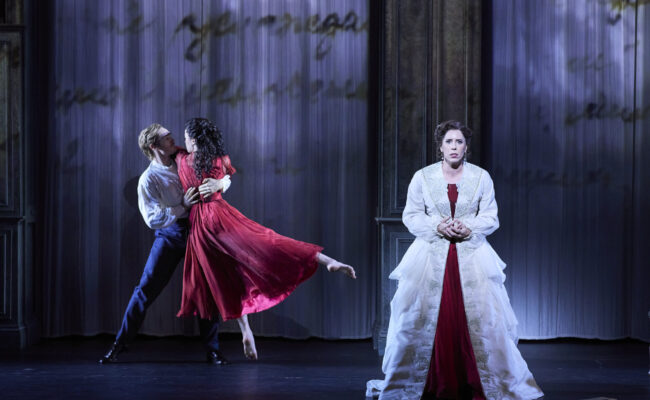
Lauren Fagan, a fine Tatiana
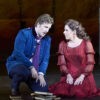
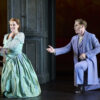
Speaking of the principal singers, here is where we can finally get to some of the evening’s positives. Lauren Fagan was a fine Tatiana. Holten did not help her in the slightest, preferring to give most of the acting to Ms Tennyson, her Doppelgänger, and largely leaving Fagan to provide the soundtrack merely, hugely disrespecting her as well as the most basic notions of directorial responsibility. This was never more evident than in the Letter Scene, in which La Fagan was required to stand, in the background, in shadow, and just sing. Which, to be fair, did rather well. Ukrainian baritone Andrei Bondarenko has sung the title role so many times, and for so many companies, that I genuinely could not tell if his studied world-weariness was the character’s or the artist’s. Frankly, under present conditions, I would not blame him either way. He, too, sang admirably, somehow managed to survive the indignities of some of Holten’s more pungent brain farts, and along with Fagan, possessed one of the only voices in the evening that was sufficiently and consistently powerful enough, volume-and-tone-wise, to justify its presence. Nicholas Jones possesses a pleasant lyric/character tenor, and has a lovely facility for paring it back to a plaintive mezza voce, and while that doesn’t exactly compensate for a lack of spinto oomph for moments like the climax of “V vashem dome!”, his finely spun, prayer-like approach to “Kuda, kuda” in particular was most affecting — a highlight. The remaining principals were varying shades of dependable.
Conductor Anna Skryleva led a brisk account of the score.
David Meadows
Eugene Onegin. Opera Australia. Sydney. 2026.