Die Walküre
La Scala
The Artworks of Truth and Love
“The monstruous sin of the absolute egoist is that he sees in his fellow Man almost nothing but the natural conditioning of his own existence … thus will he not give, but take.”
The Artwork of the Future, Richard Wagner
⇔
“Der Ring des Nibelungen is considered one of the most challenging, ambitious, and logistically taxing undertakings in all of art, but it is not impossible to stage.”
AI Overview
All fairy tales and myths tell of truth and love, and within these virtues are found the guiding sentiments of that Wagnerian ‘Gesamtkunstwerk’, derived from antiquity’s bestowing upon us Aeschylus’s Oresteia trilogy. And true to form, the composer-dramatist sought to bring new hope to a mid-19th century bourgeois, industrialized society, restoring its values for the creation of a new order. In essence, Wagner’s political make-up was second to that of his artistic, and the first representation of his epic Ring cycle at the Bayreuth Festspielhaus in 1876 was the realization of his life-long dream. One may imagine his great joy in having a world-wide audience there for the performances, though he would have to wait some time before the ‘enlightened’ masses he so wished for would seek out the benefits of his redeeming Art through spiritually-tinged experiences that would elevate their own culture. He would sympathize with Goethe’s hero Faust who tells us: “The true Paradise of all people lies here; at city’s gate in celebration – men elite alongside peasants! Here I brave to be a free man.”
In relation to this then, the all-too-human values of truth and love are deeply embedded within the flow of Wagner’s music, incessant and unrelenting by its own force. Though harsh and galvanizing in connotation, it revolves around emotions related to Man’s essential needs. Then, too, much is layered in a Shakespearean sense as we come to grips with dramatic entanglements in Die Meistersinger and Tannhauser, in Der fliegende Holländer and Tristan und Isolde. “Never did the course of true love run smooth” we are warned in A Midsummer Night’s Dream, the play that introduced the word ‘tragi-comic’ to the world. For Wagner, love was always in some way all-consuming, suffocating at turns, as also obsessive. The roots of all tragedy lie in Antique Greek Theater, yet as Der Ring was created to ideally serve Wagner’s society in overcoming its evils, a great deal derives from pure post-Schopenhauer Romanticism as related to human suffering and resistance to society’s dictates, suggesting that we sacrifice our destinies through an awareness of the traps of desire and illusion.
A World within An Opera
What we are in for when approaching Wagner must never be underestimated. Should we look to those concentrated episodes which leave great impressions upon us through moments of dramatic action and musical outbursts alone, we would miss much of what is evolving during the live performance. Arrive to the theater hurried, distracted or exhausted from life’s obligations and Wagner will almost deny you entrance; do not offer him your full concentration and stamina and your theatrical experience will be minimized. When sharing in a Wagnerian performance, the first sign that our willingly extended preparation has been in earnest is that one’s sense of passing Time dissipates, and thus the opera will never seem too long. Indeed, it is one’s own curiosity that will be partially satisfied by experiencing Wagner in this manner.
Though one may make a case as to why one or another of the Ring cycle operas is their favorite, it is generally thought that Die Walküre is the most popular, and for good reason: it deals with human love and the deeply rooted psychological drives needed to oppose society’s interference and restrictions in the pursuit of personal happiness. Not only do we encounter Siegmund and Sieglinde, the ‘star-crossed lovers’ and incestuous twins, but we will also deal with a frustrated, despotic father in Wotan, an all-too-human God heaping his Jungian ‘impersonal Karma’ upon his daughter, Brünnhilde, the true protagonist of the entire Ring. Let us remember that in witnessing the darkly whimsical prologue that Das Rheingold is, with the Fricka-Wotan marital squabbles, the antique civil laws of familial bonds take hold. Yet, we never abandon the characteristics of a sprawling fairy tale, what with royalty embedded within the realm of mythic Gods, newly-constructed castles in the air, wandering through deep forests dealing with the good and evil alongside magic and strange creatures. Die Walküre is populated with those of the earth, even when their destinies are interfered with by Gods or sub-terranean entities. There is something unique about that dwelling set within the bosom of a forest in the opera’s First Act; herein its domestic confines intertwine with all the dramatic action of the entire Ring. The appeal of earthiness, and that warm fireplace beckoning, offers a potent symbol of structured, transformative protection representing the intense, unconscious and emotional spiritual energies within the spirits of both Siegmund and Sieglinde. After deliberation with trepidation, Siegfried instinctively begins the drama putting need before civic responsibility, setting forth the wheels of his destiny (yes, a sort of ‘Sliding Doors’): “Whoever’s hearth this is, here I must take shelter!”
The End of a Beginning
As a contrast to many other existing operatic realities, Wagner’s personages inhabit worlds of constant inner turmoil born of contorted, enmeshed relationships. Shakespeare’s characters demonstrate that imperfect Man will err by turning to mischievous calculating, falling prey to emotions, or succumbing to ruthless ambition through irrational actions. Let us not forget that this is often accompanied by magic, and its resultant curses, love potions and contact with the surreal. Yet, we are ever-closer to our modern world, suffering from extreme emotions, egoistic desires, remaining victims of the crushing forces of fate. Understanding the character’s motivations and their entangled relationships with each other while travelling through the Ring’s landscapes is for anyone an arduous endeavor, and even the experienced Wagnerian may doubt ever having arrived at that terminal point of his full acquaintance with them through the libretto’s suggestiveness and the music’s nuances, let alone one’s involvement in identifying with their ‘raison d’être’ as the staged representation progresses. This is because the impact of Wagner’s understanding of human perplexity, developed through his sense of theatrical reality, will ever surprise us through their involvement with the curse upon the ring itself.
This is so as every entity of this drama, the Gods, Men and Animals of this myth, must continually wrestle with their unawareness of purpose as circumstance sweeps them away one by one. The fact that they sense doom is in itself the beginning of their journey and, in many symbolic ways, Wotan is not the only weary Wanderer, true, demonstrates that it is they who represent tragedy as who must carry the burden of their errors and falsehoods to their downfall. Wotan more than any other tragic figure in literature. Look to the tormented, guilt-ridden outpourings in his Act II monologue before his daughter, wherein he desires his own end as release from suffering. We need not Freud to illuminate his fearful words “Das Ende! Das Ende!” (“The ending of it all! The ending!”), whereupon all stage action and music come to an almost indeterminable standstill – a chilling moment indeed as a by-now lonely man’s desolation leads to his checkmating himself. Behind this is a powerful theme in all Wagner – that of ageing, losing power and dying – as so Wotan’s melancholic monologue, unique in all of Opera, begins “When the pleasures of youthful love began to wane … ” It seems as if Wagner were anticipating by a good twenty years those first psychoanalytic sessions of Sigmund Freud in the Vienna of the 1890’s, with Brünnhilde here as the listening analyst of all those echoes filtered through the dramatic power of classical tragedy.
The Staging of Myths
Given these parameters as to what a Wagner opera attempts to convey, one can deduce that the matrimony of text to music has indeed created an artwork ‘for’ our future, precisely so excavating into the past though its formal structure under the wing of Romanticism. The breadth and scope of portraying every aspect of mankind as a reflection of society – then and now – leaves much room for the spectator to imagine where his own guiding values lay. Yet, how deep into those beliefs can a stage director go? Or, most importantly, how and to what degree does he delve into his own sensibilities to convince us of his directorial choices, claiming ‘originality’ in having understood the true intentions of the composer?
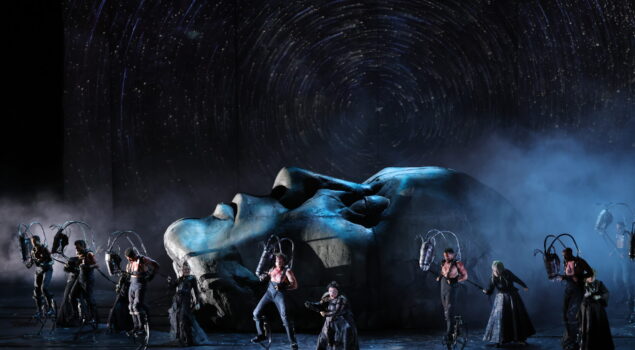
David McVicar, the stage director and set designer, represents Wagner faithfully, never exaggerating nor wandering from the work’s core, never changing or snipping at the text so as to fit into a personal adaptation, but instead offers us a portrait of what could in some ways outline the composer’s mindset. Apart from the stage settings and costumes, these being the prime indicators of a director’s choice of fixing upon historical perspectives within the ‘mise en scène’ when framing his presentation of an opera, much must be observed regarding the sensations of his having captured the characters’ inner sentiments. Their motivations and stage presence must become manifest through their movements, something which Wagner demanded of himself, as he often indicated in his writings regarding the importance of the ‘mime’ performer. This is important for us today as it makes contrasts between the realistic and the technological. Almost every possibility has been attempted these last twenty years in particular, resulting perhaps in failure. Striking images can and should be created through simplicity. One thinks here of the way Fricka’s rams or the Valkyries’ horses (mimes resembling humans more than animals) drag them through their entrances and exits in stylized, energetic gestures, perfectly animated in union with Wagner’s highly-charged music. Everything should be psychologically and philosophically connected, but can one capture all of this by simply attempting to represent myth itself as the hallmark semiotic sign defining all stage action and setting? This is what La Scala’s Ring cycle purported to do, but with scarce results at times. It is insufficient to offer scenic and dramatic solutions that will combine to reflect one over-ruling single leitmotif – appearing here as Man’s greed as symbolized by the image of a human hand, both on stage curtains and as sculptured rock formations beneath the Rhine. Though acceptable, and the image does appear through all four operas, it is in itself a foregone conclusion, creating no suspense nor illuminating possible meanings of Der Ring’s universality. If indeed this is the director’s ‘leitmotif message,’ then it fails to grasp that ideal symbolism which it should embrace.
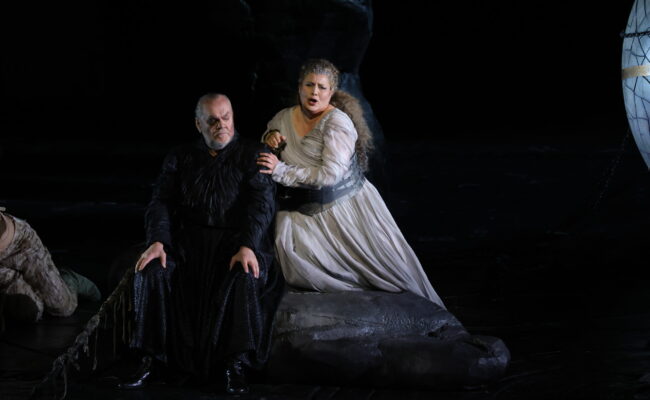
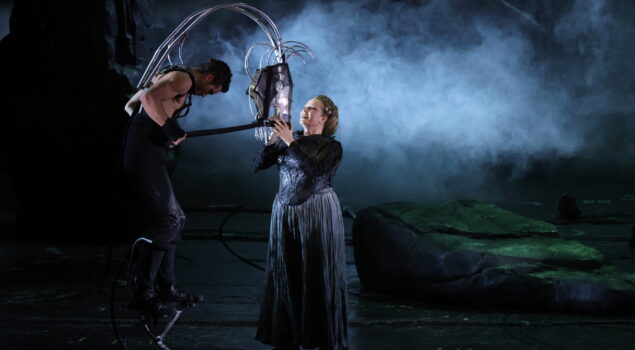
We know what the great scenes of Die Walküre are, and leave the theater with less spirited emotion than hoped for. All the solutions for the animals were disappointing, and also all-too-humanish. Wotan’s ravens resembled something out of Johann Strauss II’s Die Fledermaus, and were pulleyed up out of sight as in a high-school musical. Fricka’s two rams wore cream-colored tights and horned helmets; they were parked distractingly upstage, stretched out on the stage floor seemingly discussing something important, whether it be about the Ring or not. Brünnhilde’s stead, Grane (Gar-nah) donned black tights, and had a protruding metal horse head attached to his shoulders; his moonboots were purely springs, and he hopped about stomping La Scala’s wooden stage noisily. Believable or not, the horse is just too human, as if ready to talk, and even once taking the friendly liberty of putting his hoof upon the Valkyrie’s shoulder. This is multiplied in the famous Valkyrie’s Ride, a scene almost never carried off in an interesting manner –one fears the only solution would be to have real flying horses saddled with real Valkyrie warriors. Here, the Valkyrie clammer off their mountainous rock in their Victorian dresses to grab their horse’s reins and frolic about until they put them to pasture upstage.
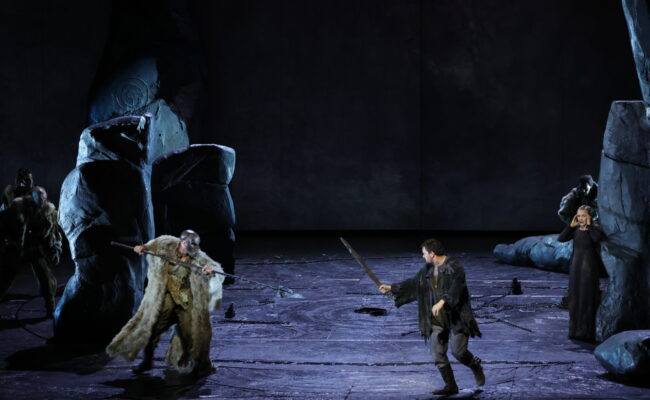
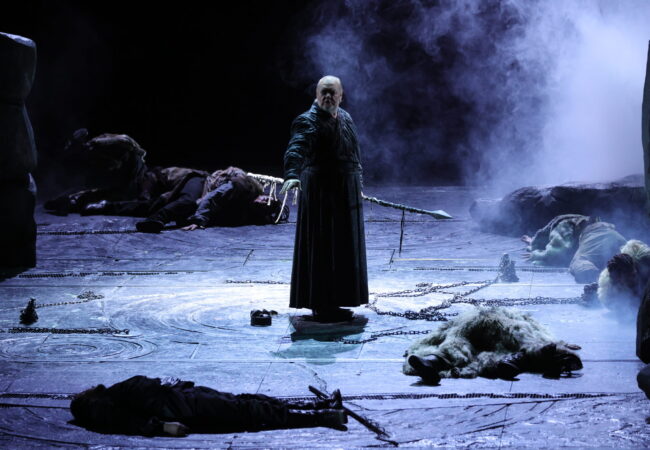
Two other moments cloud the staging. One is the killing of Siegmund as truly dramatic sounds from the orchestra pit keep our gazes riveted to the stage. The tensions raised when fighting for one’s life are missing, and the aggressive jabs of spear and sword were almost danced. Though not in Wagner’s libretto, Hunding plays dirty, kicking Siegmund in the crotch. The Volsung then crosses paths with Wotan who should then smash his sword (an important moment), but Siegmund awkwardly does it himself, tripping awkwardly. The other moment is the scene of Wotan’s ‘Magic Fire Spell,’ as led by the hand of Wagner’s captivating lullaby-like swaying. This comes after the caressing melodies binding a father and daughter’s intimacy, and McVicar did handle this gingerly, touchingly. What follows, however, is perhaps a bit unneeded, cumbersome, a staging that over-tinges one of Wagner’s greatest, most subtle emotional theatrical moments. The music is a closely-knit host of melodies from previous scenes – there is even Alberich’s ‘renunciation of love’, and the symphonic outpouring of Brünnhilde’s plea, almost two minutes of precious emotion, only to lead into Wotan’s farewell spiked with the almost innocuous flames of Loge. The rock sculpture of Erda’s prone death-mask separates itself to reveal Brunhilde’s sleep-rock resting place. Four stage assistants in black skirts, already seen, bring the Valkyrie’s mask and black shroud covers. As the flames begin to encircle her, the assistants unnecessarily dress Wotan in his wanderer’s cloak as he drifts into Siegfried. Grane faithfully leans against the rock. All move about ever so slowly, even the flames, in rhythm to a music that indeed caresses and moves everyone on the scene, as too anyone off-stage and in the opera house. Rituals crowded with the unnecessary become gratuitous.
The Evocative Voice
The voices that bring Wagner to us may not be thought of as being heavenly as to character, true, but they are always from heaven. Gifts from afar. These singers are almost always literally shouting at full-voice, hitting right on every entrance tied to tricky rhythms, while also acting out their parts as if the musical demands were non-existent. Almost all of them in the first week-long cycle of early March 2026 were identical to those who have been part of this Ring since November of 2024. yet the impression that they were more settled into their roles was evident. Indeed, almost all of them, through the evocative qualities of their interpretations, made statements of dramatic power, illuminating what could, at times, escape us in being whisked along by the tragic elements ever-present within the text. They made it all look so easy because it ‘is’ easy, yes, but only after they have taken possession of their roles fully. While following their staging assignments and taking musical cues from the pit, their involvement with one another was remarkable.
Michael Volle’s ‘Wotan’ may strike some as being a complete interpretation. His experience as a Leider singer undoubtedly aids him in revealing depth of character, creating both the emotional and physical prowess of a disturbing character at odds with himself and the world. The nuances of creating images in the public’s eyes through inflection, introspection and timing make for a complete Wagnerian character. The range of his voice is linked to the more dramatic roles of Verdi and Richard Strauss. It is not banal to say that he is a stentorian Wotan, spell-binding in his ‘sprechgesang-like’ 20-minute Act II monologue, one of the high point of the evening, along with his ‘Farewell’ scene that ends the opera.
As his daughter Brünnhilde, Camilla Nylund, seen by many of us at Bayreuth and elsewhere, was a forceful presence, as the role inherently demands. Her acting notably displayed depth as she was absorbed in different dramatic situations, her voice carrying the weight of Wagner’s declamatory style. This she did nobly as Isolde in Bayreuth’s new production last year. Here, the scene with Wotan at the end of the opera, when she faces her human weaknesses as a Goddess no longer were most moving. Heroic, undefeatable, mythical, hers was a truly great performance.
David Buff Philip’s Siegmund has been a growing role in his extensive, varied repertoire. There is a video of him preparing this same role during a Master Class with the great Gwyneth Jones about ten years ago, and the voice sounded the same now. It is a lyrical tenor, smooth in delivery, portraying emotion when needed. The only reservation one may have is that he is not exactly a Wagnerian heldentenor, but this is true of many others performing today. As an actor, he uses his flexible physical attributes to good advantage. As his twin sister and lover, Sieglinde, Vida Miknevičiūtė was one of the stars of the evening. She has recently performed the same role in Berlin and in Bayreuth, and it shows. The voice seems naturally energetic, up to the suspended phrasing in the ardent love phrasing. Most sensitive and tellingly dramatic was her evocative monologue, ‘Der Männer Sippe’, her account of being forced into marriage, and of Wotan’s visit, ramming the magic sword into the tree. The mezzo-soprano Okka von der Damerau, Fricka, was vocally the most stable of all range-wise, and we note that she has sung Erda and also Brünnhilde. Her acting was charismatic, just right for the Goddess of Marriage who defends her values nobly. The Austrian bass Günther Groissböck was an imposing Hunding, his weighty, well-placed voice was ever-present, bringing out the primitive harshness of his character as an insensible tribal leader who has no sense of gentleness towards his wife. His insecurities and need to establish his power were well drawn. The bass is potent, sneering, snarling, groveling, yet perhaps a bit too much so; there needs to be subtle changes in emotion, craftiness, and overt control. Perhaps here, McVicar asked for this aggressive, animalesque, unrelenting, jealous behavior. Hunding, however, is also crafty, a leader of his ‘wolf’ pack, an agile hunter, yet little of this came out.
The eight Valkyries were spunky, playful, moving in routines as college cheer-leaders, united, more so than at times usually encountered, and all with vivid, vibrant voices: Gerhilde/Caroline Wenborne, Helmvige/Kathleen O’Mara, Ortlinde/Olga Bezsmertna, Waltraute/ Stephanie Houtzeel, Rossweise/ Eva Vogel, Siegrune/Virginie Verrez, Grimgerde/ Nadine Weissmann, and Schwertleite/Freya Apffelstaedt.
Alexander Soddy, here conducting the entire Cycle 1 of this production, picked up where Das Rheingold left off. It seems his treatment of the woodwinds favors all the transitions in the symphonic vein of the opera. He created his own musical language – simple, direct, smooth, demonstrating respect for Wagner’s indications, and avoiding personal exaggerations. But this conveys a slight sense of the ‘routine’, the ‘musically-correct,’ where perhaps a more investigative approach of orchestral balance would bring out the subtleties of Wagner’s own revisiting of leitmotivs as indications of the drama’s intricacies. This is a never-ending process, and one expects Soddy to produce alternate versions of Der Ring as his career progresses. The La Scala Orchestra played admirably, faithfully commenting upon the stage action as would the chorus in Antique Greek Tragedy. True, this depends upon the conductor, yet all musical sounds do have their origins within an instrument, and something must be sensed by a discerning public, as was here the case. Today, also, Wagner is better interpreted on an international level.
As stated, the scenery was created by the same director, David McVicar, along with Hannah Postlethwaite. In the drawings and models, the scenery were interesting, yet much proved to be unappealing on the stage. There were indeed symbols, rune engravings, hands symbolizing greed, masks of various types to live through antique symbols borrowed from Hyper-realism. One may note that Emma Kingsbury’s costumes here were better adapted to the over-all look of the opera than to those of Das Rheingold, Shakespearean inspiration in part. They were basically lifeless, non-character adaptive, and gathered together in unison of long, baggy skirts. David Finn’s lighting, Katy Tucker’s videos and the Gareth Mole’s choreography and David Greeves’ martial arts contributions were all just a notch above average, but one believes this was due to the choices made by the director, McVicar.
In all, a successful Die Walküre. One’s major lament was that scenic solutions of the phantasmagorical in Wagner’s fairy tale were less than inspired, and that the scenic elements did not transport us to that other world where myth dwells. Then again, it does seem that whatever choices one makes in bringing Wagner’s visions to a stage, the question of whether it is a possibility or not will arise.