Das Rheingold
La Scala’s week-spanning cycle
Wagner’s spatial probings transmuted
“Remembrance is the garnered tint itself
which the painter borrows from the object –
to bestow it on others akin thereto.”
Opera and Drama, Richard Wagner
Prologue for an Interpretation
Within the covers of the eight volumes of Wagner’s own writings, we discover strewn references regarding desired scene settings for his operas – descriptions, designs, paintings even, all in the service of the other arts. Yes, Gesamtkunstwerk,’ that dreamt-of amalgam of all means of expression. As images on prehistoric cave walls bear out, sketches are the most primitive of communicative means for representing truth. Herein, we have Wagner holding the ‘painter’ responsible for the stage representations of his musical dramas. He goes on to say in Opera and Drama that “The lifegiving force of dramatic Expression is the verse-melody of the performer: it brings on the absolute orchestral melody as a foreboding; from it is led the instrumental-motive’s thought, as a remembrance.” There we have it – music serving a theatrical text, a harbinger for socio-philosophical observations on human behavior, and a symbol of our essential relation to Nature itself.
Witnesses to Wagner’s own first staging of Der Ring in 1876 tell of the composer’s insistence on Man’s fidelity to Nature as a principle for ideal Art, yet of the difficulty of meeting that demand visually in Das Rheingold. Musically, he accomplishes this; the stirring of the Rhine River’s undercurrents was released from a somnambulistic trance that he had in proximity to the Mediterranean. Experienced as when in Bayreuth, the sunken, hidden orchestra pit emits an almost inaudible bass string drone, joined by raucous bassoons, only then to have eight French horns exhale the’ genesis’ melody, one after the other. ‘Ruhig heitere Bewegung’ (in a ‘relaxed, blithe motion’) writes Wagner above the first notes of the fifteen hours to come. Cellos, violas, and violins capture the flowing waters as woodwinds hint at character formation, resembling bird calls. It all seems to arrive from Wagner’s dream images; all is marked p. until the last eight bars of f. legato become a wave engulfing the stage. Thus, it was for Wagner, who alone envisioned the end of this mythical musical legend, drifting unconsciously in a Shamanistic manner towards a new-born world, anticipating Freud, Jung, and Minimalism.
The Leitmotifs of Space
We are now coming to David McVicar’s scenic interpretation for La Scala. The fact that here a stage director designed the sets to house the dramatic action would seem a guarantee, at least of homogeneity. Given the physical and emotional influence, the ambiance of any single scene in this admittedly complex undertaking would create through the progressive voyages sweeping us through the drama, the use of the theatrical space, its perspectives, and limits, is of paramount importance as it was for Wagner. It is often stated that if he were alive today, the composer would make use of every technological means available to materialize the world of his visions: Augmented Reality, 3-D, AI, or Surround Sound. I do not believe this to be the case. First, these apparatuses have been used in Opera, and often with dismal results; one such as Wagner would not have been satisfied. As conjecture, we might assume that he would have moved towards Adolphe Appia’s defining space through light, or cinematographic insertions, Brechtian. As scenery is not to be considered ornamental, message-giving, or symbolic of a reality, at least so for Wagnerian representation, it must be unique, whether original or déjà-vu. Essential, therefore, is its positioning within a stage’s empty space, and its relation to music and text.
What might be the essence of aesthetic unbalance is the over-use of the center stage area. It may be that bulky elements force the characters to use or avoid that space; or that it pushes the action to the sides. The first scene of four, on the bottom of the Rhine, places three large stone hands, wrist to fingertips upon a revolving stage. The Rhine-maidens, at first nestled within palms and fingers, roll about until that horrible-in-every-way dwarf Alberich pops out from behind a hand upstage. He pursues them undexterously, and the miming is too dance-like to indicate their being brats or to capture Alberich’s frustration. All soon changes as the presence of the ‘gold’ is announced by a solo trumpet call, and all is wonder. Lo and behold, a trap door opens (an Ancient Greek theater device, known as ‘Charon’s steps’) and a male dancer in pale gold tights and Noh theater-like golden mask is among them. Be he only a symbol? One may play with the idea of there being an awareness of self, innocence, purity, nature uncontaminated; yet he remains a dancer, physically creating sharp gestures for musical themes. At best, this is another director’s stab at having the gold represent anything but mineral gold. Upon swearing that he will abandon human love, the curse upon possessing the gold commences as Alberich rips off the precious metal’s mask, escaping. Not a bad touch, but a natural solution it is not, or the dwarf would have had to drag the dancer off. An on-stage curtain with a ring design on it falls, but the dancer remains in sight. There follows four minutes of a post-theft scene change, an Interlude divided into two sections. The first representing the fleeing Alberich with the gold and the hysteria of the Rhine-maidens bereft of a natural element, along with a sense of guilt for having revealed Nature’s secrets to the dwarf Alberich, albeit in perfect innocence. Extremely psychological in essence, Wagner’s music here is certainly best heard and not seen, not acted out. The gold is emotionally perturbed, wrecked, and twists and turns in anguished contortions. That truly grave musical moment when the Rhine-maiden Woglinde reveals the secret of the gold’s curse returns hauntingly in the orchestra, but now we must witness the dancer’s desperation and sense of loss. Yet many a Wagner lover will remember the effect the musical phrase, leitmotiv, alone had upon him, this repeated ghostly retelling of the tragedy associated with the betrayal of Nature in renouncing humanity.
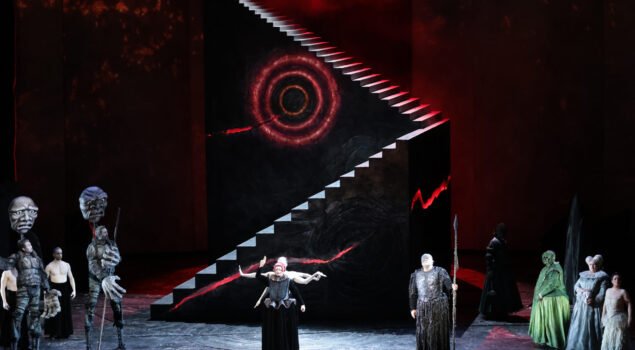
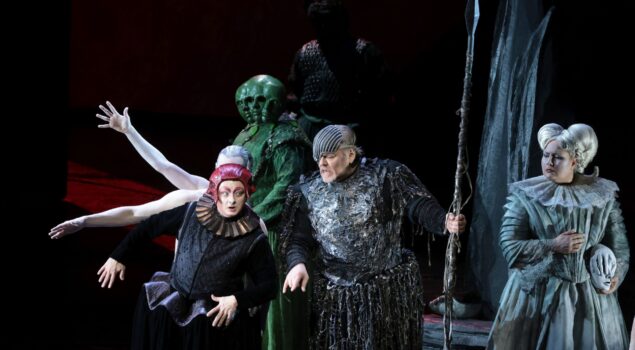
The second scene brings us to the world of the Gods as ruled by Wotan who lives among semi-Gods, dwarves, and giants. The second part of the Interlude echoes with the music of the majestic Valhalla castle, airy, march-like in its regality. It may be all in Wotan’s head – a dream, until he is abruptly awoken by his wife Fricka. Yet McVicar, the stage mini-curtain still down, introduces four mime’s torso nudes with long black whirling dervish skirt, their gestures abstract. Little matter: they will be seen through Der Ring, used as those ‘kurogo’ scene assistants in the Kabuki and Noh theatre performances. We now have the second scene in view: a giant stone staircase rising almost out of sight, a circle rune-like incision on its side walls, four prehistoric standing-stone Menhir thrones placed about. The atmosphere created by McVicar, scenographer, is sparse, solemn, Godly, yes; yet again much occupies a large portion of center stage. We guess right in imagining that much is on a revolving stage. Wotan stands, as does his wife Fricka, then the Gods of Lightening (Froh) and Thunder (Donner). Wotan is not sleeping, though the music suggests he is dreaming; his wife Fricka, Goddess of Marriage, does ask him to wake up. The Giants, Fafner and Fasolt arrive to demand their money for having built Valhalla. In difficulty Loge, the lawyer-like God of Fire arrives to save the day, and therein the plot is hatched to steal the ring from Alberich and offer it to the Giants; if not, the Giants will take Freia, their daughter and Goddess of Eternal Youth, thus bringing about their own end. The sweet melody of her magic golden apples appears, and the Gods begin to wilt. Here, we must wonder about the director’s choices for the costumes. They are interesting, yet motley, and create contrasts that inhibit the spectator from partaking in the action, set in no specific historical period. Wotan’s tunic suggests armor, yet Fricka and the other Gods are dressed in Shakespearean style, with Freia in a white wedding gown. The portrayal of the Giants is debatable – militarized, swash-buckling outfits, large hands and heads attached. They prance about as if walking on eggs, donning moonboots made of springs, and using their long walking sticks. The expressions on their masks are menacing, but nothing else. It is the combination of epochs and not that weakens the sense of time and place – might it all have been more of a fairy-tale, or pre-historic or medieval.
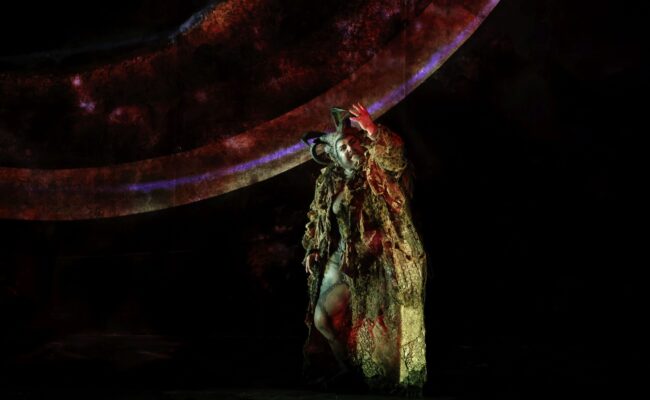
We are brought to the underworld, and Nibelheim is introduced through a glorious symphonic suite, anvils clamoring, and it is time for our imaginations to transport us there. But no, there is an added bit of pantomime – Alberich arrives just before the hammering starts, admiring the just-forged ring on his finger. He bites at it, making sure it is pure gold, then raises his outstretched arm in a gesture of power. The music Wagner wrote, however, describes something else. Perhaps, one could see parallels to the evils of the Industrial Revolution, or too, size up the personalities of the envious, deeply hostile dwarf race. Soon, Wotan and Loge will arrive, with godly tricks up their sleeves to regain the ring. Centerstage, there is a large skull, devilish, yet also resembling the entrance to a House of Horrors in an amusement park, held up by rudimentary tree trunks as scaffolding, something out of the original King Kong film. Mime’s outfit is in fitting with the scene, Halloween-like, but can pass as he is a magician, one who has fashioned the Tarnhelm, a wonderous metal- meshed helmet giving one the power to become invisible. Many of us will recall the first time we heard its melody; truly mysterious, other-worldly, spellbinding. By the way, the hordes of dwarf-slave factory workers are obviously children, and all-too-happily playful. As to playfulness, the staging of the Alberich-Loge-Wotan trio was the best of this evening. The games of deceitfulness, untruthfulness, and one-upmanship is their perniciousness fulfilled Wagner’s characterizations; it is a shame it is all in front of that reclining skull, which opens laterally, revealing the Chinese parade-like operated snake that Alberich has become. Less convincing is the conversion to a frog – manipulated as a Bunraku puppet by men in black, who are simply driven away as Alberich is grabbed and tied up by Loge as a mini-curtain falls – the greedy hand, now red, burning upon it.
An Opera within an Opera
The last scene, an opera in itself beginning again in some ways, wherein one by one, each character takes his just-or-not part in the tragedy. McVicar invents, at times to little effect, and miscalculates. Wagner puts so much into this finale that it is also difficult for a stage director to go awry: The music brings back leitmotivs, all in a splendid manner, yet there is the introduction of Erda, Mother Earth, and Donner, Froh and Freia have important contributions to make musically. Fafner commits the world’s first fratricide, or so it might appear. A frustrated Alberich breaks off some barnacled horns off his head and will appear in Götterdämmerung somewhat devilish.
McVicar, however, plays his hand a bit too heavily, and, if nothing else, does not allow Wagner’s sense of drama to move all towards its justified dénouement. While the presence of Mime, accompanying the dwarves in piling up the gold as payment to the Giants, was somewhat gratuitous, the arrival of the gold, crawling bloodied towards the Gods climbing to their Valhalla was simply out of place. The idea of the gold as a person is, again, a clumsy device, forced at best. Erda’s movements somehow made her less mysterious, and took something away from the solemn, primordial wisdom of her moving utterances. Her carrying about a basketball-sized illuminated blue globe did not create a sense of awe. Entering from and retreating into the side wall of the staircase was a letdown as she must pertain to the Earth, its depths, to the font of truth in Nature. Yes, the characters on a whole were set down well as to the blocking, and their relationships with each others, but here credit, too, must be given to Wagner in weaving their interactions .
Noteworthy Ensemble Interpretations
Apart from the Rhine-maiden Woglinde, the entire cast was identical to that of the first series of performances that opened this Ring in November of 2024. Though widely considered to be a balanced ensemble of seasoned Wagnerian artists, one must state that all of them performed better in this first cycle from 1 to 7 March 2026. The acting was as solid as before, yet they all moved better as an ensemble, something to be expected for any opera.
The family of Gods, Wotan (Michael Volle), Fricka (Okka von der Damerau) and Freia (Olga Bezsmertna) portrayed the interior struggles of a bourgeois family to the hilt, as too struggling through their botched relationships with about everyone else. Wotan retained his outer strengths yet suffered more for his weaknesses, asking, it seemed, for more clemency not only from the others surrounding him , but also us, the spectators His vocal prowess and perfect intonation allowed him to create variations, as if in improvising a momentary reaction, conveying sensitivity as a God in need of being understood. Fricka again was a tour de force, her facial expressions deeply considered in reaching out to us, as if asking for help. She sang beautifully, dramatically in her changing, seemingly improvised reactions to impossible situations. Freia played the victim more, suffering from her entrapment as being bartered for her secrets to eternal youthfulness; her voice itself captured the youth she assured others of.
Donner (Andrè Schuen), Froh (Siyabonga Maqundo), and Loge (Norbert Ernst) were overall more convincing this time around. Each of these roles seemed better sung. They were more established, more resolute in their roles of serving the Gods as seen through their movements, posture, and emotions. Loge, that mercurial flame of a shifty God whisked about the stage cunningly, accompanied unhappily by two of the voiceless stage servants, who imitated his gestures in becoming flickering flames, scarcely effective. Wagner placed Loge’s voice high, stiff, and sharp, and so it must be to assume the character of a master of ceremonies in flames, combined with a slick lawyer-type and purveyor of contracts, and these qualities all came through.
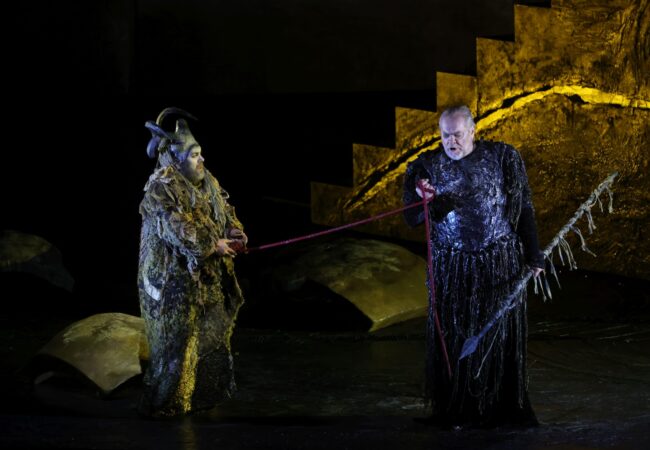
Then, too, the complexities of such roles as Erda (Christa Mayer), as too for the Nibelungen tribe, Alberich (Ólafur Sigurdarson) and Mime (Wolfgang Ablinger-Sperrhacke). Erda’s portrayal may have suffered from the staging, as she appeared unsure, off-balance, with a bit too much action for such a stately, controlled God. Much went against the tone of her abstractness and desire to communicate with humans. The Giants, Fasolt (Jongmin Park) and Fafner (Ain Anger) were vocally present, vivid in their interactions, though truly hampered by balancing gingerly upon spring platform boots. They were a good team, tough and tender in dealing with the Gods; at times they seemed laughable in their clumsiness and awkward outbursts. The Rhine-maidens Woglinde (Polina Pastirchak), Wellgunde (Svetlina Stoyanova), and Flosshilde (Virginie Verrez) interplayed graciously, jokingly yet also as tinged with tragedy. Their music seems light, but they must react to their psychological situations changing every two minutes.
A Wagnerian Scala Orchestra
Alexander Soddy seems to have whisked through the score, yet his chosen ‘tempi’ were not at all fast. He tends to follow along with those modern-day renderings that avoid the bombastic, yet he did extract from the La Scala brass a maximum of the sentimental, and from the woodwinds a minimal of character introspection. Soddy picks up on what Meyerbeer, Mendelsohn, and naturally, von Weber were to Wagner. Respecting this today, all would lend itself to a setting for moods, a breath of musical thought bringing us into another reality. For the rest, the orchestra of Scala gave the best of themselves, especially, as usual, the strings and woodwinds, with a fairly weighty sound from the brass. Erda’s scene did come off as weak as expressiveness, but this again may have had something to do with the staging, which fell flat.
The Supporting Crew
Hannah Postlethwaite created the scenery along with McVicar, and one suspects that the director has his feelings about how the settings should look, and that she executed the designs. The costumes by Emma Kingsbury were at times well-designed, but sadly lacking a unified style, probably due to the director’s demands. The lighting was fine, but when aiming towards the sets, much detail was lost. The videos of S. Katy Tucker made little impression as they were limited to the changing colors and nuances upon the stage curtains with the ring design.
Overall, not a bad rendition of Wagner’s prelude to his Tetralogy. Lots of nice touches from McVicar, but also many ideas that were only able to satisfy the need to stage an episode, playing all straight out. Doing for the sake of doing. The weakness lay in the lack of an overall concept. True, better perhaps this version from those elsewhere that go astray, towards the ridiculous, towards what is estranged from Wagner himself. Perhaps, yes, the Ring is impossible to stage. Might there be a curse upon the ring?