

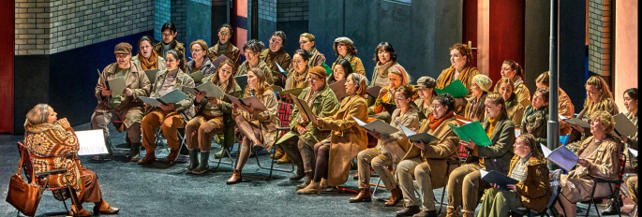
The Flying Dutchman in Bayreuth. There is no one about, but soon a mother with her young boy will arrive, then a man, then villagers bringing folding IKEA chairs and tables on and off stage. The mother, as we will soon understand, is a street prostitute, kissing a client passionately precisely as the theme of Senta’s love-redemption sounds, only soon to be rejected not only by men, but also by the villagers. Shattered, she hangs herself, dangling from a window just above where her son is sitting. During the entire Overture, villagers come in and out, as if in an Alain Resnais film. The boy’s ‘Traumatic Memory Imprinting’ catches the facial features of someone we will meet later on in the opera: a then-young Daland, the merchant, and Senta’s soon-to-be father. The mother? No worries. Tcherniakov has turned Senta’s governess, Mary, into his wife.
Tag: Bayreuther Festspiele
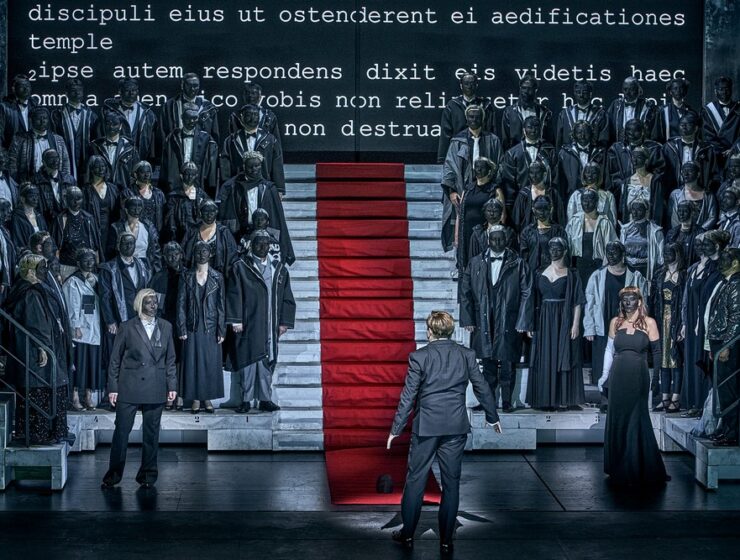
Rienzi. An Epochal Life of Images. The Second Act followed immediately with no break, and the huge screen flew upwards to reveal the same slow-motion clapping citizens seated upon a white bleacher-like section; frankly not one of the most attractive scenic elements, as it also will be over-used until the end of the opera, where it is out of place. Its sole purpose was to house the vast chorus center-stage, neatly arranging them unobtrusively it must be said. As to the length of Act One and Act Two joined for a total of two hours, there is little else to do if the Ballet is to included which it was here. Originally, a wise move by Wagner, opposed as he would be in being forced to insert a ballet into the Third Act of his Tannhauser 16 years later in Paris, which he spitefully did, but at the beginning of the First Act, causing a riot out of which grew his hate for Meyerbeer and his gang. Yet, to paint History rightfully, we must recall that Meyerbeer also helped Wagner produce his operas in Dresden.