Les Contes d’Hoffmann
St. Gallen
Les Contes d’Hoffmann 18.10.2026 Theater St. Gallen. Fantastic opera in five acts by Jacques Offenbach. Libretto by Jules Barbier, after the play by Jules Barbier and Michel Florentin Carré.
Conductor: Michael Zlabinger Director: Guta Rau Set designer: Isabelle Kittnar
Hoffmann: Rolando Villazón Olympia / Giulietta: Eva Langeland Gjerde Antonia: Marie Lombard Lindorf / Coppélius / Dr Miracle / Dappertutto: Andrew Foster-Williams Nicklausse: Jennifer Panara Wilhelm / Cochenille / Franz / Pittichinaccio: Riccardo Botta Lutter / Crespel: Jonas Jud Hermann / Schlemihl: Felix Gygli Nathanael / Spalanzani: Mziwamadoda Sipho Nodlayiya Voice from the grave: Gloriela Villalobos Theater St.Gallen Chorus / St.Gallen Opera Chorus St.Gallen Symphony Orchestra
Performance attended: 18 October 2026, Theater St. Gallen
Music: 4****
Production: 4****
Les Contes d’Hoffmann
Les Contes d’Hoffmann is a formidable opera to stage. Few works move so abruptly between exuberant comedy, fantastical deception and harrowing tragedy. Its unusual history adds another complication: Offenbach died before completing it, leaving every production to decide what musical shape the opera should take. We were therefore particularly curious about St. Gallen’s use of the edition prepared by Michael Kaye and Jean-Christophe Keck. Which arias would be included, which were omitted, and in what order would the acts appear?
Villazón
The prospect of star tenor Rolando Villazón in the title role heightened our anticipation further. We are always glad to return to Theater St. Gallen. Its distinctive concrete building, with its staircase and unexpected corners, is worth a visit in itself. We appreciate the excellent sightlines – and even the handy shelves in the toilet cubicles, which we wish every opera house had. On this occasion, our affection for the theatre was rewarded with a lively performance that succeeded both musically and theatrically.
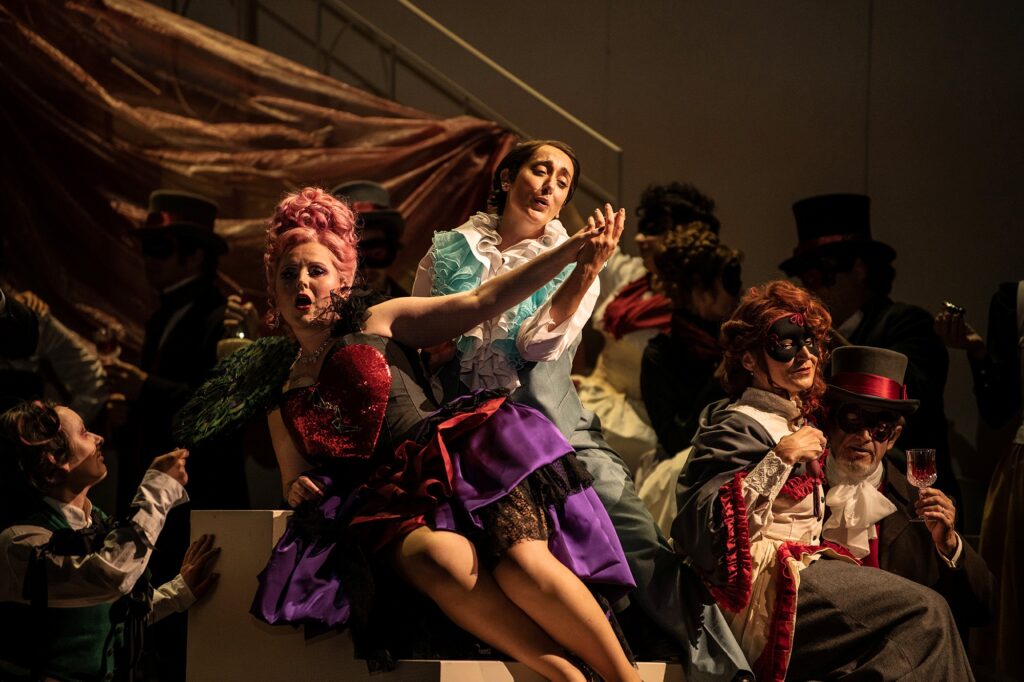
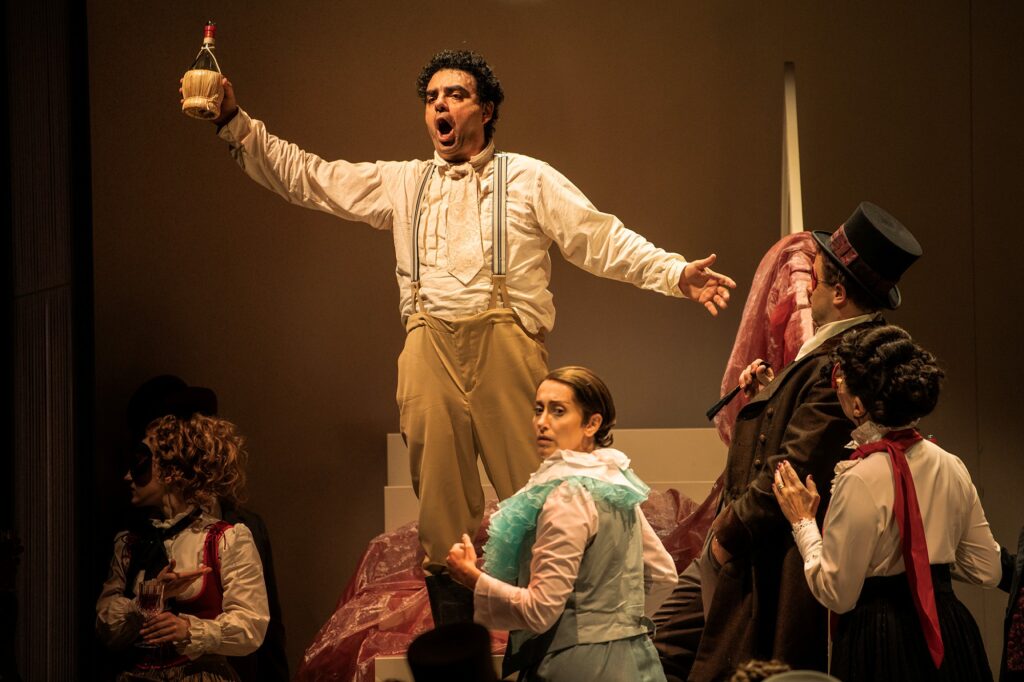
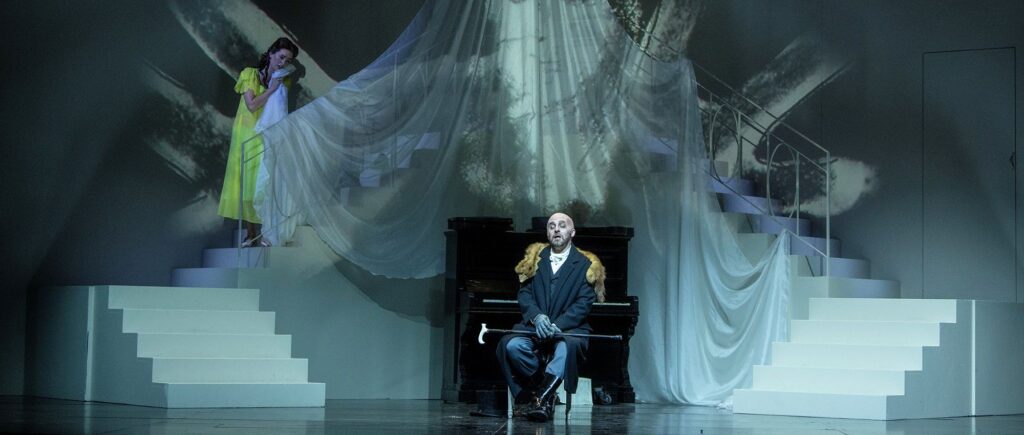
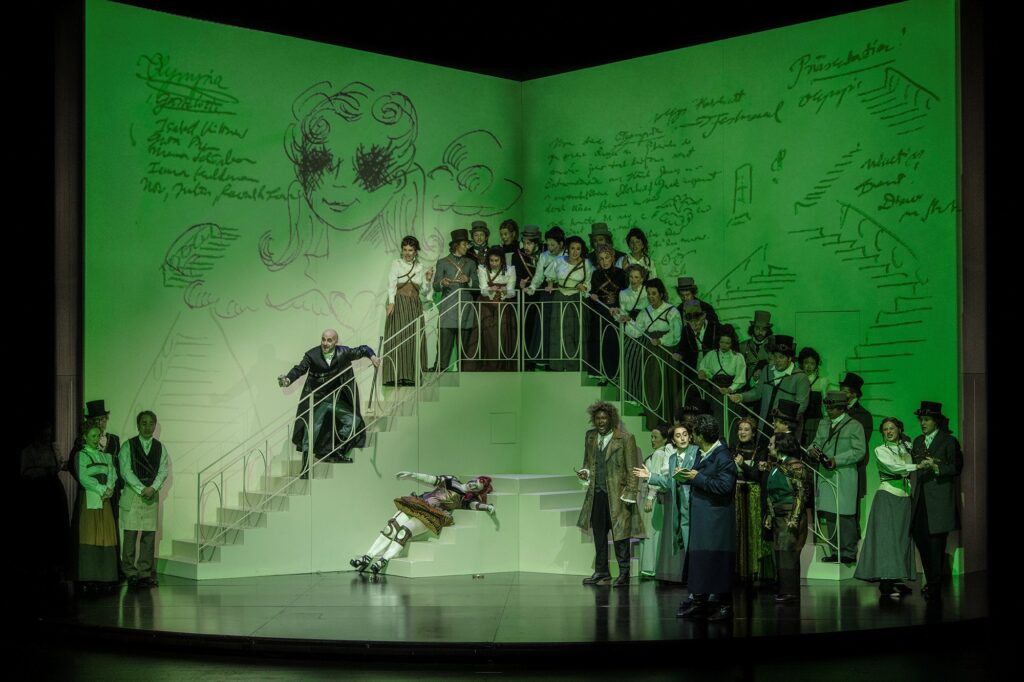
We greatly enjoyed Guta Rau’s production, especially where it followed the turns in Hoffmann’s tales with pace, wit and strikingly clear images. Her relatively libretto-faithfull approach was a welcome change from some of the director-led extravagances we have endured on Swiss stages large and small. Rather than imposing a conspicuous reinterpretation on the opera, Rau put her faith in its characters, music and stories. To us, this also suggested a theatre with confidence in its audience. The opening was particularly strong, almost exemplary. Isabelle Kittnar’s set places us in a cellar lined with beer barrels, where the scenes with the students are both atmospheric and decidedly funny. Rau keeps the action moving without relying on a succession of isolated gags. The transition to the Olympia act, with its white staircases, worked beautifully too. We were less pleased to see the same stairs return in the Antonia act. Given how different the stories feel, we would have welcomed a more distinct setting.
The Antonia act nevertheless demonstrated the power of a single, well-judged image. The moment when Antonia’s dead mother appears on a large white curtain and calls to her has stayed with us. The apparition gives visible, unsettling form to Antonia’s inner conflict. The Giulietta act, by contrast, seemed short of Venetian atmosphere. The white walls at the back might have lent themselves to projections; a more sensuous use of Andreas Enzler’s lighting could also have set this act more clearly apart from the other tales. Visually, the set and costumes might just as readily have served for the party at Flora’s salon in Act II of Verdi’s La traviata. What we wanted was not so much another effect as a visual identity of its own for Giulietta’s story. Even so, the production won us over with its energy and its feel for both comic and tragic moments.
Les Contes d’Hoffmann
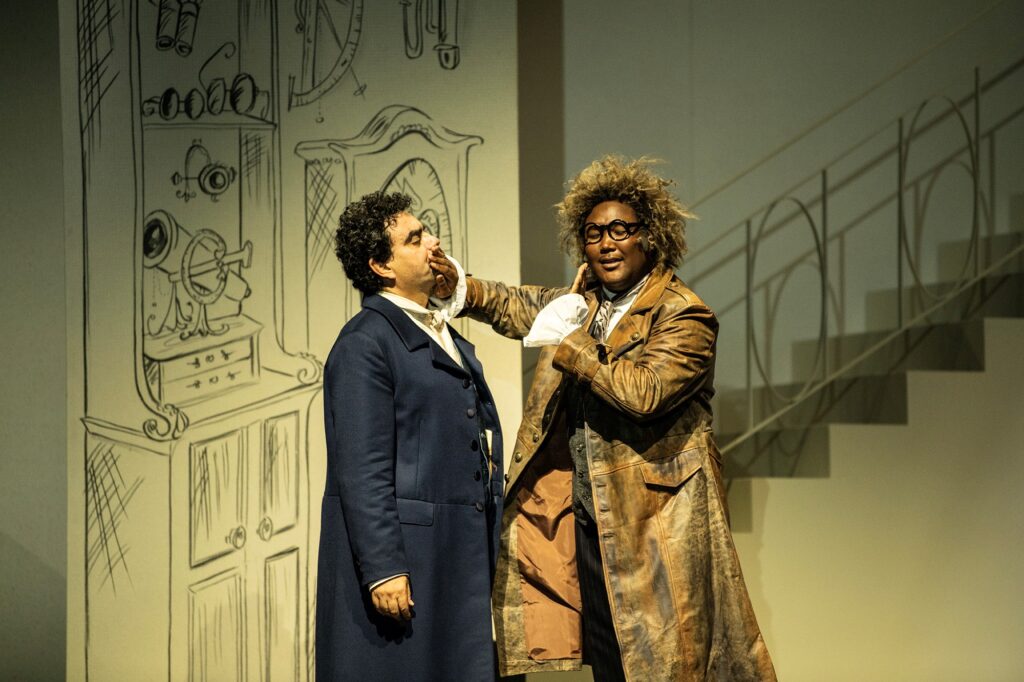
We particularly liked Mara Lena Schönborn’s nineteenth-century costumes. They lent the production visual coherence without making its different characters seem to inhabit the same world. Dietgard Brandenburg’s animations and projected handwritten texts were an attractive idea too; the animation of the duel between Hoffmann and Schlemihl was especially memorable. It was a pity that we found the writing difficult to read.
Clarity and attentiveness
Michael Zlabinger’s conducting appealed to us from the first notes. The St.Gallen Symphony Orchestra played with clarity and attentiveness, and its rapport with the singers was persuasive for much of the evening. Offenbach’s music needs suppleness, but also room to breathe in its lyrical and dramatic passages. We did not agree with every tempo Zlabinger chose: Olympia’s aria seemed a little too slow, while the Barcarolle – a Venetian gondolier’s song – struck us as rather too fast to conjure much atmosphere. At that speed, singing while propelling a gondola might have proved difficult as well.
We also enjoyed the Theater St.Gallen Chorus and St.Gallen Opera Chorus, prepared by Edward Mauritius Münch and Filip Paluchowski, though we would have liked a fuller choral sound in the Olympia act.
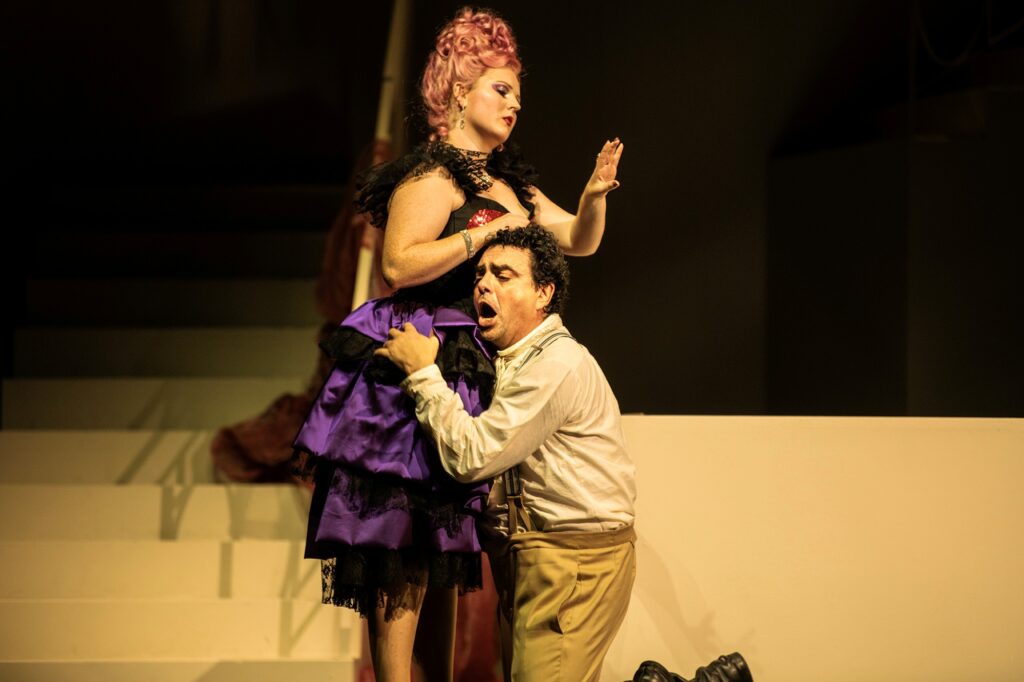
Rolando Villazón fitted splendidly into the St. Gallen ensemble. He threw himself into the role and sustained the long evening as Hoffmann with great expressive force and remarkable physical commitment. His expressive, deeply musical singing impressed us, as did the now baritonal color of his voice, especially in its lower register. At times he attacked the high notes almost aggressively, enough to make us worry about his vocal cords; some sounded pressed and slightly flat, while others rang out securely. He put so much energy into the ‘Klein-Zack’ ballad that we wondered whether he could possibly keep it up to the end. He could. On stage, too, he was tireless, repeatedly hurling himself to the floor and rising again with equal determination. Hoffmann’s impetuosity became something we could not only hear but see and feel.
Jennifer Panara – wonderful sensitivity
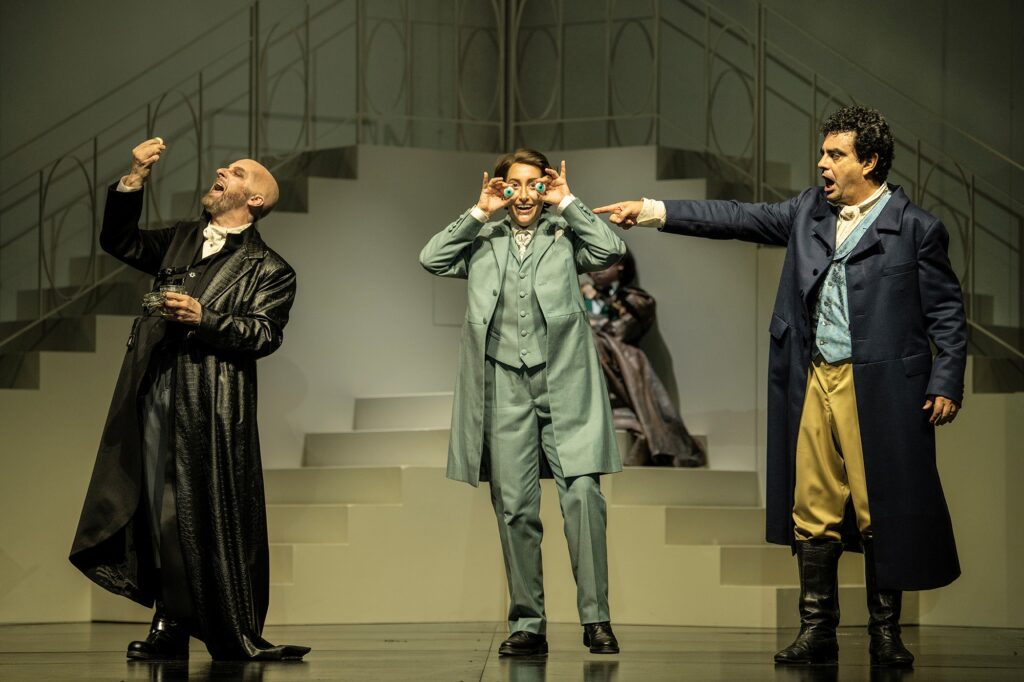
Jennifer Panara impressed us as Nicklausse with her beautiful, even voice, assured style and musicianship. Nicklausse is more than Hoffmann’s companion: the character observes his tales, challenges his illusions with another point of view and, as the embodiment of the Muse, directs our gaze beyond the individual love stories. Panara’s vocal poise made her an effective foil to the impulsive Hoffmann. She sang ‘Vois sous l’archet frémissant’ with wonderful sensitivity. At moments, however, we wished we could hear her more clearly. The orchestra might have played more discreetly, or she might have stood nearer the front of the stage, where her voice might have projected more clearly.
Les Contes d’Hoffmann
Eva Langeland Gjerde took on two contrasting roles, Olympia and Giulietta. After this evening, we would trust her with Antonia as well. We particularly enjoyed her Olympia: her precise, robotic performance brought out the character’s artificiality with considerable wit, while her brilliant, sustained high notes and clean trills, even at the top of the range, made ‘Les oiseaux dans la charmille’ a vocal highlight. All the more reason to wish that Giulietta, too, had offered her a similarly dazzling moment. We found ourselves thinking of the omitted septet, ‘Hélas! mon cœur s’égare encore’, and of Joan Sutherland’s celebrated studio recording with the Orchestre de la Suisse Romande, made at Geneva’s Victoria Hall. In that recording, music from the septet is heard instead in the epilogue, to the words ‘Adieu! Je ne veux pas te suivre’, with Sutherland interpolating a radiant high E-flat towards the end. It would have been a pleasure to hear Gjerde in such a passage, given the beauty and security of her high notes. That is not, however, a standard by which this performance need to be judged. The septet was not part of Offenbach’s original score but belongs to the opera’s later performance history.
Marie Lombard – a beautiful, affecting voice
Marie Lombard sang Antonia, whose story takes us from the comedy of the Olympia act into tragedy. Antonia loves Hoffmann, but is equally devoted to singing, which her father forbids out of concern for her health. Lombard sang with a beautiful, affecting voice; ‘Elle a fui, la tourterelle’ was especially successful, with heartfelt expression and a flowing line. Dr Miracle exploits Antonia’s conflict by summoning the voice of her dead mother. In this production, the apparition on the white curtain gave the scene particular force. Gloriela Villalobos sang the voice from the grave unseen, from the rear of the stage. We would have liked to hear her more distinctly – and, indeed, to see her.
The trio ‘Chère enfant! que j’appelle’ depends on rapid changes of tempo and accelerandi which, when they come off, create an almost magical tension and a sense of mounting urgency and breathlessness. In the closing passage, leading to Antonia’s high C-sharp on ‘Et que mon âme vole aux cieux!’, the coordination between stage and conductor briefly seemed to falter. The orchestral playing, too, lost its clarity for a moment; from the auditorium, the shifts of tempo became difficult to follow. As a result, they did not have their full effect for us. Lombard’s approach to the final note sounded slightly tentative, though the note itself rang out powerfully and brightly. That brief uncertainty did nothing to diminish her wonderful performance overall. Her position on the staircase, some distance from Dr Miracle and the conductor, may also have made coordination harder.
Andrew Foster-Williams played all four of Hoffmann’s adversaries – Lindorf, Coppélius, Dr Miracle and Dappertutto – as he had in the 2025 Zurich production of Les Contes d’Hoffmann. We were impressed by the ease with which he moved between them, giving each a distinct presence. He convinced us vocally as well: his resonant, expressive voice gave all four the necessary weight without blurring their differences. At the same time, one sensed throughout that Hoffmann was not simply confronting four separate enemies. Casting one singer in all four roles makes them seem different manifestations of a single adversarial force. Each intervenes in one of Hoffmann’s stories in his own way: Coppélius is bound up with the deception surrounding Olympia, Dr Miracle intensifies Antonia’s conflict, and Dappertutto manipulates events in the Giulietta act. We would also have liked to hear Foster-Williams sing ‘Scintille, diamant’ as Dappertutto. That familiar aria, however, was not part of Offenbach’s original score for Les Contes d’Hoffmann: it was added later, using music from his opéra-féerie Le voyage dans la lune. We regretted its absence a little but did not regard it as a flaw in the performance.
Les Contes d’Hoffmann
A well-balanced ensemble
The smaller roles contributed much to the impression of a well-balanced ensemble. Riccardo Botta appeared as Wilhelm, Cochenille, Franz and Pittichinaccio, giving each an individual character through his delight in performing and sure comic instinct. Jonas Jud sang Lutter and Antonia’s father Crespel; as Crespel in particular, he gave the father’s concern for his daughter palpable weight, not only through his fine singing voice but through his striking speaking voice. Felix Gygli made a clear impression as Hermann and Schlemihl. Mziwamadoda Sipho Nodlayiya took on Nathanael and Spalanzani, the man who presents Olympia to society and plays a crucial part in Hoffmann’s deception. His lovely tenor, bel canto phrasing and evident enjoyment of the stage made him a welcome presence in the ensemble. With so many singers doubling or taking several roles, it is particularly gratifying when the smaller parts do more than simply come and go: each enriched the evening in its own way. That was consistently the case here.
A successful evening at the opera
For us, this St. Gallen Les Contes d’Hoffmann made for a thoroughly successful evening at the opera. Guta Rau’s production impressed with its lively direction of the cast, humor and occasional striking image; Michael Zlabinger and the St. Gallen Symphony Orchestra gave the singers attentive musical support. Not every tempo felt right to us, and we would have welcomed a more distinctive atmosphere in the Giulietta act. But Villazón’s wholehearted Hoffmann, Gjerde’s dazzling Olympia and the consistently high standard of the ensemble outweighed those reservations. The casting team deserves considerable praise as well: these singers were not only excellent choices individually but worked remarkably well together.
What remains in the memory is a performance that brought Offenbach’s shifts between comedy, fantasy and tragedy to the stage with palpable enjoyment. Praise is due, too, to the St. Gallen audience, which followed the performance with close attention and thanked the performers at the end with an almost immediate standing ovation, accompanied by rhythmic applause. The enthusiasm was already evident in the interval. ‘Gell, das isch sauguet’ – ‘It’s bloody good, isn’t it?’ – one woman said to her neighbour. ‘Yes, absolutely fantastic,’ came the reply. After the performance, we were happy to agree and can warmly recommend a visit.