

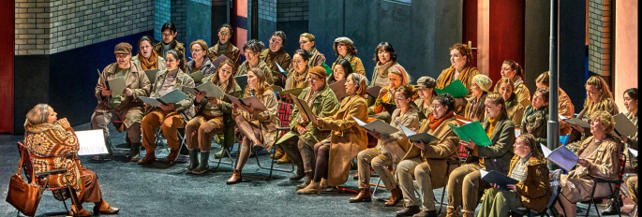
The Flying Dutchman in Bayreuth. There is no one about, but soon a mother with her young boy will arrive, then a man, then villagers bringing folding IKEA chairs and tables on and off stage. The mother, as we will soon understand, is a street prostitute, kissing a client passionately precisely as the theme of Senta’s love-redemption sounds, only soon to be rejected not only by men, but also by the villagers. Shattered, she hangs herself, dangling from a window just above where her son is sitting. During the entire Overture, villagers come in and out, as if in an Alain Resnais film. The boy’s ‘Traumatic Memory Imprinting’ catches the facial features of someone we will meet later on in the opera: a then-young Daland, the merchant, and Senta’s soon-to-be father. The mother? No worries. Tcherniakov has turned Senta’s governess, Mary, into his wife.

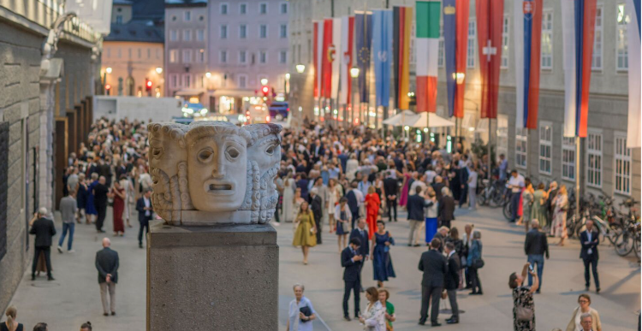
Saint François d’Assise. To all this, the stage director Romeo Castellucci has added two perhaps not totally necessary scenes to the First Act: the saint’s renunciation of worldly possessions, striping naked to demonstrate his choice of a new existence; his encounter with the terrifying Wolf of Gubbio, uniting him with Nature. We will also encounter a strutting peacock and, as a final touch after the death of Saint François, a small flock of wandering sheep.
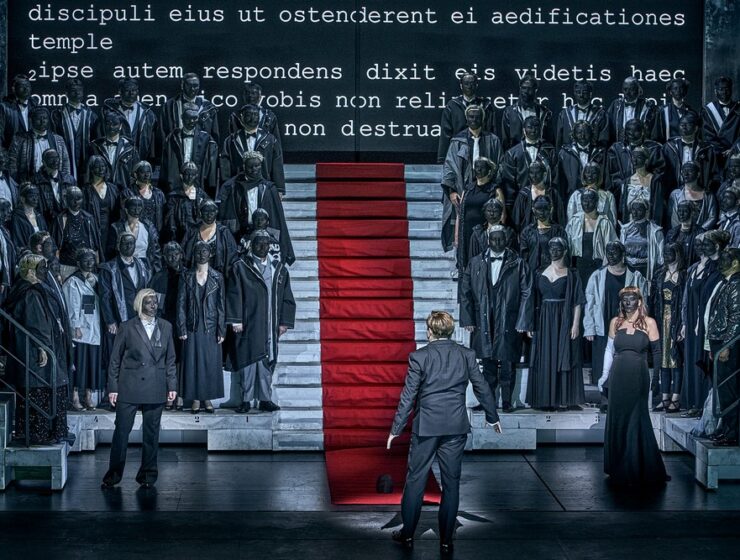
Rienzi. An Epochal Life of Images. The Second Act followed immediately with no break, and the huge screen flew upwards to reveal the same slow-motion clapping citizens seated upon a white bleacher-like section; frankly not one of the most attractive scenic elements, as it also will be over-used until the end of the opera, where it is out of place. Its sole purpose was to house the vast chorus center-stage, neatly arranging them unobtrusively it must be said. As to the length of Act One and Act Two joined for a total of two hours, there is little else to do if the Ballet is to included which it was here. Originally, a wise move by Wagner, opposed as he would be in being forced to insert a ballet into the Third Act of his Tannhauser 16 years later in Paris, which he spitefully did, but at the beginning of the First Act, causing a riot out of which grew his hate for Meyerbeer and his gang. Yet, to paint History rightfully, we must recall that Meyerbeer also helped Wagner produce his operas in Dresden.
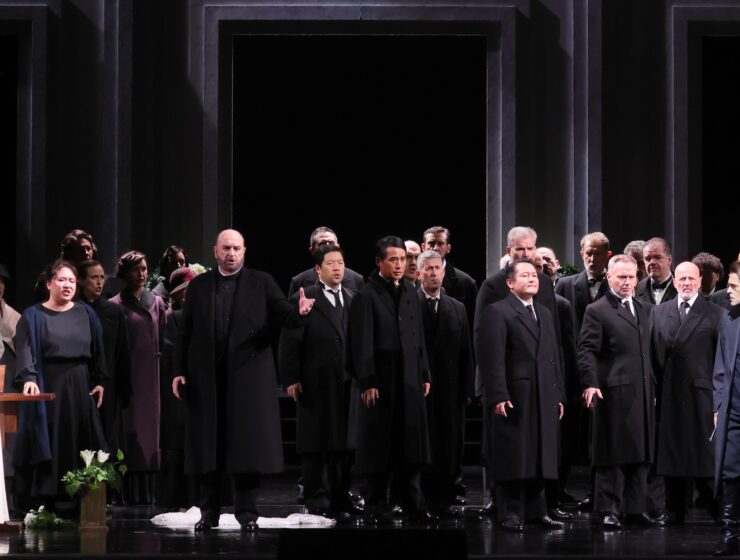
Lucia di Lammermoor. As Lucia, Rosa Feola lived fully through the gamut of emotions. She made use of every nuance in Kokkos’ staging, and every one of her appearances led logically to her sad demise. At every turn, vocally and theatrically, Feola’s Lucia remains a fragile figure, a victim of the manipulations of others causing her to doubt her lover’s fidelity. The Brünnhilde of Götterdämmerung comes to mind; both will sacrifice their lives through delusion. Observing Feola was a moving experience, made richer through the musical dissolution of her consciousness. The top notes were more than there, and delivered almost naturally, and in character with the crazed sad, desperate demise. An absolutely wonderful Lucia.
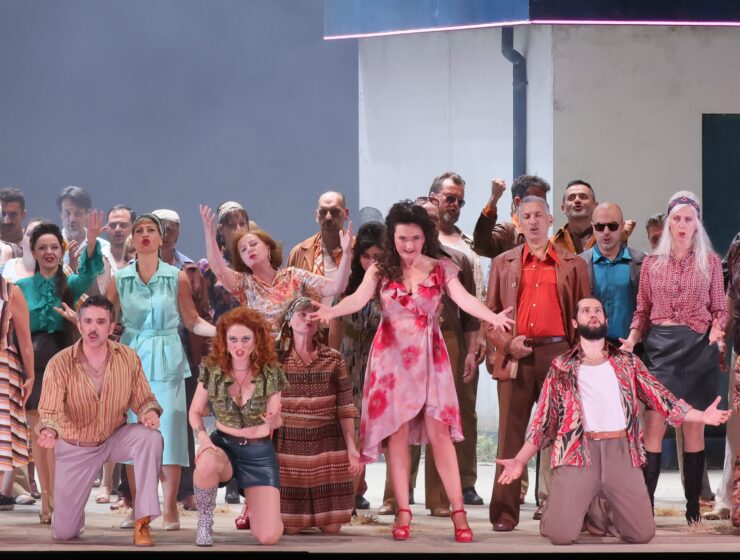
La Scala’s Far West ‘Carmen’. Nearly every solution or off-the-mark innovation seemingly failed to captivate us as there was little sympathy for the personages as perceived, and they were surprisingly almost always projected through excessively old-fashioned stock mimic gesturing. This was especially so for the chorus who were never present in their prescribed roles, and were often asked to carry out bizarre, invented scenarios, unrelated to the main flow of action and with total regard to the words they were singing. In Carmen, they are essential characters inserted within the plot and must remain so.
Pelléas et Mélisande. Sara Blanch was a superb Mélisande, attempting a diverse role, one requiring stamina, a middle voice, and total immersion in a character on stage for almost all the opera. She seems to be the same person on the outside, but is the victim of changing moods, and thus so it is in the music that we discover her performance’s beauties.
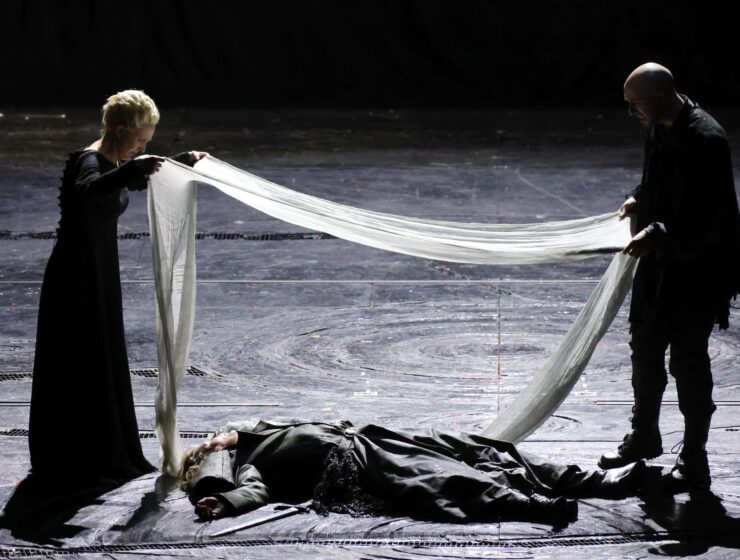
Götterdämmerung. Hagen’s hunting party wanders across a bare stage of a forest, with a huge boar hung by its feet above the stage. Hagen’s spearing of Siegfreid is not credible as the hero hardly turns around enough to watch those Batman-caped ravens flying off to Valhalla. Then, we come to a most questionable staging of Siegfried’s ‘Funeral March,’ wherein Sieglinde and Siegmund returning from the beyond; she with a 20-foot-long white linen shroud used to symbolically embalm the son she last saw while giving birth. Then, for seemingly hours, the parents break into tears, their bodies shaking violently in emotion. Wotan the Wanderer also returns, broken spear in hand, approaching Siegfried’s corpse, then only to fall to the ground in shock upon discovering who has been killed. None of this was needed.
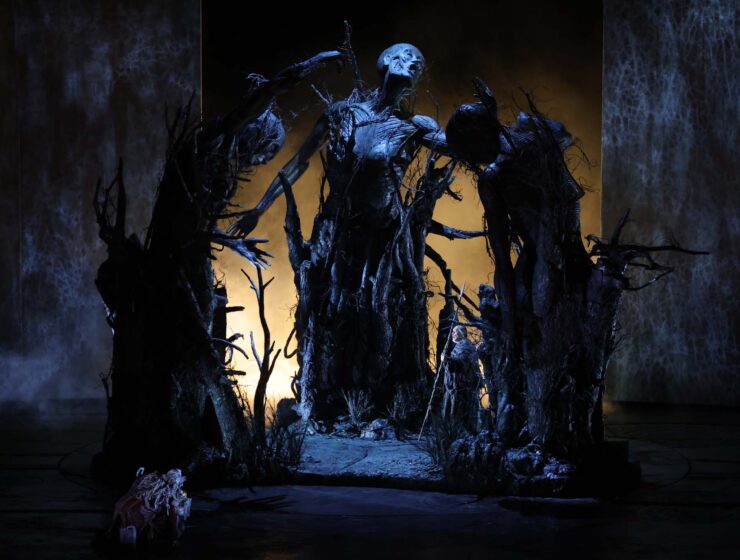
Siegfried. Alexander Soddy, heard again in bringing off the score with flair, offered a truly symphonic version – the big passages never hurried, measured stiffly, but colorful with variations. sprightly version of this chapter in the Ring saga.
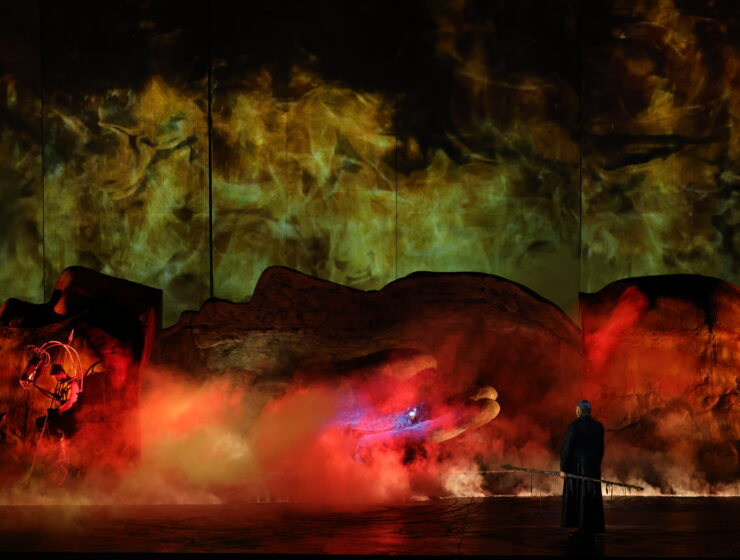
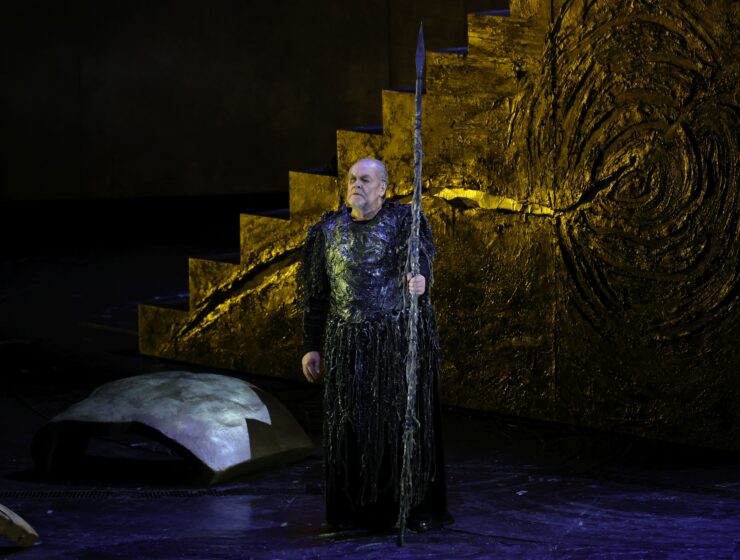
Das Rheingold at La Scala. Overall, not a bad rendition of Wagner’s prelude to his Tetralogy. Lots of nice touches from McVicar, but also many ideas that were only able to satisfy the need to stage an episode, playing all straight out. Doing for the sake of doing. The weakness lay in the lack of an overall concept. True, better perhaps this version from those elsewhere that go astray, towards the ridiculous, towards what is estranged from Wagner himself. Perhaps, yes, the Ring is impossible to stage. Might there be a curse upon the ring?
Das Rheingold at La Scala. Overall, not a bad rendition of Wagner’s prelude to his Tetralogy. Lots of nice touches from McVicar, but also many ideas that were only able to satisfy the need to stage an episode, playing all straight out. Doing for the sake of doing. The weakness lay in the lack of an overall concept. True, better perhaps this version from those elsewhere that go astray, towards the ridiculous, towards what is estranged from Wagner himself. Perhaps, yes, the Ring is impossible to stage. Might there be a curse upon the ring?